SMALL PETS & BIRDS
What Size Wheel Does a Hamster Need to Stay Healthy and Safe
The right hamster wheel size depends on breed: dwarf hamsters need 7.9–9.4 inches, while Syrian hamsters need 9.4–11.8 inches to avoid an arched back and spinal strain.

If you’ve been wondering what size wheel does a hamster need, the simplest clue is right in front of you: if your hamster arches its back while running, the wheel is too small. For dwarf hamsters, look for a wheel between 7.9 and 9.4 inches across. For Syrian hamsters, go with 9.4 to 11.8 inches. Below those ranges, a hamster has to curve its spine just to fit, and that posture shows up fast once you know what to look for. The rest of this guide walks through how to confirm your hamster’s breed, pick the right diameter and material, and keep checking the wheel so it stays safe as your hamster grows or as the wheel wears down.
What You’ll Learn and What to Gather Before You Shop
Before you buy anything, you need three pieces of information: your hamster’s breed, your cage’s current size grade, and a tape measure. Breed decides the diameter range you’re shopping in. Cage size decides whether a bigger wheel will even fit without crowding out food dishes and hideouts.
Once you have those basics, the buying process is short: confirm breed, pick diameter, choose material, check it fits the cage, then build good bedding habits around it. The sections below go through each step in order, plus how to keep checking the wheel over time.
Step 1: Identify Your Hamster’s Breed to Set a Baseline Size

Dwarf hamsters (Roborovski, Campbell’s, and winter white varieties) and Syrian hamsters (also called golden hamsters) need different wheel sizes because they’re different animals, not just different weights. A chubby dwarf hamster is still a dwarf hamster. A lean Syrian hamster is still a Syrian hamster. Breed, not body condition, is what should drive your wheel-size decision.
This matters because a lot of hamster-size confusion online comes from people comparing weight or general bulk instead of asking which breed they actually have. A video of a hamster exploring a play area once drew the comment "I’m confused, is your hamster big or fat?" That question misses the point: size perception depends on breed, and a Syrian hamster will always look larger than a dwarf hamster side by side, regardless of how much either one weighs.
How to Tell a Dwarf Hamster from a Syrian (Golden) Hamster
Syrian hamsters are the larger, single-colored (often golden or cream) hamsters you’ll most often see in pet stores, and they’re always solitary. Dwarf hamsters are smaller, sometimes have a dark stripe down the back, and include Roborovski, Campbell’s, and winter white types, each with slightly different coloring and temperament.
If you’re not sure which one you have, check with the store or shelter where you got the hamster, since the breed label affects every sizing decision from here forward, not just the wheel. Guessing based on how big or small your hamster looks next to pictures online can mislead you, especially with a dwarf hamster that’s simply on the larger end of its own breed’s normal range.
What Size Wheel Does a Hamster Need: Diameter by Breed
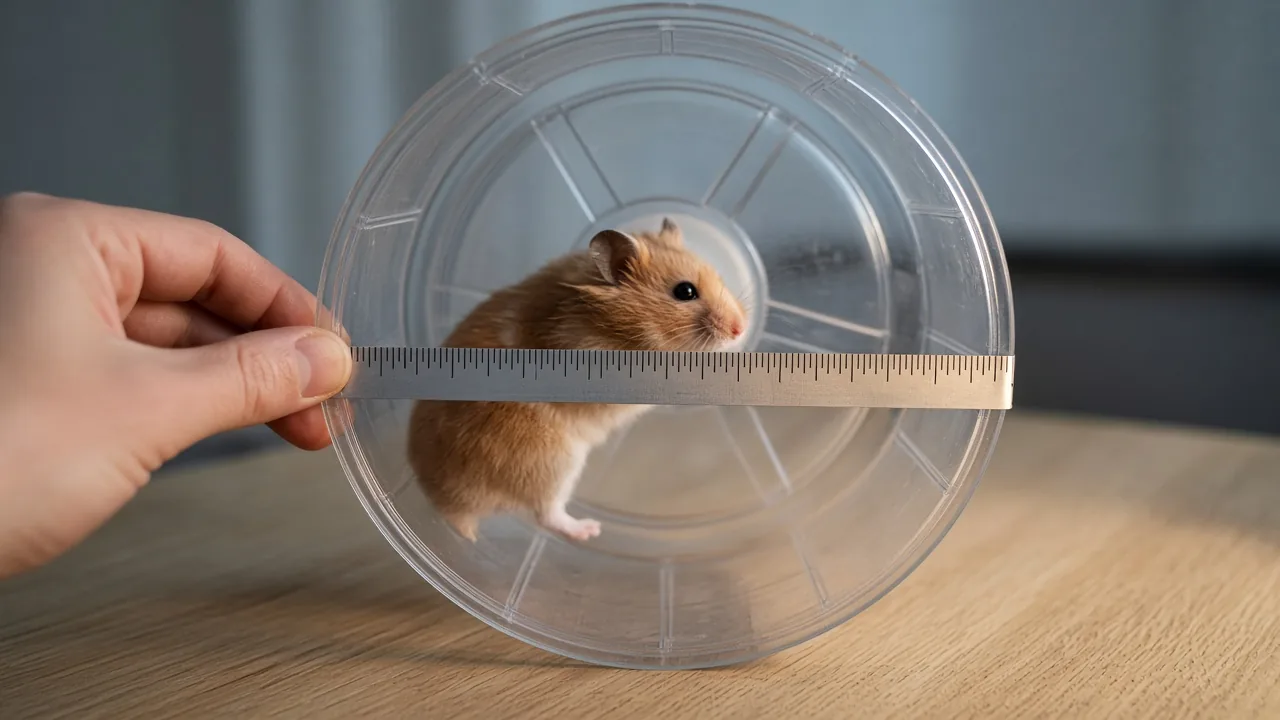
Here’s the range to shop in, broken down by breed:
| Breed | Minimum diameter | Recommended range |
|---|---|---|
| Dwarf hamster (Roborovski, Campbell’s, winter white) | 7.9 in | 7.9–9.4 in |
| Syrian hamster (golden hamster) | 9.4 in | 9.4–11.8 in |
These aren’t arbitrary numbers. Wild Syrian hamsters may cover 3 to 6 miles in a single night of foraging, a distance comparable to a human running half a marathon. A pet hamster that gets most of its exercise on a wheel is trying to replicate that same mileage in a tiny loop, so the wheel’s curve has to be gentle enough that the hamster’s spine stays straight through a full stride.
That’s why a wheel that’s "close enough" in size often isn’t close enough in practice. A hamster can technically run on a wheel half an inch under the recommended minimum, but it will do so with a curved back instead of a flat one, night after night. Over months, that repeated posture is the kind of thing that can turn into a real orthopedic problem rather than a one-time discomfort.
Why a Too-Small Wheel Causes an Arched Back
One hamster owner compared a 9.1-inch wheel to a 10.6-inch wheel side by side and noticed something she hadn’t expected: on the smaller wheel, her hamster’s back curved upward and stayed arched the entire time it ran. On the larger wheel, the same hamster’s back stayed flat and level. Nothing else in the setup changed, just the wheel.
That’s a single owner’s observation, not a controlled study, so treat it as a useful data point rather than definitive proof that 9.1 inches is unsafe for every hamster. Still, it lines up with the general logic of wheel sizing: a smaller circle forces a tighter curve, and a tighter curve means more spinal bend per stride. If you can only choose between two sizes and your hamster’s breed allows for either, the larger option is the safer default.
Step 2: Choose a Wheel Material That Won’t Pinch Feet or Hurt the Spine

Diameter solves one problem; material solves a different set. A correctly sized wheel with the wrong surface can still catch toes, pinch feet in gaps, or wobble enough to throw off a hamster’s stride.
| Wheel type | Grip and surface | Injury risk | Noise level | Best for |
|---|---|---|---|---|
| Solid acrylic/plastic wheel | Smooth, continuous running surface | Low, no gaps to catch feet | Can be noisy if poorly balanced or clipped to wire | Most dwarf and Syrian hamsters |
| Wire or wire-hybrid wheel | Rungs with visible gaps | Higher, feet and tails can slip through gaps | Often quieter than solid wheels | Not generally recommended |
| Saucer (flat disc) wheel | Flat, angled running surface | Uneven weight distribution across the back | Usually quiet | Not generally recommended |
| Hamster ball | Fully enclosed sphere | Can tumble or fling the hamster if it rolls off a ledge or speeds up on hard floors | Loud on hard surfaces | Occasional supervised use only, if at all |
A solid, continuous running surface is the safer default because there’s nothing for a foot to slip into mid-stride. Wire and wire-hybrid wheels look sturdy, but the gaps between rungs are wide enough to catch a hamster’s foot while it’s running at speed, which can lead to a sprain or worse. Whatever material you choose, check it with your own hands before adding it to the cage: run a finger along every seam and gap to find anything a toe could catch on.
Are Hamster Balls and Saucer Wheels Safe?
Saucer wheels distribute a hamster’s weight unevenly because the running surface tilts instead of staying level, which puts more pressure on one side of the spine than the other with every lap. Hamster balls carry a different risk: once a hamster builds up speed inside a closed sphere, it can lose control, tumble, or get flung if the ball hits a step, a cord, or an uneven surface. Supervision doesn’t eliminate that risk, it just lets you catch it after it happens.
This conclusion comes from one detailed hamster-care guide rather than an independent safety test, so it’s worth treating as informed opinion rather than settled fact. That said, the logic holds up: anything that removes the hamster’s ability to stop or redirect mid-run adds risk that a simple exercise wheel doesn’t carry. If you already own a saucer or ball, you don’t need to throw it out, but it shouldn’t replace a properly sized exercise wheel as the hamster’s main source of daily exercise.
Step 3: Match the Wheel to the Cage Size and Prevent Escape Attempts
Wheel size and cage size are connected, not separate decisions. A dwarf hamster generally needs a cage rated at grade 47 or higher, with a minimum height of about 11.8 inches. A Syrian hamster needs a cage rated at grade 60 or higher, with a minimum height of about 15.7 inches. Those height minimums matter because a tall-enough wheel needs tall-enough walls around it, or the wheel ends up crowding everything else in the cage.
Cage material matters just as much as size. Inexpensive wooden cages, sometimes sold for very little money in a roughly 24-inch size, are frequently made from low-grade particleboard that can develop a chemical smell, rough or splintered edges, and warping once it absorbs urine. A large, affordable option that avoids those problems is a clear plastic storage bin with a secure, ventilated lid added on, which costs less than a dedicated enclosure but still gives you smooth, chew-resistant walls.
Even a cage that looks roomy enough can still invite escape attempts if the construction has gaps or a weak lid. One owner reported a hamster repeatedly trying to escape a 24.8 by 17.7 by 15-inch acrylic bin, despite the bin technically meeting size minimums for a dwarf hamster. The lesson isn’t that the size was wrong, it’s that corners, seams, and the lid itself need checking for gaps a hamster could squeeze through or chew open, separate from whether the overall footprint is large enough.
Step 4: Set Up Bedding Depth and Zones Around the Wheel
A correctly sized wheel still needs a stable base to sit on, which means bedding depth matters more than most new owners expect. Aim for a minimum bedding depth of about 3.9 inches throughout the cage, deeper in the zones where your hamster digs or nests.
A three-layer approach works well for most setups:
- Bottom layer: a water-absorbing material to handle moisture from below.
- Middle layer: a urine-absorbing layer, avoiding pine or cedar shavings, since the oils they release can irritate a hamster’s respiratory system.
- Top layer: nesting material for burrowing and sleeping, avoiding cotton fluff or fibrous nesting wool, which can wrap around feet or cause a blockage if swallowed.
In colder months, increase the proportion of nesting material in that top layer so your hamster can build a warmer burrow. One owner who used a roughly 12 by 12 by 24-inch wooden enclosure with this three-zone setup and the full 3.9-inch depth reported going a full month without odor buildup, even in a humid climate, though results like this will vary with ventilation and how often the cage is spot-cleaned.
How Often to Check Teeth and Diet While You Monitor Wheel Use
Wheel size only solves part of the activity picture. A hamster that’s unwell or missing something in its diet may avoid the wheel even if the diameter and material are both correct, so it’s worth checking overall health alongside wheel fit.
Healthy hamster teeth are naturally yellow-brown. White teeth can signal a calcium deficiency, and offering a small amount of cooked egg white or plain tofu can help address that gap. Beyond teeth, feed a natural, hamster-formulated staple food as the base diet, and supplement with fresh vegetables, fruit, and a small amount of animal protein about twice a week. Cut fruit into small pieces before offering it so it dries out quickly instead of sitting in the bedding and growing mold.
If your hamster suddenly stops using a wheel that previously fit well, don’t assume the wheel itself is the problem. Changes in appetite, tooth color, or general energy are worth checking first, and a vet visit is the right next step if those signs show up alongside reduced wheel activity.
How to Clean the Wheel and Check It for Wear
Hamsters aren’t fastidious about where they go to the bathroom, so a urine corner or sand bath area only needs cleaning about once a week. The wheel itself should get wiped down on a similar schedule, more often if you notice buildup on the running surface, since a sticky or grimy surface can affect grip as much as the wrong material would.
While cleaning, run through a short wear checklist:
- Cracks or chips in the running surface, especially near the edges
- A loose or wobbly axle that makes the wheel tilt or stick during a stride
- Sharp edges where plastic has chipped or worn thin
- Noise changes, like a new squeak or clicking sound, which often signal a mechanical problem before it becomes visible
Retire the wheel the moment any of these show up, regardless of how new or expensive it was. A cracked or wobbly wheel undoes the benefit of getting the diameter right in the first place, since an unstable running surface can cause the same kind of uneven posture a too-small wheel does.
Common Questions About Hamster Wheel Size and Safety
My hamster barely uses the wheel. Is that normal?
Some hamsters run for a long stretch every night, while others use the wheel in short, inconsistent bursts. Short or irregular wheel sessions aren’t automatically a problem, but if your hamster has gone from active to barely moving, check diet, teeth, and general behavior before assuming the wheel is the cause.
Do I need a high-end cage, or will a simple wooden box work?
A well-built wooden enclosure can work fine, as long as it avoids low-grade particleboard and meets the minimum size and height for your hamster’s breed. Higher-grade acrylic or specialty cages often add smoother interior walls and easier cleaning, but the core requirements, size, ventilation, and a wheel that fits without crowding, matter more than the price tier.
Is a grade-47 cage big enough for a larger dwarf variety?
Grade 47 is the general minimum for dwarf hamsters, including larger varieties like winter white or Campbell’s. If your dwarf hamster runs on the larger end of its breed, sizing up from the bare minimum gives you more room for a bigger wheel and reduces the odds of the escape-attempt behavior that shows up when space feels tight.
Are urine sand and bath sand the same thing?
These serve different purposes even though both involve sand. Bath sand is for grooming, dust-bathing behavior, and should stay separate from the area your hamster uses as a bathroom corner, which gets cleaned more frequently due to moisture and odor buildup.
Watch how your hamster actually uses its space: whether it runs hard every night, digs constantly, or seems to hide more than it explores. Let that behavior, combined with its breed, guide the wheel size and material you choose, and put a quick check for cracks or wobble on your regular cleaning schedule. If you’re also setting up chew toys or tunnels for the same cage, the same habit of checking for wear and rotating in fresh options applies there too.
This article is for general information only and is not a substitute for advice from your veterinarian. Always supervise your pet with a new toy, and replace any toy that is damaged or small enough to swallow.

Contributor
admin
Continue reading
All stories
SMALL PETS & BIRDS · 11 October
Is Millet Spray Holder Safe for Birds? What to Check Before You Buy
SMALL PETS & BIRDS · 11 October
Do Hamsters Need an Exercise Wheel to Be Happy? A Buyer’s Guide
SMALL PETS & BIRDS · 11 October
Responses
Moderated discussion