CAT TOYS
Why Interactive Cat Toys Are Better Than Automatic Ones
Interactive wand toys let cats complete the full stalk-chase-pounce-catch sequence that automatic and remote toys can't replicate. Learn how to match play style to your cat and keep sessions safe.
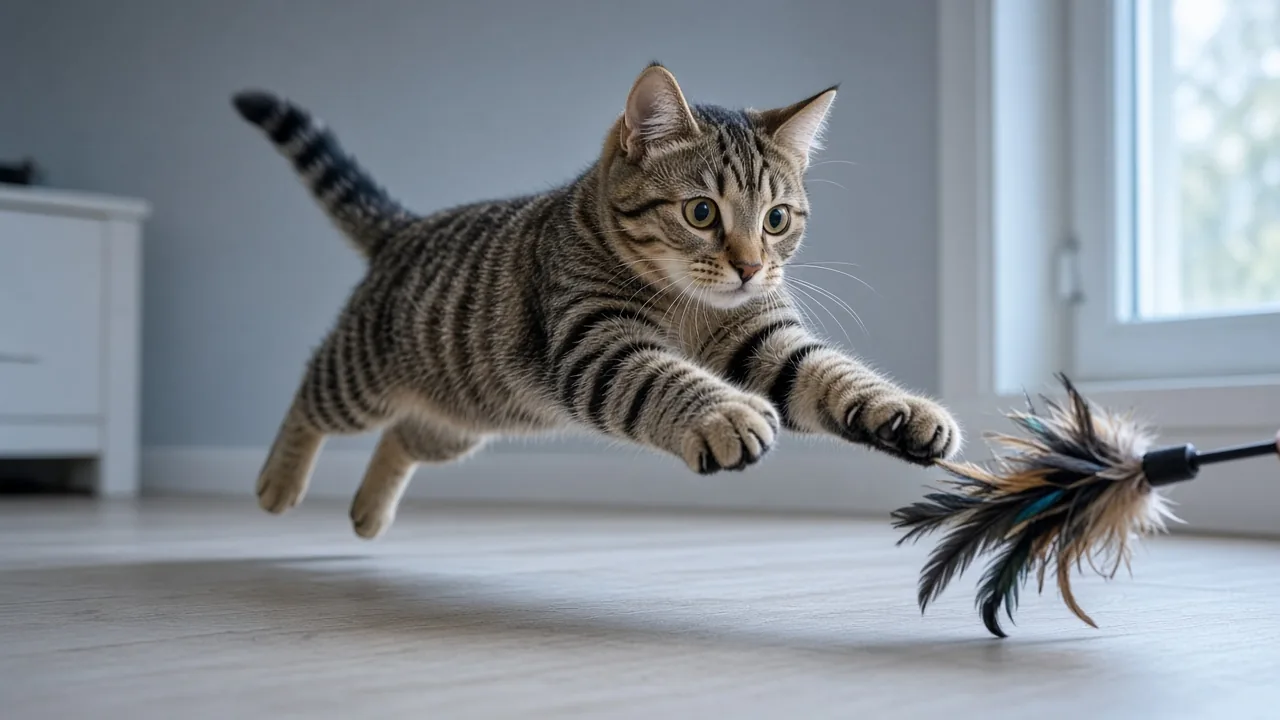
A wand toy you move yourself lets a cat finish the full stalk-chase-pounce-catch sequence that automatic and remote toys can only partly imitate. This is the main reason why interactive cat toys are better than automatic ones for most cats, most of the time. Below you’ll find how the toy types differ, how to match play style to your own cat, and the safety and cleaning checks that keep sessions both fun and safe.
Why Interactive Cat Toys Are Better Than Automatic Ones
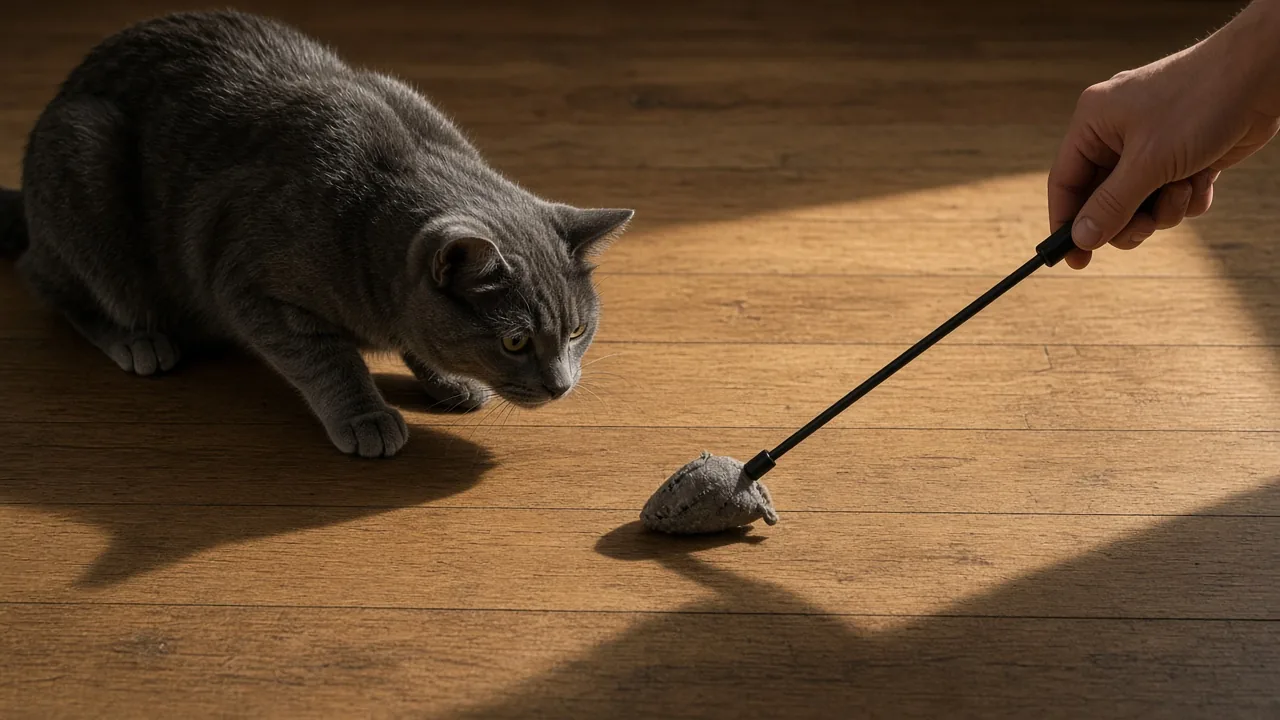
Cats treat play as a stand-in for hunting. A pet cat that has never caught a real mouse still carries the same wiring that tells a wild cat when to crouch, when to creep forward, and when to strike. For that wiring to feel satisfied, the "prey" has to behave like something alive: it darts, pauses, hides, and occasionally gets caught.
A wand toy in your hand can do all of that because you’re reading your cat’s body language in real time. You slow down when she crouches, speed up when she loses interest, and let her catch the toy just often enough to keep her engaged. Remote toys and self-activated toys can’t adjust that way. A ball that gets tossed once rolls in a straight line and stops. A motorized toy under a blanket moves in the same loop every time.
Predictability is the problem. Once a cat has figured out the pattern of a toy’s movement, much of the mystery disappears, and so does the drive to chase it. Interactive play avoids this because you’re never moving exactly the same way twice.
The payoff isn’t just entertainment. Many cat behaviorists consider interactive play, second only to the litter box, one of the most useful tools owners have for building a bond with their cat. A short daily session gives your cat a reason to look forward to you walking into the room, not just to feeding time.
Interactive vs. Remote vs. Self-Activated Cat Toys: What’s the Difference
The word "interactive" gets used loosely in pet toy marketing, and that causes confusion. A toy can be labeled interactive because it lights up or makes noise when touched, but if your cat is the only one controlling it, it isn’t interactive in the sense that matters for hunting instinct. Here’s a clearer way to sort toys into three categories.
| Toy type | Who controls movement | How realistic the "prey" feels | Best-fit play style |
|---|---|---|---|
| Remote toys | Cat, after you toss or place it | Low — moves once, then stops or rolls predictably | Cats who like to bat, carry, or ambush a stationary object |
| Self-activated toys | A switch or timer, not a person or the cat | Medium — moves on a loop, but the pattern repeats | Cats who enjoy solo play or need something running while you’re out |
| Interactive toys | You, in real time | High — speed, direction, and pauses change constantly | Almost any cat, especially strong stalkers and chasers |
Remote toys include small balls, catnip mice, and fake flies you throw across the floor. Self-activated toys include motorized "mouse under a blanket" style toys that run on a switch or timer. Interactive toys are the ones with a cat on one end and a person on the other, most commonly a wand toy with a feather, fabric strip, or lure attached to a string.
None of the three categories is inherently bad. The distinction matters because only the interactive category gives your cat a hunting partner who reacts to her, instead of a toy that simply does its own thing nearby.
What You Need Before Starting Interactive Play Sessions
You don’t need a large toy collection to start. A single wand-style toy with a lure attachment, five to ten minutes of uninterrupted time, and your cat’s regular food on hand afterward cover the basics.
Keep these points in mind before your first session:
- Pick a wand with a lure that resembles something a cat would actually hunt, such as a feather, fabric strip, or fuzzy attachment, rather than something purely decorative.
- Choose a time when you can give full attention, since cats pick up quickly on distracted, half-hearted movement.
- Have a small amount of wet food or a few pieces of a usual treat ready for right after play.
- Clear enough floor space for your cat to crouch, dash, and leap without knocking into furniture.
None of this requires an expensive setup. A plain stick with a strip of fabric or an old shoelace tied to the end can work as well as a store-bought wand, as long as you move it like something trying to get away.
How to Choose the Right Interactive Toy for Your Cat’s Play Style
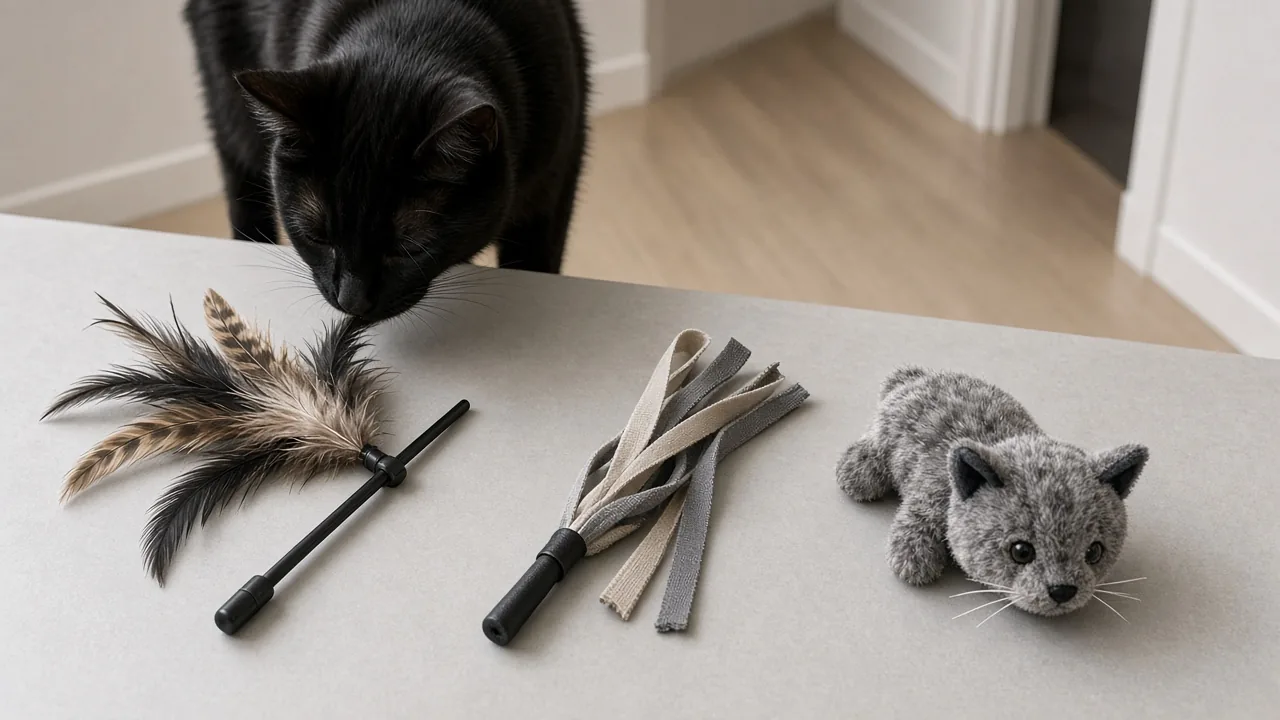
Not every cat hunts the same way, and forcing a style your cat doesn’t enjoy can make a toy feel pointless to her even if it’s well made. Watch how your cat already investigates moving things around the house, then match the toy to that pattern.
- Stalkers creep low to the ground and freeze before advancing. These cats often respond best to slow, low-to-the-floor movement, like a lure dragged along baseboards.
- Chasers want speed and distance. A longer wand that lets you flick the lure across open floor gives them room to run.
- Pouncers want a target that stays briefly still so they can line up a jump. Pausing the toy under furniture or behind a corner before it "escapes" again suits this style.
- Carriers want to grab the prey and walk off with it. These cats often do best with toys they’re allowed to actually catch and carry rather than ones constantly pulled away.
A cat can show more than one style depending on mood or time of day, so it’s reasonable to switch tactics mid-session if the current approach isn’t landing.
Gentler Interactive Toys for Shy or Easily Startled Cats
Some cats find a fast-moving wand toy more alarming than exciting, especially if they’re naturally cautious or new to a household. For these cats, lower-intensity versions of the same stalk-and-pounce instinct tend to work better.
A soft toy or small puppet that pops up briefly from behind a couch or bed, then disappears again, lets a shy cat practice watching and reacting without feeling cornered. A scarf or thin piece of fabric dragged slowly along the floor, rather than snapped quickly through the air, gives the same low-pressure option.
The goal with a nervous cat isn’t to build up to full-speed wand play right away. It’s to let her succeed at smaller challenges first so play starts to register as safe rather than overwhelming.
Adjusting Interactive Play for Senior Cats
Age alone doesn’t mean a cat has lost interest in hunting-style play. Some senior cats stay enthusiastic well into old age, and a few owners have described cats staying playful almost to the end of long lives. That said, older joints and lower stamina usually call for some adjustment.
Shorter sessions, run more often, generally work better than one long session. Keep the toy lower to the ground so jumping isn’t required, and watch for signs she’s had enough: slower response, lying down mid-chase, or walking away. If a senior cat who used to chase readily starts avoiding play altogether or seems stiff afterward, that’s worth mentioning to your veterinarian, since it can point to joint discomfort rather than simple disinterest.
Step-by-Step: How to Run a Hunt-Catch-Kill Play Session
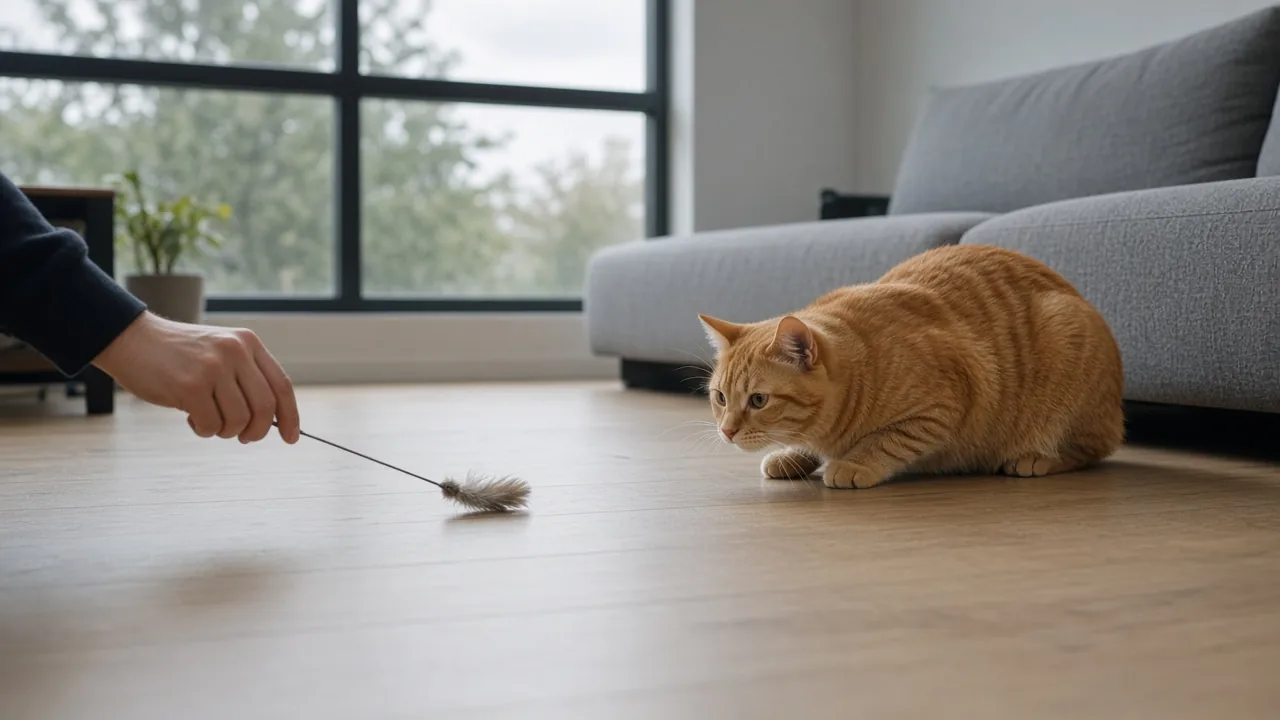
A satisfying session mimics the full arc of a real hunt, not just a few seconds of chasing. Here’s a simple sequence to follow.
- Start slow. Let the toy move at a distance, like prey that hasn’t noticed the cat yet, giving her time to settle into stalking mode.
- Build the chase. Once she’s locked on, speed up the movement, change direction, and let the toy dart behind furniture or around corners.
- Allow a catch periodically. Don’t make the toy impossible to reach for the whole session. Let her successfully pounce on it every so often so the game stays rewarding instead of frustrating.
- Praise each stage out loud. A calm, encouraging tone during the chase and right after a catch reinforces that she’s doing something right.
- Wind the session down gradually. Slow the toy’s movement in the last minute or two rather than stopping abruptly.
- Feed right after. A small meal of wet food or a bit of raw or canned food immediately after play may complete the hunt-catch-kill-eat sequence many cats seem to find most satisfying.
Watch the balance between challenge and reward throughout. A cat who never catches anything can lose interest out of frustration, while one who catches the toy every single time may get bored from a lack of challenge.
How to Build a Daily Play Ritual Your Cat Will Recognize
Cats respond well to routine, and play is no exception. Running sessions at roughly the same time each day, whether that’s right before dinner or after you get home from work, helps your cat start anticipating play rather than being surprised by it.
Just as important: put the toy away when the session ends. If a wand toy stays out on the floor all day, pulling it out stops meaning anything special. Keeping it stored between sessions turns the act of reaching for it into a clear signal that play is about to start, similar to how the sound of a can opener signals mealtime.
A consistent ritual also makes it easier to notice changes in your cat’s behavior. A cat who normally comes running the moment the toy comes out but suddenly ignores it may be dealing with pain, illness, or stress worth checking into.
Low-Cost and DIY Interactive Toy Ideas That Still Work
Price has surprisingly little to do with whether a cat enjoys a toy. Plenty of owners have found their cats consistently prefer homemade or improvised options over anything bought specifically for play.
A plain paper grocery bag is a frequent favorite, and it has the advantage of being disposable, so you can simply swap in a new one once it tears instead of worrying about cleaning it. One owner described a homemade pom-pom made from strips cut off an old bread bag, tied in the middle with a fabric strip, that stayed in regular use for well over a decade.
Other low-cost ideas that work along the same hunting-instinct lines:
- A homemade fishing-style wand: an old fishing lure with the hook and hanging ring removed, tied to a fishing rod, cast and reeled in across open floor or yard space for a cat to chase.
- "Cat soccer": taking turns kicking or batting a lightweight ball back and forth with your cat.
- A floating ball game: a shallow basin of water with a ping-pong ball, placed near a slowly oscillating fan so the ball drifts, giving a curious cat something to watch and try to scoop out.
- A pop-up puppet game: a soft toy popped briefly out from behind furniture, good for cats who find fast wand movement too intense.
None of these require a trip to the store. What matters is that a person is still driving the "prey" behavior, even with a bread bag or a rod made from spare parts.
Are Self-Activated and Remote Cat Toys Ever Worth Buying
Interactive play has clear advantages, but that doesn’t mean automatic and remote toys have no place in a household. Some cats genuinely enjoy them. One owner described four cats that learned to turn on a motorized spinning toy themselves and happily played with it unsupervised, which runs counter to the idea that these toys hold limited appeal for every cat.
Self-activated and remote toys can be useful for:
- Giving your cat something to do while you’re at work or out for the evening.
- Cats who are naturally more independent and enjoy batting at objects without a person involved.
- Supplementing, not replacing, the daily interactive session, especially in homes where owners can’t always carve out dedicated playtime.
The practical limitation is that these toys repeat the same pattern of movement, so most cats eventually lose interest in a way they rarely do with a toy a person is actively steering. Think of them as a backup for solo stretches of the day rather than a stand-in for the real hunting game.
How to Check Interactive Cat Toys for Safety During Play
Supervise any new toy closely the first few times your cat plays with it, especially wand toys with feathers, string, or small attached pieces. Watch for these specific risks:
- String and ribbon: Linear items like string, ribbon, or yarn can cause serious injury if swallowed, since they can bunch up inside the intestines. Never leave a string-based wand toy out for unsupervised play.
- Feathers and small attachments: Check that feathers, bells, or fabric pieces are stitched or glued securely. If your cat manages to pull a piece off, remove it from her mouth and set that toy aside.
- Fraying or loose parts: A wand with a loosening attachment point is a sign to retire or repair it before the next session, not after.
- Choking size: Any detachable piece small enough to fit fully in your cat’s mouth is a choking risk and shouldn’t be part of a toy left within reach.
If you ever see your cat chewing persistently on a toy part, trying to swallow something, or coughing or gagging after play, stop the session and contact your veterinarian if the behavior continues.
How to Clean and Store Interactive Cat Toys
Wand handles can be wiped down with a damp cloth after sessions, especially if your cat drools or chews on them. Fabric lures, feather attachments without glued parts, and fuzzy pom-poms generally hold up fine in a gentle hand wash, then air-dried fully before the next use.
Store toys somewhere your cat can’t get to between sessions, such as a drawer or closed container, rather than on the floor or a low shelf. This does double duty: it keeps the toy cleaner, and it protects the "ritual" effect of pulling the toy out only when you’re ready to play.
How Often to Replace a Cat’s Interactive Toy
A toy doesn’t need to look brand new to still be usable, but certain signs mean it’s time to swap it out before, not after, something goes wrong:
- Fraying or unraveling string on a wand toy
- Exposed wire inside a feather attachment or lure
- A cracked, splintered, or bent wand handle
- Attachments that come loose easily when tugged
Check toys like this every few weeks if they’re used daily, and inspect them immediately any time you notice your cat chewing harder than usual on a particular spot. Replacing a worn toy costs little compared to a vet visit for a swallowed piece.
Common Questions About Interactive and Automatic Cat Toys
Why Won’t My Cat Play With the Toys in Its Toy Box
Toys left out in a basket or box tend to lose their novelty fast, since your cat has already investigated and categorized them as "known" objects. Rotating a small number of toys in and out, rather than leaving everything available at once, often brings back interest in toys that seemed ignored.
Can Cats in Multi-Cat Homes Skip Human-Led Play
Two cats taking turns chasing each other, swatting, and play-wrestling does cover some of the hunting instinct that interactive play addresses, and it can be enough on a day when you’re too tired for a full session yourself. It doesn’t fully replace focused human-guided play, though, since the game lacks the deliberate pacing and praise that keeps a solo session challenging without becoming frustrating.
How to Teach an Adopted Cat to Enjoy Interactive Toys
A cat that was never played with as a kitten, or spent years in a home where play wasn’t part of the routine, may show little interest in a wand toy at first. Short, low-pressure sessions, just a minute or two at a time, repeated daily over several weeks, often help a cat gradually start recognizing the toy as something worth chasing. Patience matters more than toy choice here. Pushing too hard, too fast, can make an already uncertain cat avoid play altogether.
Watch how your own cat likes to play, whether that’s stalking, pouncing, or carrying things off, and let that guide which toys you reach for. Check your toys for fraying string, loose attachments, or cracked parts regularly, and swap them out as soon as you spot wear, so playtime stays something your cat looks forward to rather than something that needs fixing after the fact.
This article is for general information only and is not a substitute for advice from your veterinarian. Always supervise your pet with a new toy, and replace any toy that is damaged or small enough to swallow.

Contributor
admin
Continue reading
All stories
CAT TOYS · 10 October
Why Cats That Ignore Store Bought Toys Love Free Alternatives
CAT TOYS · 10 October
DIY Food Puzzle Toys for Cats Using Household Items That Actually Work
CAT TOYS · 10 October
Responses
Moderated discussion