CAT TOYS
Is a Fishing Rod Cat Toy Safe to Use? What Supervision Really Means
A fishing rod cat toy is safe only while you're actively holding and watching it, since the string that mimics prey can also tangle around a paw, leg, or neck if left unattended. Here's how to play safely and what to check before and after each session.
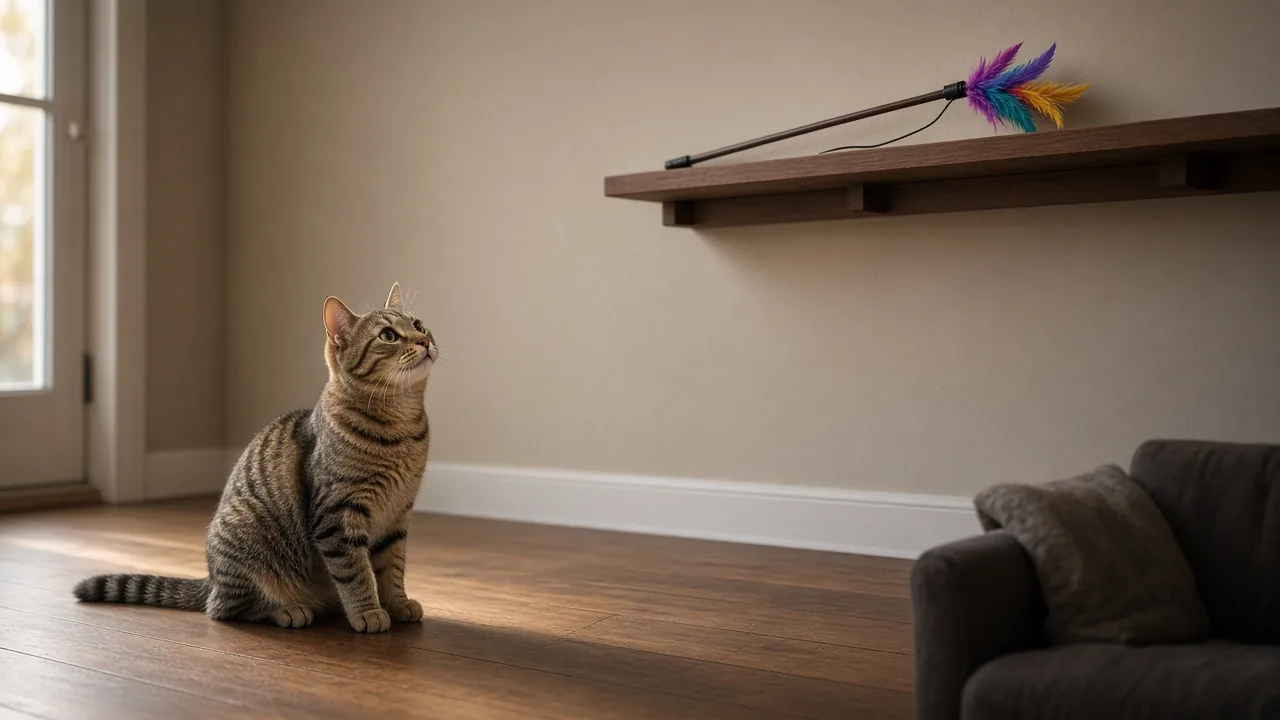
Picture a typical evening: you’re dragging a feather wand around the living room, your cat leaps, misses, leaps again, and for a few minutes everyone’s having a great time. Then the phone rings. If you set the toy down and walk away with the string still attached, that’s where things can go wrong. Is a fishing rod cat toy safe to use? Yes, but only while you’re holding it and watching. Left out for an unsupervised cat, the same toy that sparked all that fun becomes a tangling risk.
Is a Fishing Rod Cat Toy Safe to Use? The Short Answer
A wand toy is safe when you’re actively playing with your cat and you put it away the moment the session ends. It becomes risky the instant it’s left within reach of a cat who’s alone. The string, cord, or elastic that makes these toys so effective at mimicking prey movement is also what can wrap around a paw, leg, or neck if nobody’s around to step in.
This isn’t a reason to avoid fishing rod toys. It’s a reason to treat them like scissors rather than like a stuffed mouse: useful, fun, and something you put back in a drawer when you’re done.
What a Fishing Rod Cat Toy Is and How It Works
A fishing rod cat toy, often just called a wand toy, follows a simple design: a rigid pole, a length of string or cord, and an attachment on the end that your cat chases. Attachments range from simple felt shapes to feather clusters that flutter when you flick your wrist.
Some models add a pulley system inside the handle so you can lengthen or shorten the string without retying anything. That’s handy for adjusting the play distance depending on your cat’s energy level or the size of the room. The core mechanic stays the same across versions: you control the "prey," and your cat does the stalking, chasing, and pouncing.
What Cat Owners and Longtime Sellers Say About Wand Toy Safety
People who’ve spent years around cat toys tend to agree on one point: string-based toys need a human in the room, full stop. One couple who’ve spent over a decade testing and reviewing cat toys consistently pair their wand toy recommendations with a reminder to put the toy away after playtime rather than letting it sit on the floor.
A reader who described working in the cat toy industry for 40 years echoed that warning in stronger terms, saying that any toy involving string absolutely requires supervision and should be stored somewhere the cat can’t reach it on their own. When a casual cat parent and a long-time industry voice land on the same advice, it’s worth taking seriously rather than treating it as overcaution.
Why Entanglement and String Injuries Happen
Cats don’t process a dangling string the way we do. To a cat, it moves like prey, and prey gets pounced on, bitten, and wrestled. That instinct doesn’t pause just because you’ve left the room.
A few things turn a wand toy into a hazard once you’re not watching:
- Loose string can loop around a paw, leg, or neck during an enthusiastic pounce.
- Feather attachments can come loose and get chewed or swallowed.
- Kittens and high-energy cats play harder and faster, increasing the odds of getting tangled before anyone notices.
- A cat left alone with the toy has no one to intervene if the string catches on furniture or a limb.
None of this means the toy is poorly made. It means the design that makes it effective for hunting-style play is the same design that needs a watchful owner nearby.
How to Use a Fishing Rod Cat Toy Safely: Step-by-Step
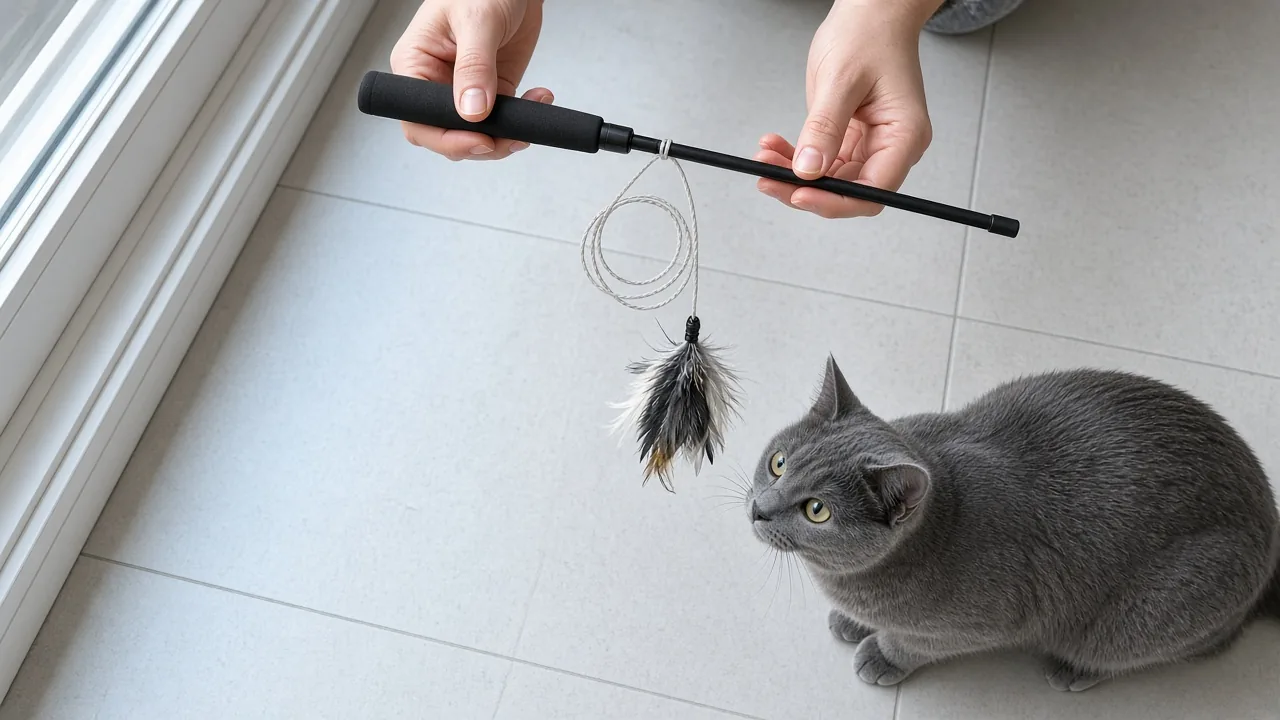
A little routine around each play session cuts the risk down to almost nothing. Here’s a sequence that works well for most households:
- Check the toy before you start. Look at the string for fraying, the attachment for loose feathers or stitching, and the handle for cracks.
- Clear the play area. Move breakable items, cords, and anything with its own string (blinds, phone chargers) out of the way.
- Hold the rod the entire time. Never set the toy down mid-play to answer the door or check your phone, even for a minute.
- Vary the movement. Short bursts of fast motion along the floor or a quick lift into the air mimic how real prey moves and keep your cat engaged.
- Let your cat "catch" the toy sometimes. A hunt that never ends in a catch can frustrate a cat, so give them the win every so often.
- Watch for fatigue. If your cat starts panting, slows down noticeably, or lies down and stops chasing, end the session.
- Put the toy away immediately after. Store it on a shelf, in a closed drawer, or hung on a hook well out of paw’s reach.
One owner’s approach to the actual play motion is worth borrowing: standing in the middle of the room and turning in a slow circle while swinging the wand, so the attachment arcs through the air the way a bird might fly past. It works well for engaging a cat’s hunting instinct, though it’s worth keeping an eye on nearby lamps and furniture, since an enthusiastic swing can catch more than just your cat’s attention.
How Long and How Often to Play With a Wand Toy
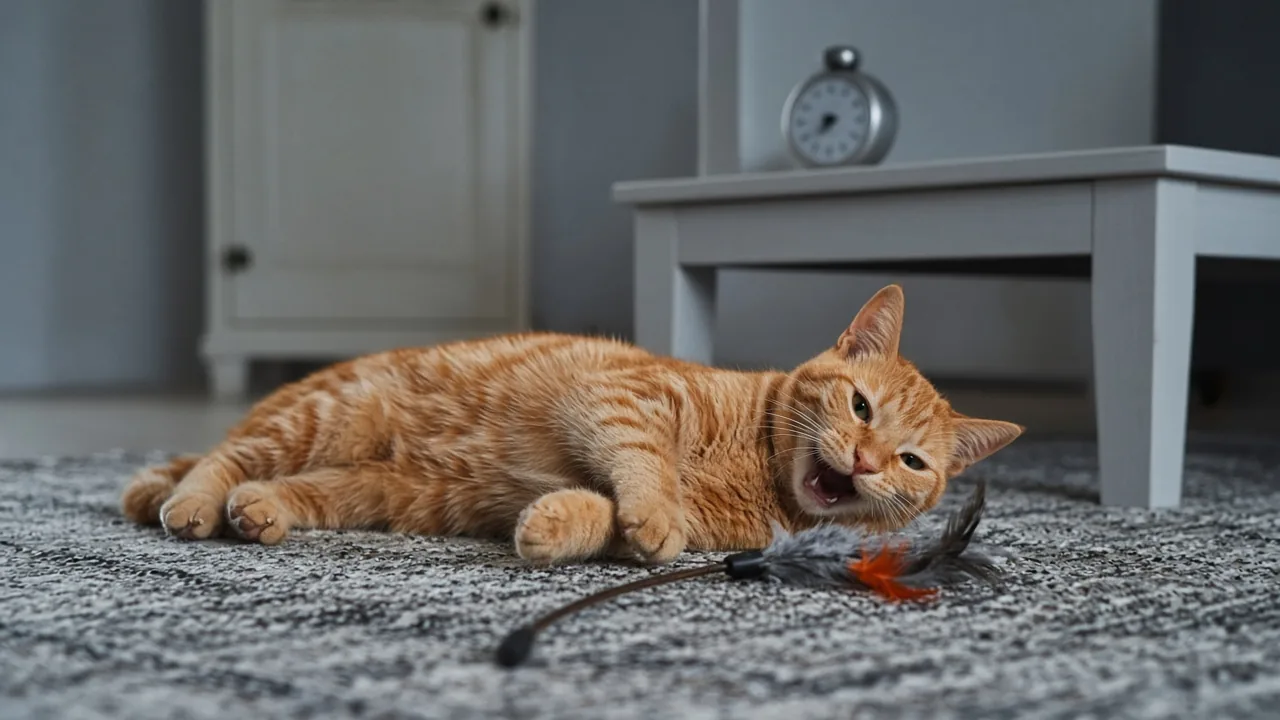
Short, frequent sessions tend to work better than one long marathon. Five to ten minutes, two or three times a day, gives most cats a solid outlet for stalking and pouncing without pushing them past their limit.
Watch your cat’s breathing and body language rather than sticking to a strict clock. Signs that it’s time for a break include:
- Open-mouth breathing or noticeably heavier panting
- Slower, less committed pounces
- Lying down mid-chase instead of resetting into a stalking crouch
- Losing interest in the toy altogether
Indoor cats that don’t get much daily exercise can tire out faster than you’d expect, especially early on. Breaking play into shorter rounds with a minute or two of rest in between lets them recover without cutting the fun short entirely.
Fishing Rod Toys vs Other Popular Cat Toys: A Comparison
Wand toys aren’t the only option, and they’re not always the right one for every household. Here’s how they stack up against other common choices:
| Toy Type | Supervision Needed | Durability | Play Style | Typical Cost |
|---|---|---|---|---|
| Fishing rod / wand toy | Constant, full-time | Moderate; string and feathers wear over time | Stalk, chase, pounce with human guidance | Budget to mid-range |
| Plastic spring toy | Minimal | High; simple design, few failure points | Solo batting and chasing | Very low cost (often sold in large packs) |
| Woven finger-trap toy | Minimal | High | Solo batting, light chewing | Very low cost |
| Puzzle feeder | Minimal once trained | Moderate to high | Problem-solving, treat foraging | Mid-range |
| Propeller/flying disc toy | Low to moderate | Low; parts can break with regular use | Independent chase, retrieving | Low cost per pack |
The clearest divide here is supervision. Wand toys sit on one end of the spectrum because the string demands your attention the entire time. Springs, finger-trap toys, and (once your cat learns the mechanism) puzzle feeders sit on the other end, letting your cat play without you standing over them.
Passive Toys That Don’t Need Constant Supervision
Plastic spring toys are about as low-maintenance as cat toys get. They’re inexpensive, usually sold in bulk, and a cat can bat one around solo for as long as they’re interested. The catch is that springs have a habit of disappearing under the refrigerator, behind the couch, or into a tangle of bedsheets, which means you’ll likely be buying replacements more often than wearing the originals out. Choosing a bright color, like yellow, makes it easier to spot one that’s rolled out of sight.
Woven finger-trap style toys work similarly. They’re cheap, don’t require any setup, and give a cat something to bat and chew on their own. Like springs, they tend to migrate to odd corners of the house, so don’t be surprised if you’re occasionally fishing one out from under a rug.
Puzzle Feeders and Propeller Toys: Benefits and Durability Issues
Puzzle feeders dispense treats as your cat noses or paws at them, which turns snack time into a few minutes of mental work. One owner found success by filling the feeder with a treat different from her cat’s everyday food, so the toy felt like a reward rather than just another meal. It can take some patience to teach a cat how the mechanism works, but once they catch on, the toy doubles as a way to supplement a light breakfast and as a bonding activity in multi-cat households, since foraging side by side can ease tension between cats who don’t always get along.
Propeller or flying disc toys spin and buzz through the air, and cats often chase them down by sound as much as sight. They’re genuinely engaging for a lot of cats, but durability is a real weak point. One household found that seven out of eight propeller discs broke within eight months of regular use. If you go this route, expect to replace discs fairly often rather than treating the toy as a one-time purchase.
Who Should Use a Fishing Rod Cat Toy (and Who Should Skip It)
Fishing rod toys make the most sense for owners who can set aside a few focused minutes, multiple times a day, to play actively with their cat. If you’re consistently able to hold the toy, watch your cat’s response, and put everything away afterward, a wand toy is one of the more effective options for satisfying a cat’s hunting instinct.
They’re a weaker fit for very busy households where play sessions get rushed or forgotten, or for homes with several cats where it’s hard to supervise everyone at once. In those cases, a mix of passive toys like springs or puzzle feeders, used alongside shorter supervised wand sessions when time allows, tends to cover more ground.
Fishing Rod Toys for Indoor Cats With Strong Hunting Instincts
Indoor-only cats with a strong prey drive often need more structured outlets than cats with outdoor access. One first-time cat owner described a cat with a noticeably strong hunting instinct but no way to go outside due to allergies and apartment restrictions, and asked what toy combination might help. Wand toys fit this situation well because the stalk-chase-pounce cycle gives an indoor cat a way to act on instincts that would otherwise go unused.
Pairing a wand toy with a rotation of passive options, like a spring toy for solo play between sessions, tends to work better than relying on any single toy. The active sessions handle the hunting instinct; the passive ones fill the gaps.
How to Check a Cat Toy for Damage Before and After Play
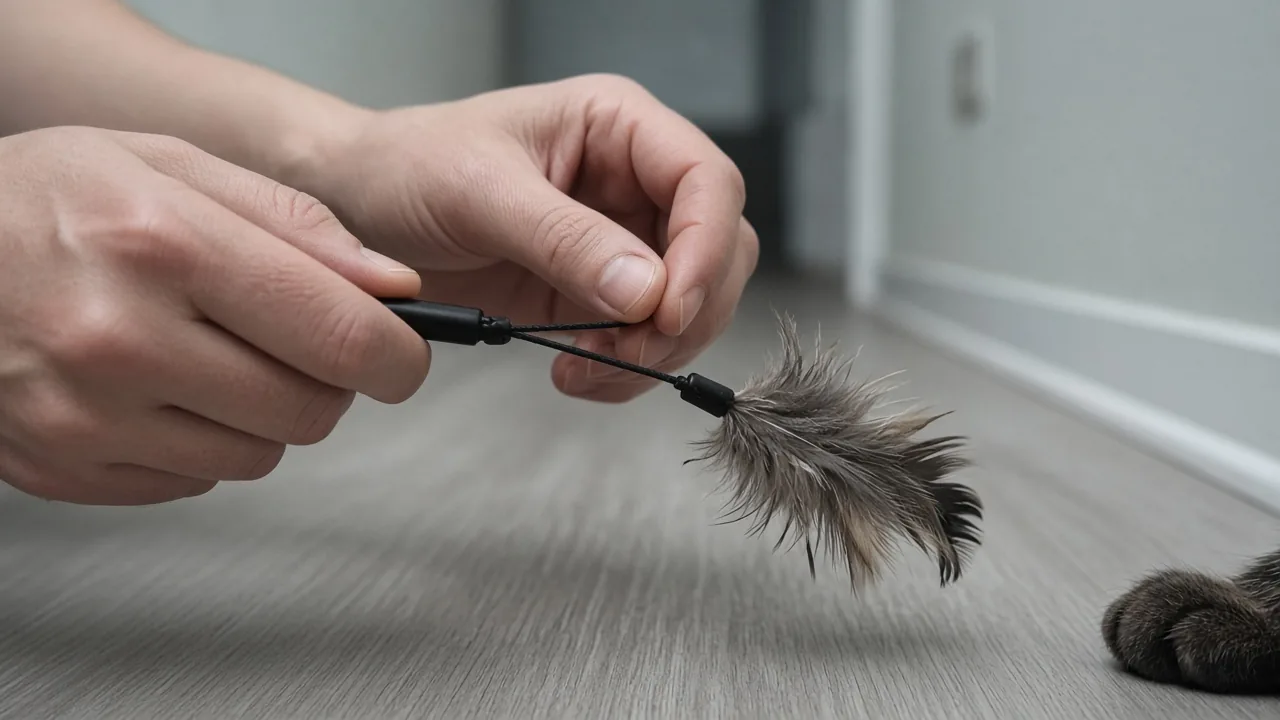
A quick inspection before and after each session takes less than a minute and catches most problems before they become a real hazard. Look for:
- Loose or missing feathers on wand attachments that could be chewed off and swallowed
- Fraying or thinning string, especially near the attachment point, where repeated pulling puts the most stress
- Cracked or splitting plastic housings on handles, propeller bases, or puzzle feeders
- Small parts that have come detached, including any bits small enough for a cat to mouth or swallow
- Sharp edges on broken plastic pieces, particularly on propeller discs that have cracked
If anything on this list shows up, stop play and set the toy aside rather than finishing out the session. A cat intent on chasing won’t slow down to avoid a frayed string or a cracked disc edge.
When to Replace a Fishing Rod or Other Cat Toy
String toys should be replaced the moment you notice fraying, not after it’s gotten obviously bad. A string that looks slightly worn today can snap or shed fibers within a few more sessions, and a snapped string leaves a shorter piece still attached to the handle that’s easy to miss during a quick glance.
Propeller discs wear out faster than most other toy types and often need replacing well before the base unit does. If you’re going through discs every few months, that’s consistent with what other owners have reported rather than a sign you bought a bad batch. Puzzle feeders and plastic housings generally last longer, but any crack or split edge is a clear signal to retire the toy.
Safer and Budget-Friendly Alternatives to Fishing Rod Toys
If the idea of a supervised-only toy doesn’t fit your household, a few alternatives offer similar play value with less hands-on commitment.
Cat Dancer-style toys use a length of wire with small pieces of cardstock attached to one end, creating erratic, insect-like movement when you flick it. They’re inexpensive, often costing less than $5, and the simple design holds up well over time.
Household items can work too. One owner ties a loop out of about 12 feet of yarn, knots the end, and drags it around the house like a small animal for her cat to stalk and pounce on; tucking it partway under a blanket adds an extra layer of hide-and-seek. The same caution applies here as with wand toys: a yarn loop is for supervised play only and should never be left out for a cat to find on their own.
A couple of common toys deserve a caution flag. Glitter balls can get torn apart during rough play, and the loose glitter or small plastic pieces inside pose a real ingestion risk if a cat is left alone with one that’s started to come apart. Any toy with loose string, elastic, or small decorative parts deserves the same "supervise, then put away" treatment as a wand toy.
Frequently Asked Questions About Fishing Rod Cat Toy Safety
Is a laser pointer a safer alternative to a wand toy?
A laser pointer removes the entanglement risk entirely since there’s no string or physical object involved. The tradeoff is that a cat never actually catches anything, which can build frustration over time. Pairing the laser with a treat, placing a piece of food where the light lands every few passes, gives your cat a real payoff and avoids an endless chase with no resolution.
Why do spring toys always go missing?
Their light weight and bouncy shape send them rolling under the refrigerator, behind the couch, and into bedsheets more often than almost any other toy. Keeping a long, thin stick or a flashlight handy for retrieving them from tight spots saves you from buying replacements every time one disappears.
Are propeller toys worth buying given how often they break?
They can be worth it if your cat genuinely loves chasing the sound and movement, but go in expecting to replace the discs regularly rather than viewing it as a one-time purchase. If frequent replacement doesn’t appeal to you, a wand toy or puzzle feeder may offer more lasting value for the same amount of money.
Every cat shows you how they like to play if you watch closely, whether that’s stalking a wand toy across the carpet, batting a spring under the couch, or carrying a soft toy around the house like a prize. Pick toys that match what your own cat actually does, and build in a habit of checking for wear and putting string toys away after every session, the same way you’d check a leash or a bowl before using it again.
This article is for general information only and is not a substitute for advice from your veterinarian. Always supervise your pet with a new toy, and replace any toy that is damaged or small enough to swallow.

Contributor
admin
Continue reading
All stories
CAT TOYS · 10 October
Why Cats That Ignore Store Bought Toys Love Free Alternatives
CAT TOYS · 10 October
DIY Food Puzzle Toys for Cats Using Household Items That Actually Work
CAT TOYS · 10 October
Responses
Moderated discussion