CAT TOYS
DIY Food Puzzle Toys for Cats Using Household Items That Actually Work
Turn a water bottle, paper cup, or egg carton into a DIY food puzzle toy for cats that taps into natural hunting instincts without spending a dime. These three household-item builds come with step-by-step instructions, safety checks, and tips for matching the right puzzle to your cat's play style.
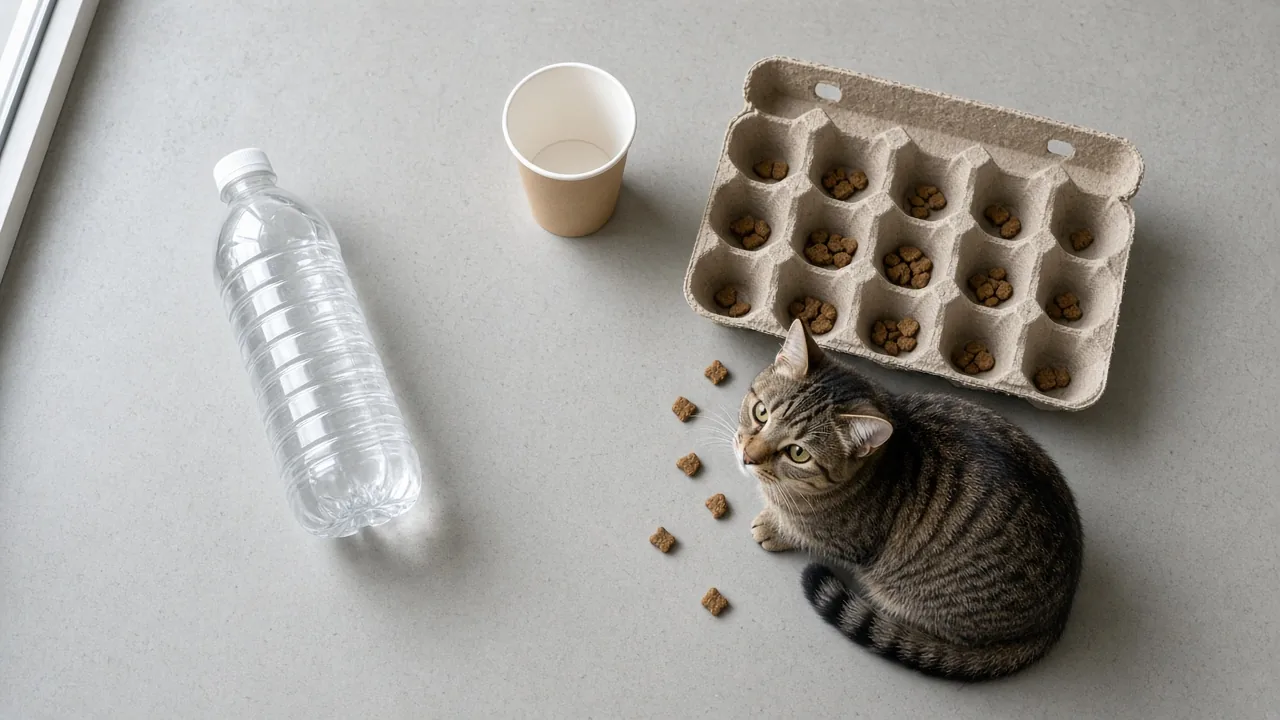
A plain box with a few holes punched in it and some treats dropped inside kept a group of test cats busier than several store-bought gadgets stacked next to it. That’s the whole case for DIY food puzzle toys for cats using household items: a water bottle, a paper cup, or an egg carton already in your recycling bin can tap into the same hunting instincts cats use on expensive store shelves, at no cost at all. If your cat has ignored a pricey toy more than once, these three builds are worth trying before you buy anything else.
Why DIY Food Puzzle Toys for Cats Using Household Items Beat Fancy Store-Bought Gadgets
One owner lined up several commercial cat toys side by side to see which ones her two cats would actually choose on their own, rather than guessing from the packaging. The lineup included a tunnel-style ball track toy with a hidden mock mouse, a tall wand toy marketed as encouraging stalking and pouncing, a motion toy with a spinning fake mouse and attached scratch pad, and a basic treat-filled box with holes cut into the sides.
After thirty minutes of free play, the cats kept returning to two things: the simple treat box and a wand toy their owner was actively holding and moving. The ball track toy, the tall wand toy left on its own, and the motion toy with the scratch pad barely got touched. A laser pointer pulled in the most enthusiasm of anything tested, though that comes with its own frustration risk since cats can chase a laser dot but never physically catch it.
The pattern that emerged was straightforward: cats responded most to food they could work for and to toys a person was actively engaging with, not to complex mechanisms or novel shapes sitting unattended on the floor. That finding lines up with why water bottles, paper cups, and egg cartons—turned into simple treat-hiding puzzles—tend to hold a cat’s attention better than their price tag would suggest.
What the Testing Method Reveals About Real Cat Preferences
Setting out multiple toys at once and watching which one a cat walks toward unprompted gives you a more honest read than any marketing claim on a box. Cats don’t read labels promising they’ll stalk, pounce, or leap; they respond to what’s actually in front of them in the moment.
If you want to figure out which DIY food puzzle toy will work best for your own cat, try the same approach. Set out a water bottle roller, a hanging cup, and an egg carton puzzle at the same time, then step back and watch which one gets investigated first and revisited most often over the following days.
Are DIY Food Puzzle Toys for Cats Safe to Make at Home
Household materials can make genuinely good cat toys, but they need a bit of prep work before they’re ready for unsupervised play. Plastic bottles and cardboard aren’t designed as pet products, so a few adjustments reduce the risk of injury or swallowing hazards.
Before offering any homemade puzzle to your cat, check for these three things:
- Sharp edges — Round off any jagged plastic from cutting a bottle, since a rough edge can scratch a cat’s mouth or paw pads during play.
- Small detachable parts — Remove bottle caps, loose labels, or anything that could pop off and become a separate swallowable piece.
- Piece size — Cut bottle rings and other components large enough that your cat cannot fit the whole piece in its mouth and swallow it.
None of these materials are made for pets, so treat the first few sessions with any new DIY toy as supervised trial runs rather than something you can hand over and walk away from.
How to Make a Water Bottle Treat Roller for Cats
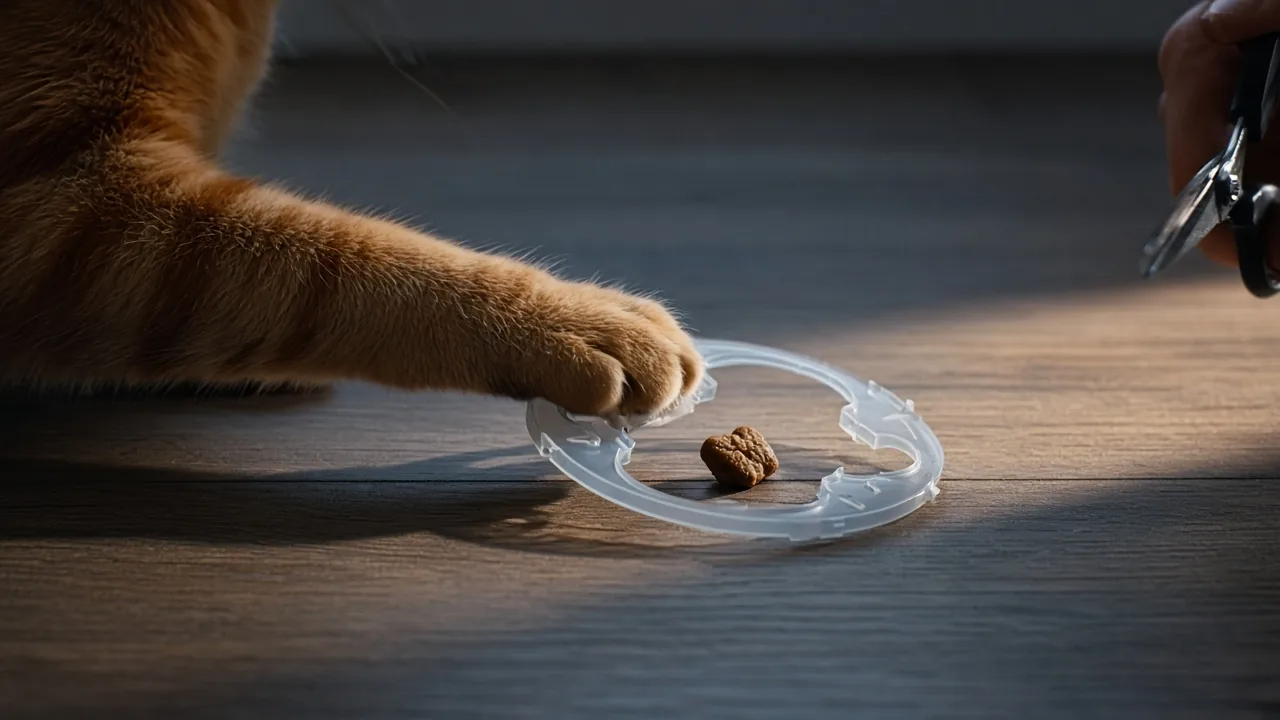
An empty plastic water bottle, cut into short rings, mimics the texture and resistance of real prey when a cat paws and mouths it. Tucking freeze-dried treats inside each ring turns that texture into a rolling, food-dispensing toy that costs nothing beyond the bottle you were already going to recycle.
The appeal here is movement combined with food. As the ring rolls across the floor, the treat shifts position inside it, which keeps a cat batting and chasing rather than losing interest after one swipe.
Materials and Step-by-Step Instructions
You need a clean, empty plastic water bottle, a pair of scissors, and a handful of freeze-dried treats small enough to fit through the bottle’s natural curve.
- Rinse the bottle and let it dry completely so no sugary residue is left inside.
- Cut the bottle into short rings, roughly 1 to 1.5 inches wide, discarding the cap and the very top and bottom sections.
- Smooth any rough or sharp cut edges with the scissors or a light pass of sandpaper if needed.
- Tuck one or two freeze-dried treats inside each ring.
- Roll the ring across a hard floor near your cat to get the game started.
Replace the rings once the plastic edges start to soften or crack from repeated biting, since worn plastic is more likely to splinter.
How to Build a Hanging Paper Cup Treasure Hunt Toy
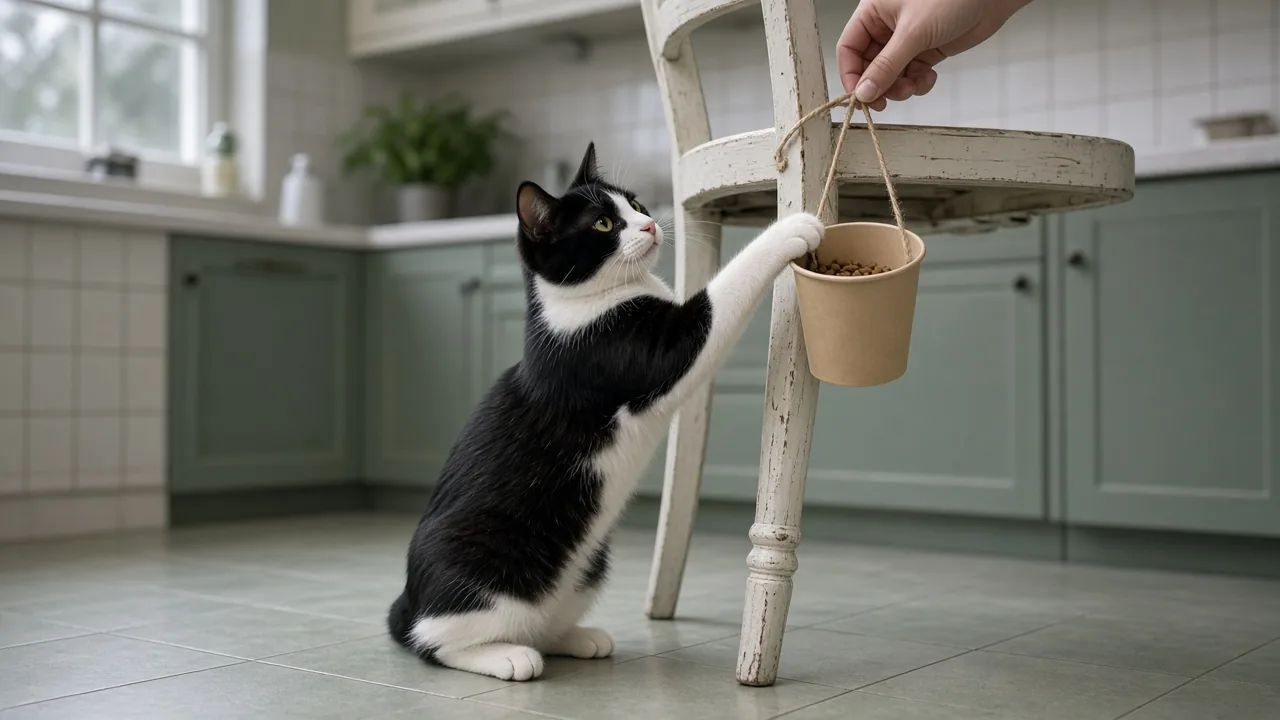
Punching holes in a paper cup, threading string through them, and suspending the cup from a table leg creates a puzzle that moves in response to your cat’s own paw and nose. Because the cup hangs and swings, your cat has to approach it from different angles, which encourages batting, reaching, and a bit of problem-solving rather than a single swipe-and-done interaction.
This build works well for cats who enjoy a more active, standing-and-reaching style of play, since the toy stays off the ground and asks for a bit more effort than a stationary puzzle.
Materials and Step-by-Step Instructions
You’ll need one paper cup, a length of string or twine, scissors, and a small amount of treats.
- Use the scissors to carefully punch two small holes near the top rim of the cup, directly across from each other.
- Thread the string through both holes and tie it off so the cup hangs level.
- Tie the other end of the string to a table leg or chair leg at a height your cat can reach while standing or stretching.
- Drop a few small treats into the cup before each play session.
- Let the cup hang at rest so your cat has to approach and nudge it to get the treats moving.
Trim any loose string ends before each session, since dangling thread is a common swallowing hazard for cats that like to chew on string toys.
How to Turn an Egg Carton Into a Treat-Digging Puzzle
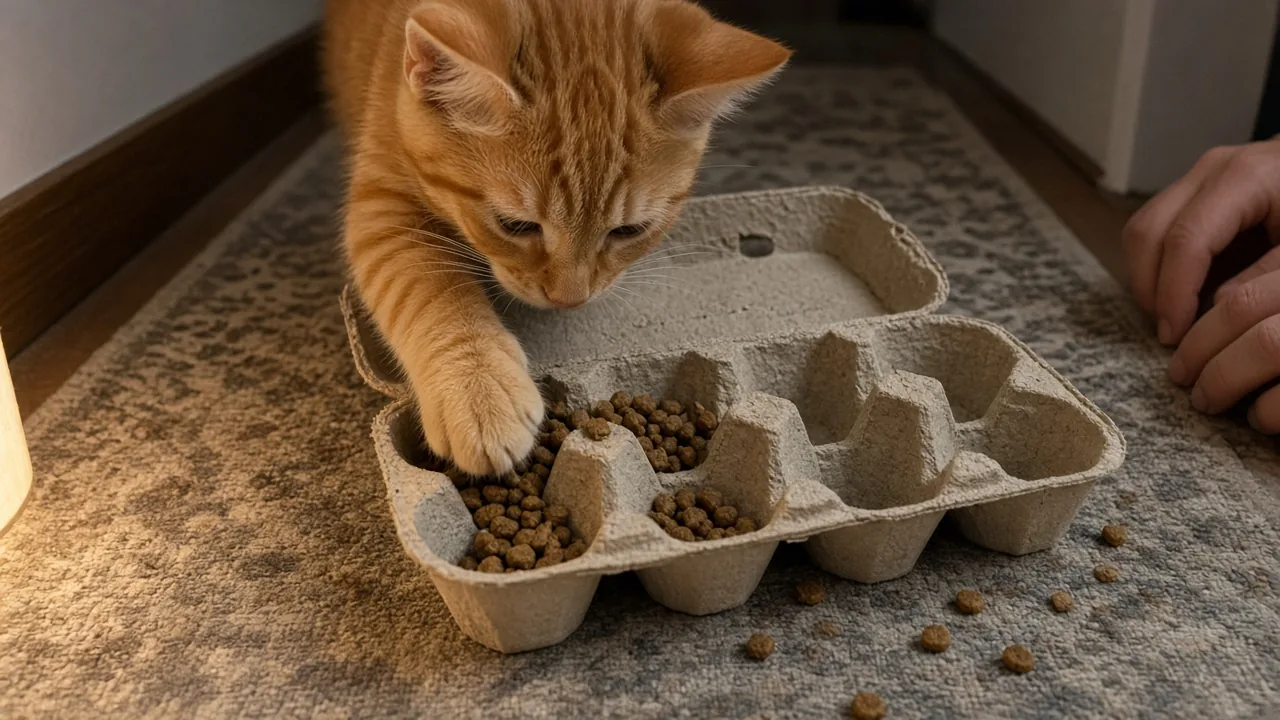
Dropping treats or kibble into each cup of an empty egg carton and setting it on the floor makes the simplest digging-style puzzle of the three. There’s no cutting, no assembly, and no learning curve, which makes it a reliable starting point if you’re not sure how your cat will respond to DIY toys in general.
This build suits kittens still learning to use their paws for food retrieval, as well as older cats who may not want to work as hard for a reward as a hanging or rolling toy demands.
Materials and Step-by-Step Instructions
All you need is an empty egg carton and a scoop of kibble or freeze-dried treats.
- Open the egg carton flat so each individual cup is accessible.
- Drop a small amount of kibble or freeze-dried treats into several of the cups, varying the amount so some cups have more than others.
- Set the carton on the floor in an area your cat already likes to spend time in.
- Let your cat use its paws and nose to dig the treats out of each cup.
Because cardboard softens quickly once it gets damp from saliva, plan on this being a short-lived build rather than something you reuse for weeks.
Comparing the Three DIY Food Puzzle Toys: Material, Difficulty, and Play Style
Each of these three builds rewards a different hunting behavior, so the right one for your cat depends on whether it prefers batting, reaching, or digging.
| Toy | Material | Prep Time | Cleaning | Best Play Style |
|---|---|---|---|---|
| Water bottle roller | Plastic | A few minutes of cutting | Wipe rings with warm water | Batting, chasing |
| Hanging paper cup | Paper, string | A few minutes of punching and tying | Replace, don’t wash | Reaching, batting |
| Egg carton puzzle | Cardboard | None | Replace, don’t wash | Digging |
If your cat tends to chase moving objects across the floor, start with the water bottle roller. If it likes to stand up and reach for things, try the hanging cup. If it’s more of a methodical, nose-down investigator, the egg carton puzzle tends to be the easiest win.
Which Cats Are a Good Fit for These DIY Puzzle Toys
Food-motivated indoor cats and kittens tend to engage with these builds quickly, since the whole design is based on a reward they already want. Cats who get restless from a lack of mental stimulation during the day are also good candidates, since digging and batting for treats gives them something to focus on besides pacing or scratching furniture.
Not every cat will take to these right away. A cat with little interest in treats in general may ignore any of the three builds regardless of how it’s presented, in which case switching to a favorite wet food smear instead of dry treats may help. Cats with dental sensitivity or missing teeth may struggle with harder freeze-dried pieces, so softer fillings or a smaller amount of kibble crushed finer can make the puzzle more comfortable to work at.
If your cat shows no interest in any food-based puzzle after several calm attempts, that’s worth mentioning to your vet, since a sudden drop in food motivation can sometimes point to a dental or health issue rather than simple pickiness.
How to Introduce a New DIY Toy So Your Cat Actually Uses It
Cats often need several short, low-pressure exposures before they engage with something unfamiliar sitting in their space. A toy that gets completely ignored on day one isn’t necessarily a failure; it may just need another day or two before curiosity takes over.
A few things that help a new DIY toy get noticed:
- Place it in a spot your cat already walks through often, rather than a corner it rarely visits.
- Add a stronger-smelling treat the first time or two to draw initial interest.
- Avoid hovering or pushing the toy toward your cat, since that can make a hesitant cat back off further.
- Try again at a different time of day if the first attempt gets no response, since energy levels shift throughout the day.
Giving a toy three or four separate short sessions before deciding it’s not a match gives a more accurate read than judging off one quiet afternoon.
Safety Checks: What to Watch for With Homemade Cat Toys
Before every play session, take a quick look at the toy’s condition rather than assuming yesterday’s setup is still fine today. Homemade toys wear down faster than anything built for pet use, so the checks matter more here, not less.
Look specifically for:
- Cracked or softened plastic rings on the water bottle roller, which can splinter into sharp pieces as your cat chews.
- Frayed cardboard edges on the egg carton that have gone soft or started to tear into small flakes.
- Loose string ends on the hanging cup that your cat could chew off and swallow.
If any of these show up, retire that specific toy and rebuild a fresh one rather than trying to patch it. The materials cost nothing, so there’s no reason to keep using a worn one just to avoid five minutes of rebuilding.
How Often to Replace or Rebuild These DIY Toys
Cardboard and paper soften with saliva and ambient moisture far faster than plastic does, so egg cartons and paper cups generally need rebuilding every few play sessions rather than being reused indefinitely. The water bottle roller holds up longer since plastic doesn’t absorb moisture the same way, but it should still be checked for cracking each time you bring it out.
As a rough guide:
- Egg carton puzzle — rebuild after it’s been dug through a handful of times or as soon as it feels damp or soft.
- Hanging paper cup — rebuild once the cup shows tooth marks, soft spots, or the string starts fraying.
- Water bottle roller — reuse until the plastic shows cracks or the cut edges roughen from chewing, then rebuild.
Since none of these builds take more than a few minutes, treating them as disposable rather than permanent keeps the play experience safer without any real added effort.
How to Clean and Rotate Homemade Treat Puzzles
The water bottle roller can be wiped down with warm water between uses to keep bacteria from building up around the treat residue inside each ring. Paper- and cardboard-based toys like the hanging cup and egg carton are better off replaced than washed, since soaking them defeats the point of a quick, disposable build.
Rotating which toy is available week to week also helps keep your cat’s interest from flattening out. A cat that’s had the same water bottle roller sitting around for two straight weeks may walk right past it, then show fresh interest once it reappears after a break and a different toy has had its turn.
Frequently Asked Questions About DIY Cat Puzzle Toys
Can I just toss a pipe cleaner on the floor instead of building one of these?
A pipe cleaner can hold a cat’s attention for a few minutes since the shape and texture mimic a bug or small prey item. It doesn’t offer the food-reward element that makes these three builds effective for longer engagement, and pipe cleaners can be swallowed in pieces if your cat chews on the ends, so supervise closely if you use one.
My cat threw up a bit of white foam after playing with a new toy. What does that mean?
Mild foamy vomiting on occasion, especially after active play or on an empty stomach, isn’t unusual in cats and often resolves on its own. If it happens repeatedly, is accompanied by lethargy or appetite loss, or you suspect your cat may have swallowed a piece of the toy, call your vet rather than waiting it out.
Watch whether your cat gravitates toward batting, digging, or stalking before settling on one of these builds as a regular rotation piece, and retire any homemade toy the moment it frays, softens, or starts shedding loose pieces. Checking homemade toys as carefully as you’d check a store-bought one, and rotating a few builds instead of leaning on just one, tends to keep both safety and interest where they need to be.
This article is for general information only and is not a substitute for advice from your veterinarian. Always supervise your pet with a new toy, and replace any toy that is damaged or small enough to swallow.

Contributor
admin
Continue reading
All stories
CAT TOYS · 11 October
How to Retract a Cat Wand Toy: A Step-by-Step Guide for Telescopic Wands
CAT TOYS · 11 October
Are Cat Tunnels Safe for Cats? Entrapment Risks and Safer Sizing Tips
CAT TOYS · 11 October
Responses
Moderated discussion