SMALL PETS & BIRDS
Why Won’t My Guinea Pigs Bond With Each Other? What’s Normal
If your guinea pigs still chase, mount, or pee on each other after weeks of bonding steps, it doesn't always mean the bond failed. Learn how to tell normal dominance behavior from real red flags.
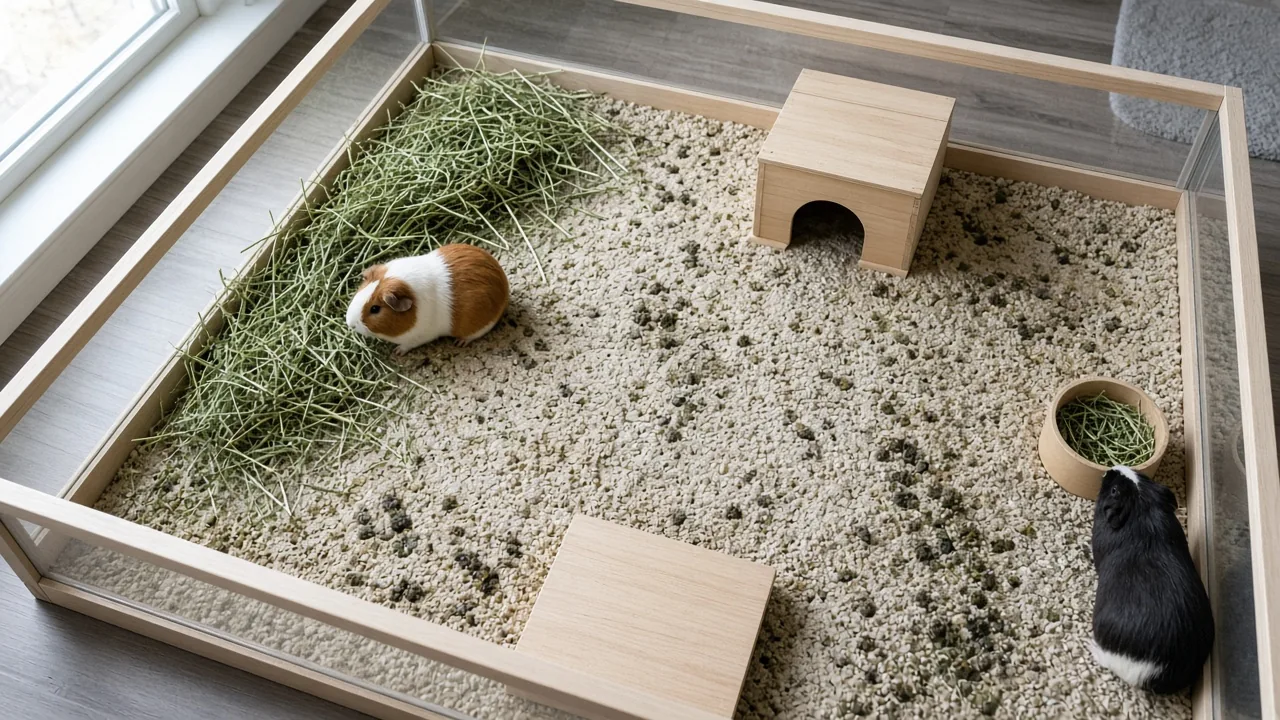
If you’re asking why won’t my guinea pigs bond with each other after weeks of effort, the short answer is that chasing and peeing often continue because bonding is a slow status negotiation, not a switch that flips once you’ve done the right steps. Some pairs settle into a tense but stable coexistence instead of becoming best friends, and that outcome is more common than most bonding guides admit.
Picture this: you’ve done the scent swaps, the shared outings, the joint baths. A month in, one guinea pig is still chasing the other around the cage, and you’re wondering if you did something wrong. In most cases, you didn’t. You’re just watching two animals work out a hierarchy that doesn’t always end in cuddles.
Why won’t my guinea pigs bond with each other even after bonding steps
Hands-on bonding methods exist for good reason. Letting two guinea pigs live side by side in separate enclosures, swapping their bedding and hideouts so each one gets used to the other’s scent, and taking them on a joint outing in a carrier bag can all lower the shock of a first meeting. These steps reduce panic and sudden aggression, which matters.
What they don’t guarantee is a conflict-free pair. One pet owner who tried scent-swapping, forced close contact, joint baths, and even shared vegetable snacking over the course of a month still ended up with a pair that chased, mounted, and marked territory on each other well past the introduction phase. The bonding steps softened the process. They didn’t erase the hierarchy-building behavior underneath it.
This matters for how you set expectations. Bonding methods are tools for reducing injury risk during introductions, not promises of friendship. If you treat them as a guarantee, every bit of chasing after week two will feel like failure, when it may just be two guinea pigs still sorting out who’s in charge.
Why do guinea pigs chase and mount each other during introductions
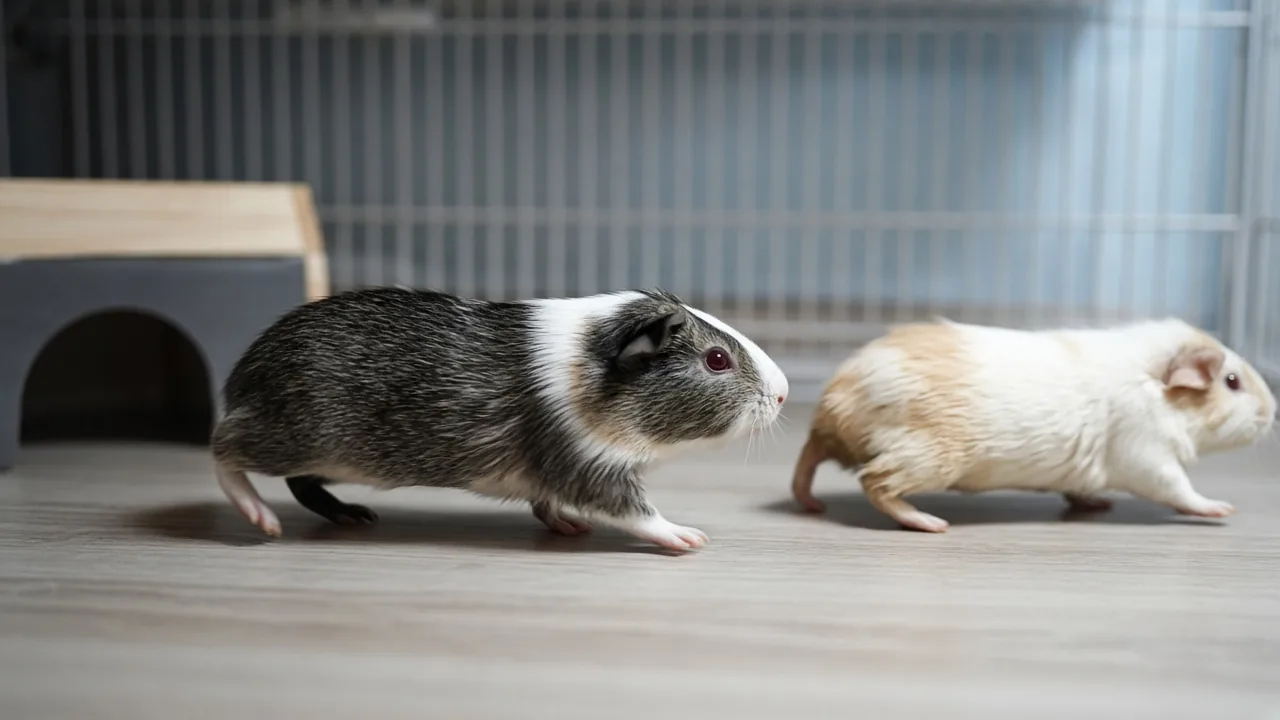
Chasing, pinning, and mounting look alarming the first time you see them, but they’re usually dominance-establishing behaviors rather than random aggression. One guinea pig is asserting itself as the higher-ranking animal, and the other is either submitting or pushing back. This is normal guinea pig social behavior, not a sign that the pair hates each other.
The behavior to actually watch for isn’t chasing itself. It’s escalation into real injury:
- Bite marks that break skin, especially around the ears, rump, or feet
- One guinea pig hiding constantly and refusing to eat or drink
- Fur loss from repeated bites rather than normal shedding
- A guinea pig that won’t stop fleeing even when there’s nowhere left to run
If you’re seeing those signs, separate the pair and reassess, ideally with guidance from a vet or an experienced small-animal rescue. If what you’re seeing is one guinea pig chasing another across the cage and occasionally pinning it for a few seconds before both go back to eating hay, that’s within the range of normal dominance behavior that owners report lasting for weeks.
Mounting specifically can confuse new owners because it looks sexual but is often about rank, even between same-sex pairs. It’s uncomfortable to watch, but on its own it isn’t a reason to split up a pair.
Why do guinea pigs pee on each other or in each other’s bowls
Guinea pigs scent-mark through urination, and a cagemate peeing on the other, in a shared food bowl, or near a contested hideout is usually a territory and resource-guarding signal rather than evidence that bonding has failed. One owner described her more dominant guinea pig repeatedly marking the submissive one through "showdown peeing," along with claiming food and favorite spots, for the entire month of their introduction process.
This behavior tends to show up most around resources the pair considers valuable: food, a preferred hideout, or a spot near the water bottle. The pattern often looks like this:
- One guinea pig claims a bowl, hideout, or hay pile.
- The other approaches or tries to share it.
- The dominant guinea pig chases, pins, or pees to reassert the claim.
- Both animals go back to normal behavior within minutes.
If that cycle repeats daily without getting worse, it’s frustrating to clean up after, but it isn’t the same as a bond that’s broken. It’s closer to two roommates who still haven’t agreed on whose side of the fridge is whose.
Does adding more hideouts, bowls, or litter boxes stop the fighting
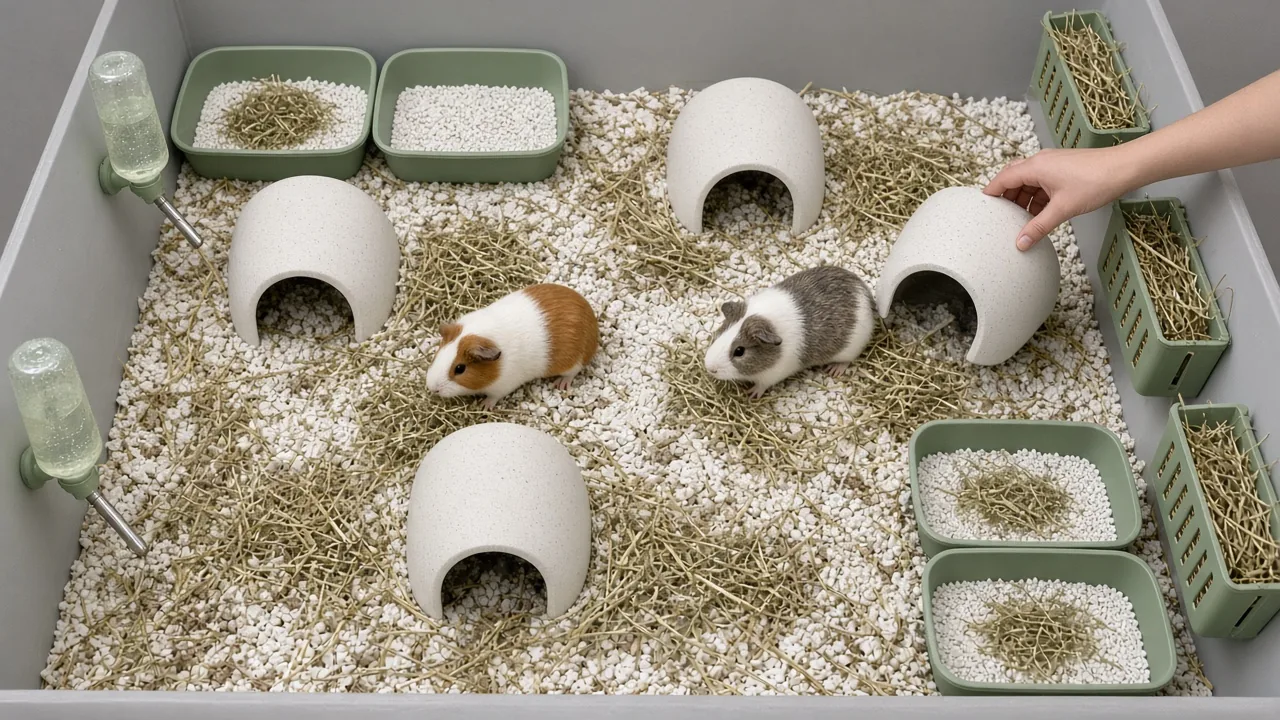
Doubling up on identical hideouts, hay racks, water bottles, and litter boxes can reduce some competition, and it’s worth trying before you assume a pair simply can’t live together. One owner upgraded her setup to two litter boxes, four matching hideouts, three hay racks, and two water bottles specifically to cut down on resource guarding.
The catch: even with that much redundancy, the guinea pigs in that setup still fought over whichever hideout, hay pile, or bowl the other guinea pig happened to be using at that moment, not whichever one was simply available. Guinea pigs can care less about having "enough" and more about not wanting the other one to have what they currently want.
That doesn’t mean extra supplies are a waste. They still shrink the number of flashpoints and give a submissive guinea pig more places to retreat to. Just don’t expect doubling your hideouts to end the conflict entirely. Think of it as damage control rather than a cure.
A few practical notes on choosing those extra supplies:
- Buy hideouts in matching styles and sizes so neither guinea pig can claim the "better" one
- Place hideouts with two entrances where possible, so a chased guinea pig isn’t trapped in a dead end
- Space water bottles and hay racks on opposite sides of the cage rather than clustering them together
How to tell if your guinea pigs are actually bonding despite the drama
Cage behavior isn’t the only signal worth watching. A useful sign of real bonding is whether the pair voluntarily clusters together or settles into a calm, consistent order during floor time outside the cage, even if things stay tense inside it.
One owner found that her two guinea pigs, who chased and marked territory inside their cage daily, would consistently gravitate toward each other once let out to roam, use an open litter box side by side without conflict, and even develop a repeatable "line order" when moving between spots. That kind of voluntary closeness outside the cage suggests the pair isn’t actually rejecting each other. They’re negotiating rank inside a space that feels competitive, while choosing proximity when the pressure is off.
If you want a quick read on your own pair, try this during a supervised floor-time session:
- Do they end up near each other without being forced to, or do they stay as far apart as the space allows?
- Does one guinea pig trail the other calmly, or does it chase with pinned ears and aggressive lunges?
- Do they relax enough to groom themselves or nap near one another?
Calm closeness during open play, even for a few minutes, is a better bonding indicator than a quiet cage. A quiet cage can just mean one guinea pig is too intimidated to move.
Is it my guinea pigs’ breed or personality causing bonding problems
It’s tempting to look for a breed-based explanation when a pair won’t settle down, but the pattern that shows up most often points to individual temperament rather than breed. Some pairs simply have incompatible personalities, the same way two people can both be perfectly nice and still clash as roommates.
This lines up with what other owners report. One guinea pig keeper described two of her own sows fighting consistently and assumed it was a breed mismatch, only to conclude afterward that it wasn’t about breed at all. In her words, some guinea pigs just can’t live together, regardless of what breed pairing you try. That conclusion, drawn from direct experience with a pair that never settled despite real effort, is a more reliable guide than assuming any particular breed is the problem.
If you’re choosing a second guinea pig and want to improve your odds, a few general patterns can help, though none of them guarantee success:
- Pairs introduced young, before either has established strong territorial habits, often adjust faster
- Two guinea pigs with calmer individual temperaments tend to clash less than two highly dominant personalities paired together
- A guinea pig that was previously the submissive partner in another pairing may settle more easily into a new submissive role
None of this is a formula. Personality is still the biggest variable, and it’s one you can’t fully predict before the two guinea pigs actually meet.
When should you accept guinea pig conflict instead of trying to fix it
At some point, the question shifts from "how do I stop this" to "do I need to stop this at all." If chasing and peeing stay stable, without real injuries, after weeks of consistent effort, it’s reasonable to accept a cycle of friction and affection rather than force a split or rehome either guinea pig.
One owner who went through roughly a month of structured bonding work, including separated housing, scent swapping, joint outings, and shared baths, ultimately reached that conclusion herself. The chasing and marking never fully stopped. But she decided the behavior had plateaued at a level she could live with, rather than something that needed fixing through separation.
A reasonable way to decide where your own pair falls:
| Signal | Likely okay to continue | Consider separating |
|---|---|---|
| Chasing | Brief, no injuries, both resume normal activity after | Prolonged, frantic, one guinea pig can’t escape |
| Peeing/marking | Occasional, tied to food or hideout disputes | Constant, one guinea pig stressed to the point of hiding full-time |
| Mounting | Occasional, rank-related | Combined with aggressive biting |
| Outside-cage behavior | Pair clusters or stays calm together | Pair avoids each other entirely even outside the cage |
| Body condition | Both eating, drinking, gaining or holding weight normally | Either guinea pig losing weight or avoiding food |
If your pair lands mostly in the left column, ongoing friction may just be part of how this particular pair coexists. If you’re seeing patterns from the right column, that’s a reason to talk to a vet or an experienced guinea pig rescue about whether separate housing makes more sense for both animals’ welfare.
How to pick cage accessories that reduce bonding stress without wasting money
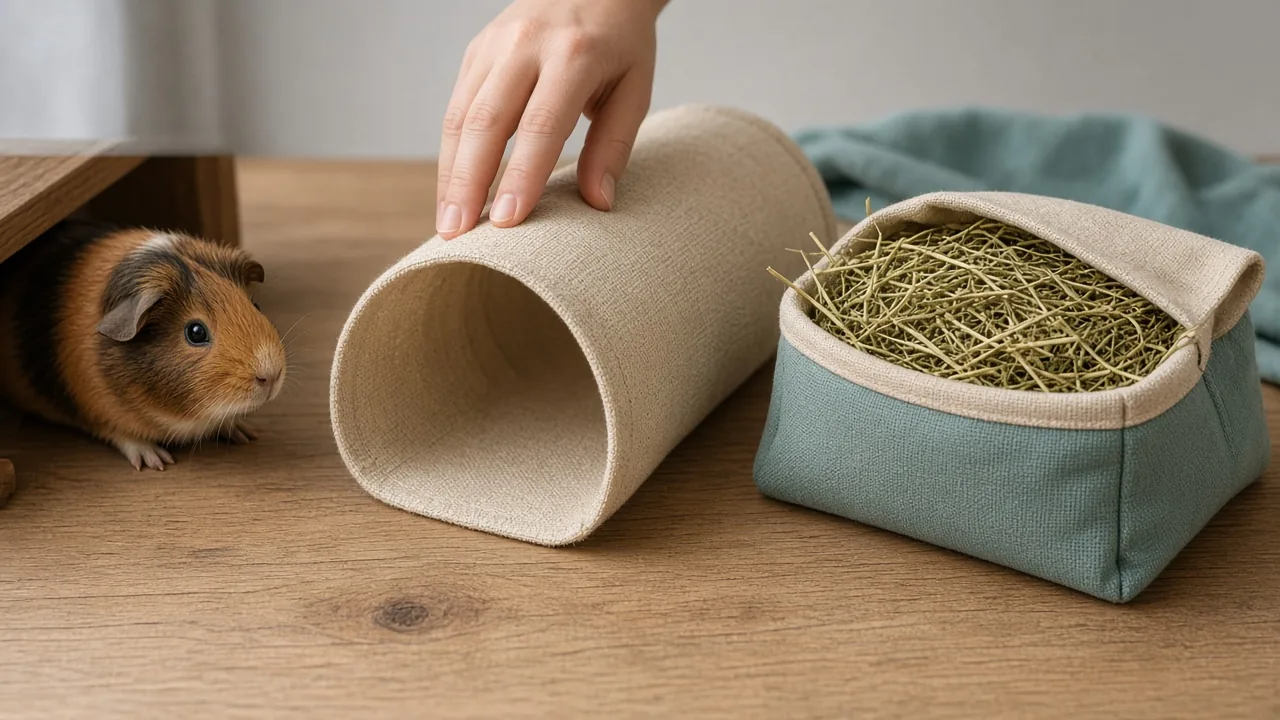
Once you’ve accepted that some tension may be permanent, it’s worth spending your money on accessories that actually get used rather than ones that look good in a listing photo. Tunnel and hideout toys marketed for guinea pigs often run smaller and pricier than their photos suggest, so checking exact size specs matters more than trusting the packaging.
A pet owner who tested several popular guinea pig products bought from a major online marketplace found that none of them were cheap, since none came from well-known brands, yet all were priced as if they were. A three-entrance tunnel toy with an elastic frame that pops open into shape cost around $13. A koala-shaped guinea pig bed came in three sizes, and even the largest one left an adult guinea pig struggling to turn around inside it, at a price of roughly $15. A vegetable-shaped foraging mat with fabric "carrot" and "pineapple" treat pouches, also around $15, got torn apart within days because the fabric wasn’t built to survive guinea pig teeth.
Her conclusion was straightforward: the tunnel held up best and got the most consistent use, but she felt a fair price for it was closer to $5 to $7, not $13. The koala bed and foraging mat, in her view, should have cost closer to $4 to $5 given how quickly they wore out or how undersized they turned out to be.
What this means for your own shopping list:
- Check the listed dimensions in inches, not just the product photos, before buying any hideout or bed
- Expect "multi-size" tunnels and beds to run smaller than they look online
- Treat fabric foraging toys with sewn-on decorative pieces as short-lived chew toys, not long-term investments
- Compare the price against simpler alternatives, like a hay-stuffed basket, before paying a premium for a themed design
Are multi-species guinea pig toys actually sized for guinea pigs
Products labeled as suitable for hamsters, guinea pigs, and rabbits all at once are frequently sized for the smallest animal on that label, which usually means the hamster. A tunnel or bed that looks roomy in a product photo can leave an adult guinea pig unable to turn around once it’s actually inside.
This isn’t a one-off complaint. Shoppers browsing the same kinds of listings have pointed out the same mismatch, noting that it’s hard to imagine a rabbit fitting into a space advertised as also suitable for a hamster. The sizing on the label often reflects marketing reach rather than an actual fit check across species.
Before buying anything marked for multiple small pets, look specifically for:
- Interior dimensions in inches, not just overall product size
- Any size chart that breaks down recommended use by species or weight
- Photos that include a guinea pig specifically, not just a hamster or rabbit, for scale
If the listing only shows a hamster next to the product, assume the real-world fit for a guinea pig will be tighter than it looks.
Which guinea pig enrichment toys are worth buying during a tense introduction period
During a stressful bonding period, simple, reliable items tend to earn their keep better than elaborate ones. Across tested products, a plain fabric tunnel got the most consistent use, while fray-prone foraging mats and undersized beds disappointed relative to their price.
A few reasons a basic tunnel tends to perform well during introduction stress:
- It gives a submissive guinea pig a place to retreat into and feel enclosed
- It folds flat for storage when you need to rearrange the cage for a new bonding attempt
- It’s less likely to become a single contested resource the way a bed or hideout can
Foraging mats with sewn-in fake vegetables, by contrast, tend to get destroyed quickly since guinea pigs will simply pull the decorative piece off the mat and chew it like a toy, which defeats the "slow feeding" purpose the product is designed for. A hay-stuffed basket does the same enrichment job for less money and less wasted material, since the hay itself is both the toy and the thing getting eaten.
If you’re buying for a pair that’s actively working through dominance behavior, prioritize:
- Multiple identical tunnels or hideouts over one elaborate single piece
- Items that are easy to wipe down or wash, since marking behavior means more frequent cleaning
- Simple designs over highly decorated ones, since decoration is usually the first thing to get chewed off
Frequently asked questions about guinea pig bonding and cage setup
Is the motorboat-like rumbling noise my guinea pig makes a sign of aggression?
That low, motor-like rumbling is often linked to dominance or courtship displays rather than pure aggression, though it can show up alongside tense behavior during introductions. Pair it with the guinea pig’s body language and the surrounding behavior rather than treating the sound on its own as a danger sign.
Can wire mesh cage grids cause injuries during chasing?
Metal grid flooring or walls can pose a snagging risk if a guinea pig’s foot or leg gets caught while running or being chased, and some owners prefer solid bar-style enclosures specifically to avoid this during active introduction periods. If your current setup uses mesh flooring and your pair chases often, switching to a solid-floor cage or adding a liner can reduce that risk.
How long should I expect introductions to take before judging whether it’s working?
Give it at least a few weeks of consistent, supervised contact before drawing conclusions, since many pairs show their worst behavior early on and settle somewhat afterward, even if full peace never arrives.
Should I separate my guinea pigs permanently if peeing and chasing never fully stop?
Not necessarily, as long as there’s no real injury and both guinea pigs are eating, drinking, and behaving normally outside of the conflict moments. If you’re ever unsure whether what you’re seeing has crossed into harmful territory, a vet or experienced small-animal rescue can help you assess the specific behavior.
Watch how your own pair behaves outside the cage, during floor time or a trip to a new room, before deciding the bond is a failure. At the same time, keep an eye on your tunnels, hideouts, and foraging toys for fraying fabric, chewed-through fabric pieces, or flattened padding, and swap them out once they stop holding their shape, since that’s usually a better sign of when to replace than a fixed timeline.
This article is for general information only and is not a substitute for advice from your veterinarian. Always supervise your pet with a new toy, and replace any toy that is damaged or small enough to swallow.

Contributor
admin
Continue reading
All stories
SMALL PETS & BIRDS · 11 October
Best Cat Litter Box for Rabbits: Safe, Easy-Clean Picks
SMALL PETS & BIRDS · 11 October
Why Do Parrots Need Shreddable Chew Toys, and What Materials Are Safe?
SMALL PETS & BIRDS · 11 October
Responses
Moderated discussion