SMALL PETS & BIRDS
Best Chew Toys to Stop Parrot Plucking and Boredom
Durable wood chews and rotating foraging toys are among the best chew toys to stop parrot plucking caused by boredom, though plucking can have many causes beyond lack of enrichment.
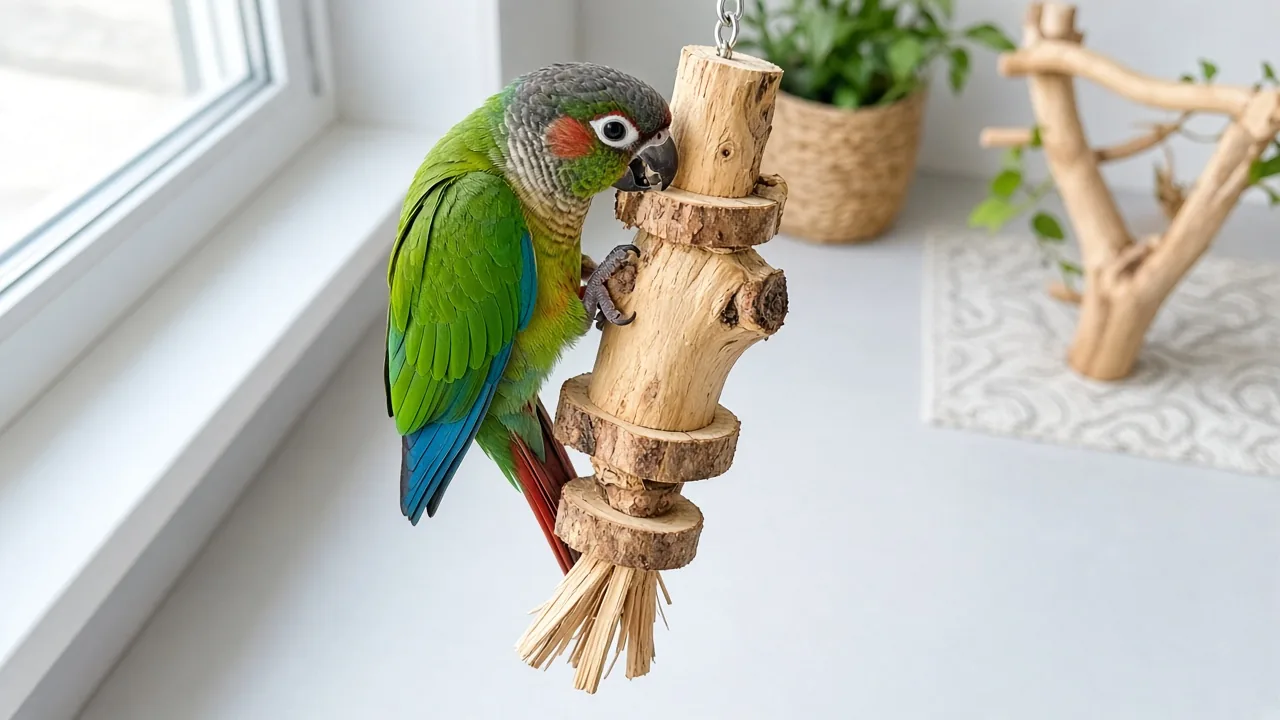
If your parrot is pulling out feathers and you’re hoping a toy will fix it, here’s the honest answer: durable wood chew toys and rotating foraging toys are often among the best chew toys to stop parrot plucking that’s linked to boredom, but plucking has many possible causes, and toys alone may not solve it. Picture a budgie sitting on the same perch all day with nothing to destroy — that bird will often redirect its energy toward its own feathers. Giving it something safe to chew and forage through can help, but it’s one piece of a larger picture.
Why Chew Toys Can Help (and What They Can’t Fix) With Feather Plucking
Parrots in the wild spend hours each day foraging, chewing bark, and manipulating objects with their beaks. A pet bird confined to a cage with little to do often has that same drive but nowhere to put it. When that happens, some birds turn their chewing instinct inward, and feather plucking is one of the results.
Boredom and a lack of foraging opportunity are two of the most common triggers owners report. Giving a bird appropriate things to chew and problems to solve with its beak can reduce the amount of time it spends idle, which in turn can reduce idle plucking in some cases.
That said, plucking is rarely caused by just one thing. Medical issues like skin irritation, nutritional deficiencies, or underlying illness can all drive the behavior, and so can emotional stress — the loss of a cage mate, a move to a new home, or separation anxiety can all trigger plucking that no toy will touch. One owner noticed her bird began plucking after its longtime companion bird passed away, which points to grief rather than boredom as the cause.
Because of this overlap, think of chew toys and enrichment as one tool in a toolkit, not a guaranteed cure. If plucking continues, is severe, or comes with skin redness, bleeding, or weight loss, a veterinarian visit is the right next step before trying more toys.
How to Choose the Best Chew Toys to Stop Parrot Plucking
Picking the right chew toy comes down to three things: your bird’s size, how hard it bites, and whether the material can stand up to that bite without creating hazards. A toy that’s too small, too soft, or too tough can end up ignored, destroyed too fast, or left untouched in the corner of the cage.
Start by watching how your bird already interacts with its cage and perches. A bird that gnaws on wooden perches or cage bars is telling you it wants something to chew. A bird that tosses or shreds paper is telling you something different — it may respond better to foraging-style toys than pure chew toys.
Naturally hard woods tend to be the safer long-term choice for serious chewers because they resist splintering better than softer woods or thin plastics. A toy that crumbles into small, sharp pieces creates a choking risk, while one that holds its shape under repeated chewing gives your bird a satisfying outlet without the mess or danger.
Prioritize toys that are destructible in a controlled way — meaning your bird can make visible progress chewing through them over days or weeks, rather than toys so tough they never show wear (which can leave the chewing drive unsatisfied) or so flimsy they fall apart in one sitting.
Chew Toy Material Comparison: Wood, Plastic, and Rope
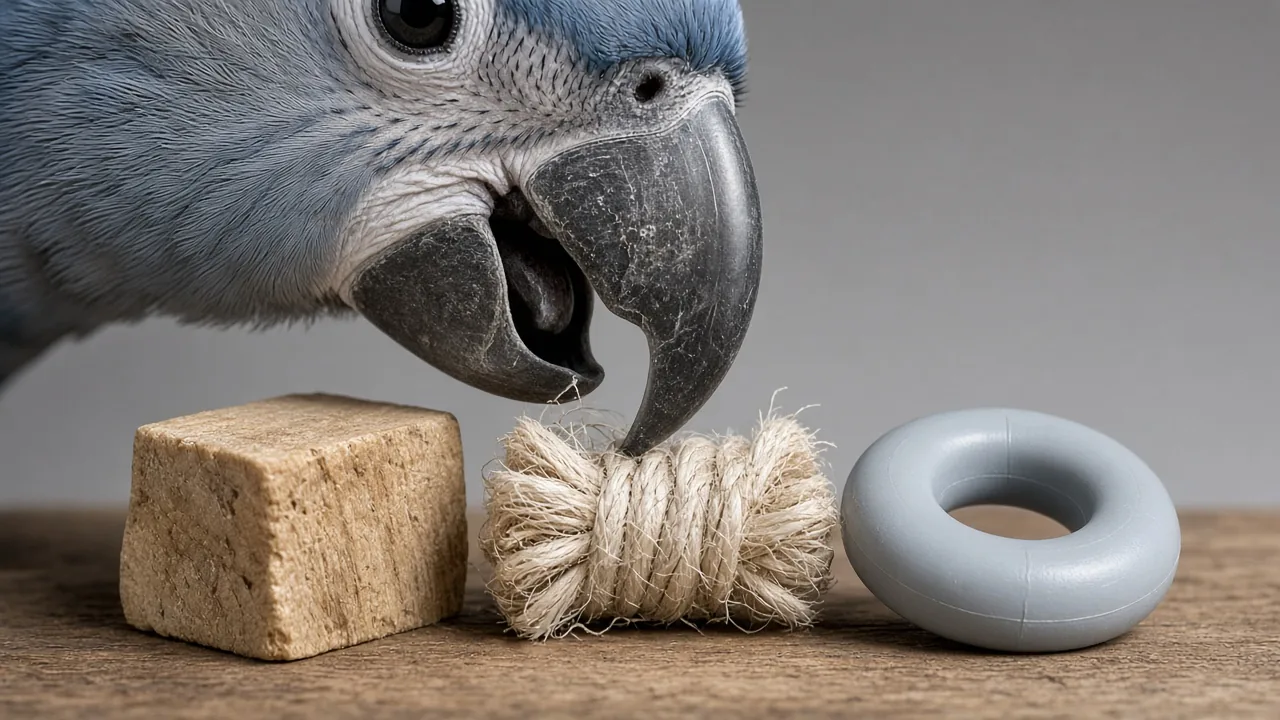
Different materials hold up differently under a parrot’s beak, and knowing the tradeoffs helps you match the toy to your bird instead of guessing.
| Material | Durability | Chew Satisfaction | Monitoring Needed | Best For |
|---|---|---|---|---|
| Hard natural wood (e.g., pear wood) | High — resists crumbling, can last years under regular chewing | High — enough resistance to feel satisfying | Moderate — check edges as it wears down | Most parrots, especially persistent chewers |
| Softer wood | Medium — wears faster, may splinter | Medium-high | Frequent — watch for sharp splinters | Smaller birds with lighter bite force |
| Rope/cotton | Low-medium — fibers fray and loosen | Medium — good for foot-and-beak play, less for pure chewing | Frequent — trim or remove loose threads | Perching, preening-style play, not heavy destruction |
| Hard plastic | Medium — some resist chewing, others crack | Low-medium — many birds prefer wood texture | Frequent — check for cracked or broken pieces | Bath accessories, feeders, less for intense chewers |
Hard natural wood like pear wood stands out because it resists crumbling and can last for years even with daily chewing, while rope and softer plastics tend to wear down faster and need closer, more frequent checks. If your bird is a heavy chewer, wood is usually the safer long-term investment even though it may cost more upfront than a bag of cheaper rope toys.
Choosing Toys by Bird Size: Budgies, Cockatiels, and Lovebirds
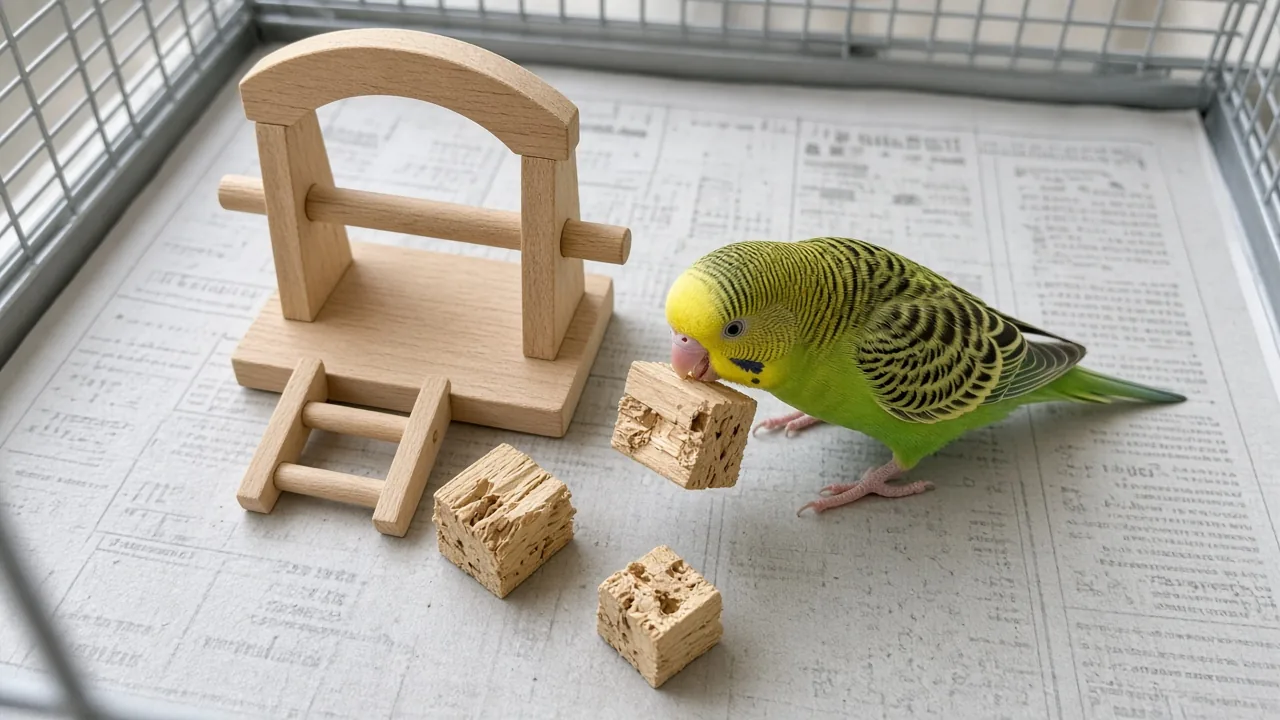
Smaller parrots don’t need — and often won’t use — toys sized for a larger bird. A thick chunk of wood that a macaw could work on for weeks may simply sit unused in a budgie’s cage because the bird can’t get its beak around it comfortably.
For budgies, cockatiels, and lovebirds, look for:
- Scaled-down wood pieces sized for a smaller beak and body
- Playground-style perches built with smaller birds in mind, often in a darker, more natural wood finish
- Multiple small chew items rather than one oversized one, so the bird has choices
One owner’s playground-style perch, made from dark natural wood and sized for small parrots like budgies, cockatiels, and lovebirds, held up for roughly five years of daily chewing by a budgie and still looked close to new. That’s a useful benchmark: if a toy marketed for small birds starts splintering or losing shape within weeks, it’s worth looking for a harder wood or thicker piece instead.
Foraging and Interactive Toys That Keep Parrots Busy
Chewing isn’t the only outlet that matters — foraging toys turn the simple act of eating into a small daily puzzle, which can occupy a bird that would otherwise sit still and pluck.
A tip-and-treat style toy is a good example. These toys are typically shaped like a hollow X, and you fill the center with seeds or small treats. The bird has to tip or rotate the toy so the food drops down into a small tray before it can eat. One owner found her budgies learned this motion in under a day, which suggests most birds pick it up quickly without extra training.
This kind of toy is especially useful for birds that are solitary or seem low-energy, sometimes described as depressed, since it gives them a reason to interact with something instead of sitting idle. It also doubles as light mental exercise, since the bird has to figure out the tipping motion rather than just pecking at a static feeder.
Rotating two or three foraging toys on a weekly basis, rather than leaving the same one out indefinitely, can keep the novelty up — birds often lose interest once a toy’s puzzle becomes too familiar.
DIY Wood Chew Toys vs. Store-Bought Options
If you have the time and a reliable supply of safe, untreated wood, building chew toys at home can be far more economical than buying individual store items. One hobbyist who had already made 200 wood toys for her birds described stringing together several wood segments — in her most recent version, five pieces instead of her earlier two-piece design — into a single hanging toy. A project like that can be finished in a morning and is enough to cover an entire cage with chewable material.
The wood she favors, sometimes called pear wood, is valued for being hard, chew-resistant, and less likely to shed small splinters or dust as it’s gnawed — a meaningful safety point, since crumbly wood debris can be a minor respiratory irritant or choking hazard in large amounts.
Store-bought options have their own advantages. A playground-style perch or a bath-and-feeder combo adds variety that’s harder to replicate at home, and it saves time for owners who don’t have the tools or interest in woodworking. Store-bought toys also tend to come with more consistent quality control on shape and finish, since the wood or plastic has already been processed.
Neither approach is strictly better. DIY wood toys are a cost-effective way to cover a whole cage with safe chewing material, while store-bought playgrounds and combo toys add convenience and variety for owners with less time to spare. Many bird owners end up mixing both — a homemade chew toy for daily destruction, plus a sturdier store-bought playground or bath toy that lasts longer.
Bath Toys and Enrichment for Shy or Untamed Birds
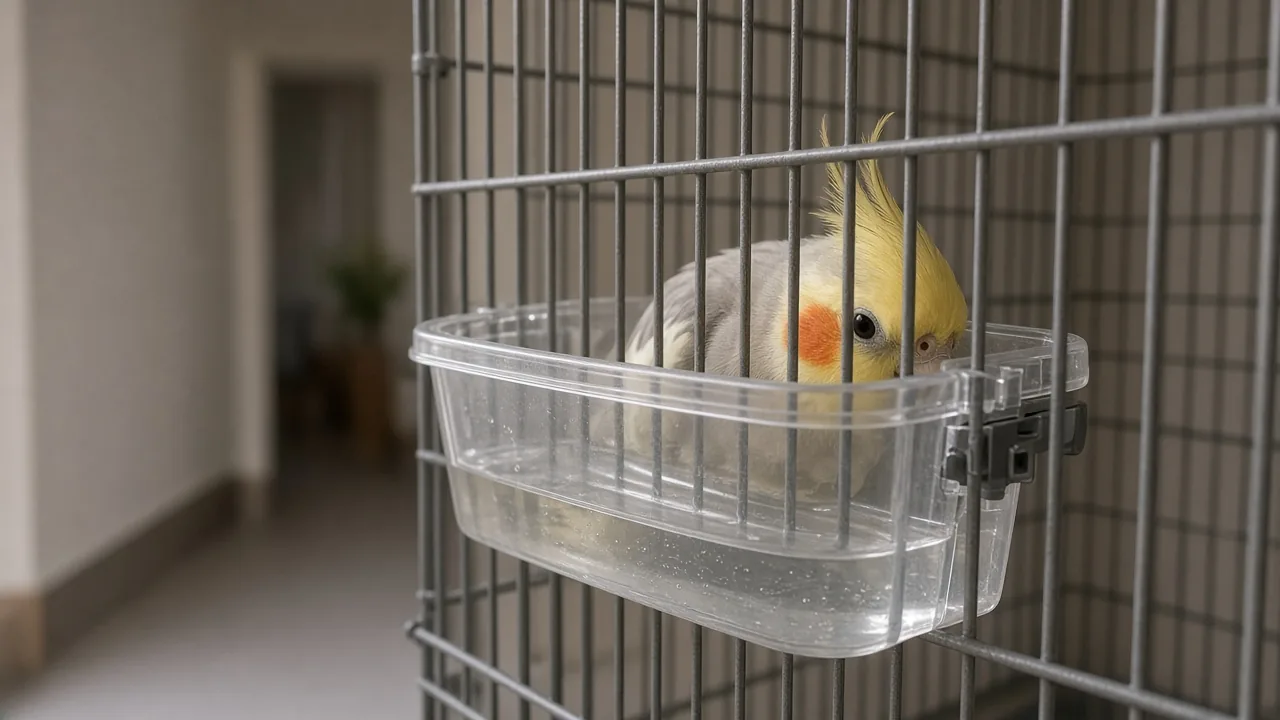
Not every bird is comfortable coming out of its cage to bathe in a separate dish, especially one that’s still untamed or skittish around hands. For these birds, a clip-on bath base that attaches directly to the cage bars can make a real difference.
These bases typically snap onto any bar position inside the cage using a simple clip mechanism. The bath portion can be removed when not in use, leaving just the base clipped in place, and reattached with water when it’s bath time. This setup lets a timid bird bathe inside the familiar space of its own cage, without the added stress of being handled or moved to a new location.
A related option is a larger, transparent bath-and-feeder combo. These units are roomy enough that multiple small to medium-sized birds can bathe together, and one owner reported all three of her budgies bathing in hers at once. The clear plastic design has a practical upside beyond bathing: you can see food, droppings, or water levels at a glance, which cuts down on how often you need to pull it out just to check on it.
Both of these options work well for birds dealing with stress-related behaviors, including some plucking cases tied to anxiety, since they add a calming, low-pressure activity without forcing interaction the bird isn’t ready for.
Are These Chew Toys Safe? What to Check Before Use
No chew toy is risk-free, and checking each one before it goes in the cage takes only a minute but can prevent an injury. Run through this before offering any new toy:
- Look for loose fibers or threads, especially on rope toys, that could wrap around a toe or neck.
- Check wood pieces for sharp splinters or sections that feel soft or flaking, since those can break into dangerously small shards.
- Test any hanging hardware — clips, chains, or S-hooks — to make sure nothing is cracked, bent, or easy for the bird to work loose.
- Confirm there are no small detachable parts, like beads or caps, that are smaller than your bird could swallow.
- Supervise the first time your bird uses any new toy, regardless of material, so you can step in quickly if something unexpected happens.
This applies just as much to a store-bought bath base as it does to a homemade wood chew toy — new doesn’t automatically mean safe, and even a well-made toy can have a manufacturing flaw you’d only catch by handling it directly.
If your bird is a particularly aggressive chewer, check toys more often than you’d think necessary during the first week, since that’s typically when wear shows up fastest and tells you how quickly that particular toy will need replacing.
How Often to Replace Parrot Chew Toys
There’s no fixed schedule that works for every toy or every bird, but the general pattern is: harder materials last longer, and you should replace based on condition, not a calendar date.
Wood toys are ready to go once they’re heavily gouged, cracked through, or splintering at the edges — a hard wood toy chewed by a small bird may hold up for a long stretch, as shown by the five-year-old playground perch mentioned earlier, but a softer wood piece under constant gnawing can wear out in weeks.
Rope and plastic items need more frequent checks because they tend to degrade faster than dense hardwood. Rope frays and loosens with use, plastic can crack or discolor, and both should be pulled the moment you see fraying strands or sharp broken edges rather than left to "see how it goes."
A simple habit that helps: do a quick toy check every time you clean the cage. If you’re already in there wiping down perches, take ten extra seconds to flex or inspect each toy for looseness, cracks, or missing pieces.
How to Clean Bird Toys and Bath Accessories
Clean toys matter as much as sturdy ones — droppings, food residue, and moisture can build up fast in a cage, especially around bath and feeder combos.
Transparent bath-and-feeder designs have a practical edge here: because you can see through the plastic, it’s easy to notice buildup before it becomes a real mess, which makes cleaning more of a quick wipe than a deep scrub. Some of these combo units are also designed so you can rinse them without fully taking them apart, a detail one longtime owner only discovered after eight years of unnecessarily disassembling hers every time. It’s worth checking your specific toy’s design before assuming full teardown is required.
For wood chew toys, a simple rinse under warm water and air-drying is usually enough between heavy use, since you’re mainly removing dust, droppings, and food debris rather than deep-set grime. Avoid soaking wood toys for long periods, as excess moisture can promote mold growth inside the wood.
Rope toys should be checked and spot-cleaned more often, since fibers can trap moisture and bacteria. If a rope toy looks matted, damp, or discolored and won’t come clean with a quick rinse, it’s usually simpler and safer to replace it than keep trying to salvage it.
Frequently Asked Questions About Parrot Plucking and Chew Toys
Will chew toys alone stop my parrot from plucking?
Not always. Chew toys and foraging toys can reduce plucking that’s driven by boredom or lack of stimulation, but plucking linked to illness, pain, or emotional stress — like grief after losing a cage mate — usually needs a different approach, often starting with a veterinary checkup.
My bird is ignoring the new toy I bought. What now?
Give it a few days in a visible spot before assuming it’s a dud — some birds are naturally cautious around unfamiliar objects. If it’s still ignored after a week or two, try moving its position in the cage, or consider that the size or material may not match your bird’s preferences (a budgie may ignore a toy built for a much larger parrot).
Are wood chew toys safe for all parrot species?
Hard, untreated natural wood is generally considered a safe chewing material, but size still matters — a chunk sized for a larger parrot can be too big or tough for a budgie or cockatiel to use comfortably, so match the piece size to your bird.
How do I know if a toy is actually helping with boredom versus just sitting there?
Watch for engagement: a bird that chews, tips, or otherwise interacts with a toy regularly is getting value from it. A toy that’s been untouched for more than a couple of weeks probably isn’t the right fit and can be swapped for something else.
Should I worry about my bird plucking after another bird in the home passed away?
That’s a reasonable concern, since grief and changes in a bird’s social environment are known triggers for stress-related plucking. Extra enrichment can help fill some of the gap, but ongoing or worsening plucking after a loss is worth discussing with a veterinarian or an avian behavior specialist.
Before you buy anything, spend a few days watching how your bird already plays — whether it chews, forages, bathes, or just perches and watches the room — since that tells you more about which toy it will actually use than any label does. Keep checking every toy in the cage for wear on a regular basis, and pull anything cracked, frayed, or missing pieces before your bird finds the weak spot first.
This article is for general information only and is not a substitute for advice from your veterinarian. Always supervise your pet with a new toy, and replace any toy that is damaged or small enough to swallow.

Contributor
admin
Continue reading
All stories
SMALL PETS & BIRDS · 11 October
Do Hamster Wheels Get Too Hot? Checking Axle Safety at Speed
SMALL PETS & BIRDS · 10 October
Do Guinea Pigs Smell Bad Indoors? Causes and Odor Fixes
SMALL PETS & BIRDS · 10 October
Responses
Moderated discussion