SMALL PETS & BIRDS
Do Hamster Wheels Get Too Hot? Checking Axle Safety at Speed
Hamster wheel axles can warm up from friction during long, fast runs, but they rarely get dangerously hot. Here's how to check for normal warmth versus real wear and when to replace a wheel.

If you’ve watched your hamster sprint on its wheel long after the lights go out, you may wonder: do hamster wheels get too hot to be safe? The short answer is that an axle can warm up from friction during a long, fast run, but it rarely reaches a temperature that could burn or melt anything if the wheel is the right size and in good condition. One owner noticed her hamster, Amy, running steadily on a new wheel for several minutes straight before slowing down on her own, with nothing more alarming than a faintly warm axle to show for it.
Why Hamster Wheel Axles Can Warm Up During Fast Running
Any time two surfaces rub against each other, they generate a small amount of heat. A hamster wheel is no exception. The axle sits inside a bearing or sleeve, and every rotation creates friction at that contact point. The faster and longer your hamster runs, the more friction builds up, and the warmer that one spot can get.
Material matters here. Metal axles conduct heat quickly and release it into the air almost as fast as it forms, so they rarely feel more than mildly warm to the touch. Plastic axles, especially ones made from polyethylene, hold onto that warmth a bit longer because plastic is a poorer conductor of heat. That’s why a plastic axle can feel noticeably warmer after a marathon running session than a metal one would under the same conditions, even though neither is actually overheating in a dangerous sense.
This is a normal mechanical process, not a defect. The same friction happens in a bicycle wheel bearing or a ceiling fan motor. The difference is scale: a hamster wheel’s axle is small and spins quickly, so the heat concentrates in a tiny area, which is exactly why it’s worth checking now and then.
Do Hamster Wheels Get Too Hot to Be Safe? What the Evidence Shows
Online, you’ll sometimes see a joke along the lines of "that axle is so hot it could start a fire if it were made of wood." It’s a funny image, but it’s an exaggeration rather than a real safety finding. Mild warmth from friction is a far cry from the kind of heat needed to scorch wood or burn skin.
In practice, a warm axle feels similar to a phone that’s been running a game for a while, noticeably warmer than room temperature but nowhere near hot enough to cause a burn. If you press your finger against the axle right after your hamster hops off and it feels uncomfortably hot, almost too hot to hold for more than a second, that’s unusual and worth investigating. But a gentle, lingering warmth after fifteen or twenty minutes of running is expected and not a sign of danger on its own.
The real safety question isn’t really "do hamster wheels get too hot," since the answer is almost always no under normal use. The better question is whether the wheel is wearing out in a way that increases friction beyond what’s typical, which is what the rest of this guide helps you check.
How to Check Your Hamster’s Wheel for Overheating and Wear
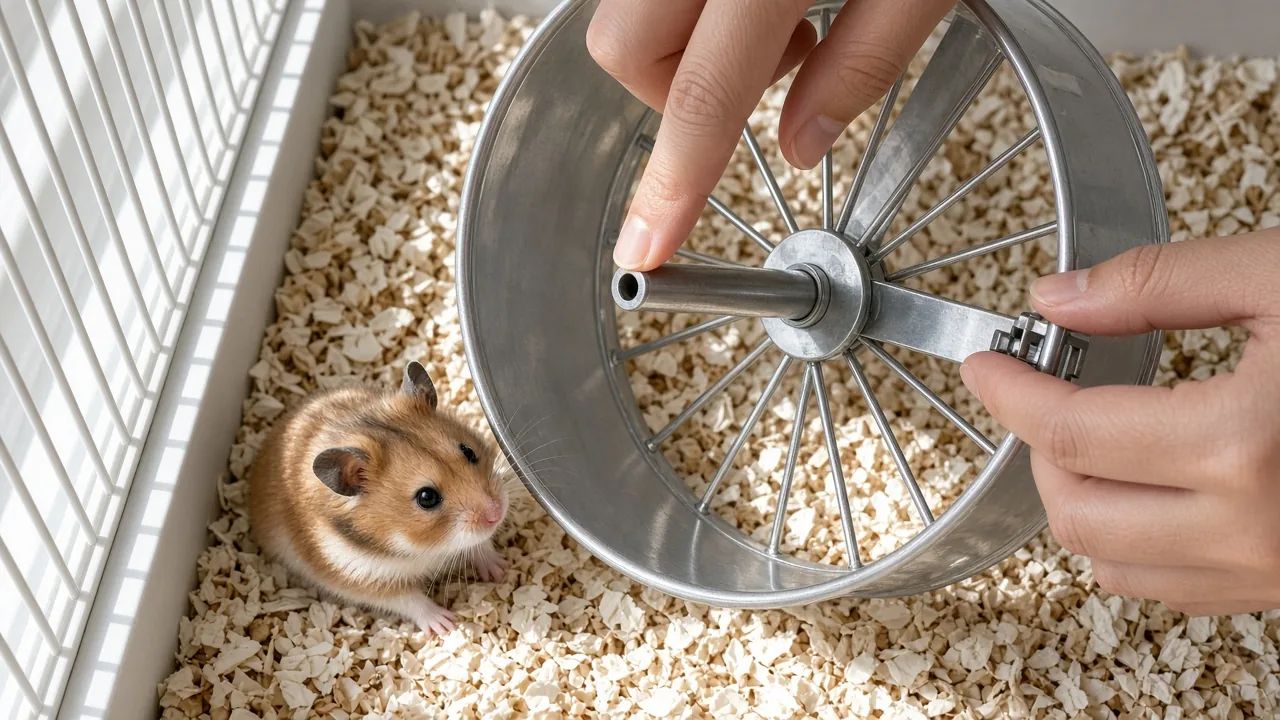
You don’t need any special tools to keep an eye on wheel safety. A quick check after an active play session takes less than a minute and tells you most of what you need to know.
- Wait until your hamster has stepped off the wheel, then wait a moment longer so you’re not startling it.
- Touch the axle and the area around the entry hole with the back of your finger first, since that part of your hand is more sensitive to heat.
- Compare the warmth to what you’d expect from a device that’s been running for a while, like a laptop on your lap. Mild warmth is normal; anything closer to uncomfortably hot is not.
- Look closely at the axle for soft spots, flattened edges, or a shiny, worn groove where it meets the wheel.
- Give the wheel a slow spin by hand and listen for grinding, clicking, or scraping that wasn’t there when the wheel was new.
- Take a quick sniff near the axle. A faint plastic smell after heavy use can be normal, but a sharp, burning, or chemical odor is not and means the wheel should be taken out of the cage until you can inspect it further.
Doing this check every week or two, or any time you notice your hamster running unusually long stretches, helps you catch problems early rather than after something breaks.
Signs a Wheel Axle Needs Replacing
Some cues are clear enough that you don’t need to debate whether it’s time for a new wheel. Watch for:
- Cracking or splitting anywhere on the axle or the point where it attaches to the wheel frame
- A new grinding or squeaking noise that wasn’t present when the wheel was new, which usually points to a worn bearing or dry friction point
- Wobble or uneven spinning when you turn the wheel by hand, which suggests the axle has bent or the bearing has loosened
- Discoloration or a shiny worn patch on the axle that signals repeated heat and friction have changed the material’s surface
Any one of these on its own is a reason to retire the wheel. If you notice two or more together, replace it sooner rather than later, since a worn axle under more friction tends to run hotter and fail faster.
Solid vs Mesh vs Wire Wheels: Which Runs Cooler and Safer
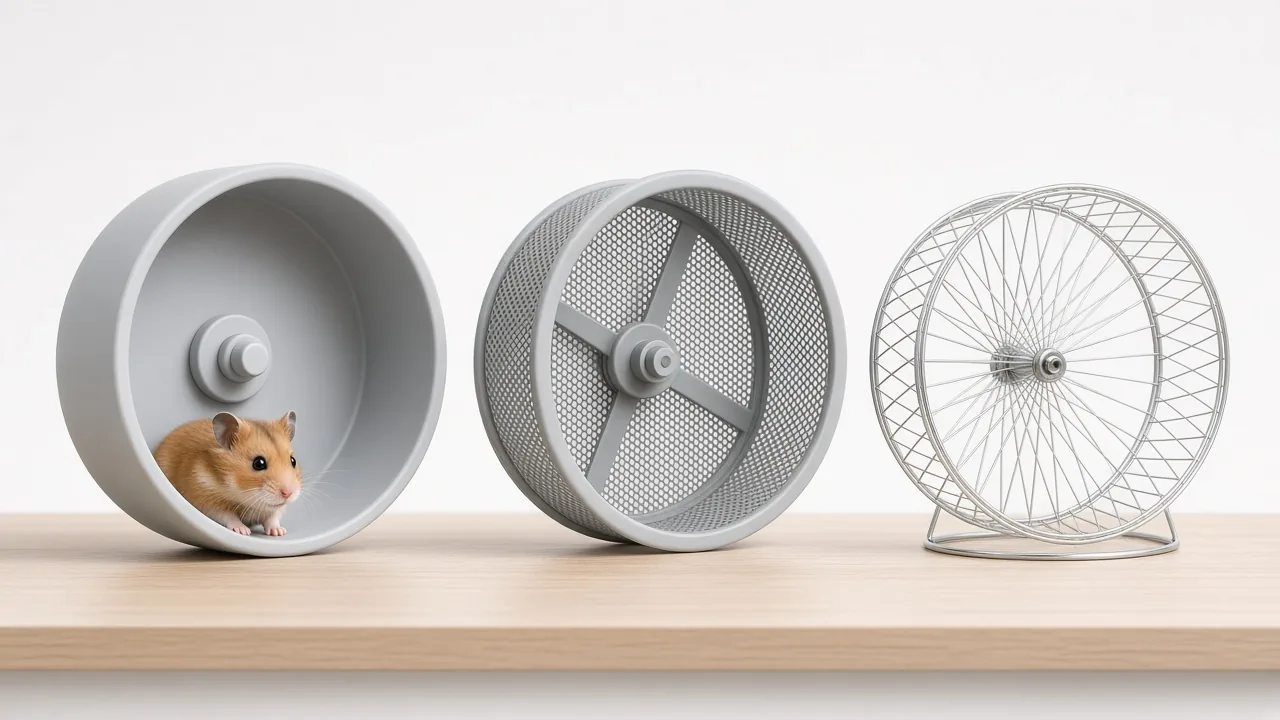
Wheel material affects more than just heat. It also shapes how safe the wheel is for your hamster’s paws, how much noise it makes, and how easy it is to keep clean.
| Wheel Type | Heat Buildup | Paw Safety | Noise Level | Cleaning Ease |
|---|---|---|---|---|
| Solid plastic | Can hold warmth longer at the axle during fast running | Smooth surface, low risk of toes slipping through gaps | Generally quiet if the bearing is in good shape | Easy to wipe down, but surface can scratch over time |
| Mesh | Metal conducts heat away quickly, axle stays cooler | Some mesh patterns can catch small toes or tails, so check gap size | Can be quieter than wire but varies by design | Droppings and bedding can lodge in the mesh holes |
| Wire | Metal dissipates heat well, among the coolest-running options | Open wire rungs carry a real risk of trapped feet or legs, especially for young or small hamsters | Often the squeakiest if not kept oiled or clean | Easy to see and clean, but harder to fully disinfect in the gaps |
Solid-surface wheels are generally the safer pick for paw health, since there’s no gap for a foot or tail to slip into. The trade-off is that a solid wheel, especially one with a plastic axle, may run a touch warmer during long sessions. Wire wheels run cooler at the axle but carry more risk for toes and tails, which is why many small-pet owners who tried wire wheels switched to solid ones after a scare. If you want the lower heat of metal without the open-rung risk, a solid metal wheel with a smooth running surface splits the difference, though these tend to cost more than basic plastic models.
Upright vs Flat Wheels: Which Design Is Better for Your Hamster
A common question among new owners is whether a wheel should sit upright like a Ferris wheel or lie flat like a disc your hamster runs across. There isn’t one clear winner here, and even experienced owners disagree.
Upright wheels are the traditional choice and tend to take up less floor space in the cage, which matters if you’re working with a smaller setup. Flat wheels let a hamster run in a more natural, spine-neutral posture, since the hamster isn’t curving its back to match the wheel’s circular wall. Some owners find their hamster strongly prefers one style over the other and simply refuses to use the "wrong" one, while others have hamsters that happily run on either.
Body shape plays a role too. Hamsters with longer, more flexible spines often adapt well to either design, while a hamster that seems to strain or arch awkwardly on an upright wheel might do better on a flat one. Cage size matters as well, since a flat wheel generally needs more floor footprint than an upright wheel of the same running-surface size. Rather than assuming one design is objectively correct, watch how your own hamster moves on the wheel you have and switch if it seems stiff, hesitant, or uncomfortable.
Why Hamsters Run on Wheels So Much (and When to Worry)
Running is instinctive for hamsters. In the wild, they travel long distances overnight searching for food, so a wheel gives a caged hamster an outlet for that same drive. This is why it’s completely normal to glance over at the cage at 2 a.m. and find your hamster still going.
Marathon running sessions, even ones that last much of the night, are usually just your hamster being a hamster. What’s worth paying closer attention to is a sudden change in that pattern. If a hamster that used to take breaks is now running nonstop for hours without pausing to eat, drink, or groom, or if the running looks frantic or repetitive in a way that feels different from its usual pace, that shift can point to stress, boredom, or an underlying health issue rather than normal exercise.
A hamster won’t run itself to exhaustion in a way that’s dangerous under normal circumstances, since it will naturally slow down and rest when tired. But if you notice non-stop running paired with weight loss, hiding, or a change in eating habits, it’s worth a check-in with a vet experienced in small pets rather than assuming it’s just enthusiasm for the wheel.
Exercise Balls vs Wheels: Comparing Two Ways Hamsters Move
A wheel isn’t the only way to let your hamster move around. Exercise balls, the clear plastic spheres a hamster runs inside while rolling across the floor, are a popular alternative, and each option serves a different purpose.
Wheels are built for unsupervised use. You can set one up in the cage and let your hamster run on it overnight without needing to watch over it, which is part of why wheels are the default choice for most setups. Exercise balls, on the other hand, need active supervision every time. One owner introducing a new exercise ball to her hamster found it took a little time for the hamster to get used to steering it, and during that adjustment period the ball needs a clear, obstacle-free path.
The bigger safety concern with exercise balls is what’s around them, not the ball itself. A hamster rolling across a floor can tumble down stairs, get wedged against furniture, or roll into a gap it can’t back out of. During one supervised floor session, a different hamster toy, a small ride-on car, actually got stuck against an obstacle and couldn’t move forward until its owner stepped in to free it, which is a good reminder that any floor toy needs a clear, hamster-proofed space and someone watching.
If your schedule allows for a few minutes of hands-on supervision, an exercise ball adds variety and a change of scenery. If you need something safe to leave running while you sleep or step away, the wheel remains the more practical choice.
Multi-Hamster Households: Is Sharing One Wheel Safe?
You may come across videos or photos showing several hamsters piled together, taking turns on a single wheel, and wonder whether that setup is something to copy. In most cases, it’s not something to replicate at home.
Syrian hamsters, the most common pet variety, are solitary by nature and generally need to live alone with their own cage and their own wheel. A video showing multiple hamsters appearing to share a wheel peacefully doesn’t necessarily prove that housing them together is safe. Viewers watching one such clip pointed out that the hamsters seemed to only briefly overlap on the wheel rather than genuinely cohabit, and others questioned whether the footage simply hadn’t captured any fighting that happened off-camera. A few calm minutes on film isn’t the same as a verified track record of peaceful group living.
If you’re considering housing more than one hamster together, research the specific species first, since some dwarf hamster species have different social needs than Syrians. When in doubt, the safer default is one hamster, one cage, one wheel, which also removes any guesswork about whether a shared axle is getting more wear than it should from double the use.
How to Choose a Safe, Right-Sized Wheel for Your Hamster
Picking the right wheel comes down to three things: size, surface, and axle design.
Match the diameter to your hamster’s size and breed. A Syrian hamster needs a noticeably larger wheel than a dwarf hamster. If a wheel is too small, your hamster has to arch its back to run, which can lead to spine strain over time. As a rule of thumb, your hamster’s back should stay fairly flat and straight while running, not curved like a crescent.
Choose a solid, uninterrupted running surface. Gaps, rungs, or mesh openings increase the risk of a trapped foot or tail, which matters more for day-to-day paw safety than axle heat does. A smooth surface also means less debris collecting in corners.
Pick an axle design you can actually inspect and clean. Some wheels have fully enclosed axle housings that look tidy but make it hard to check for wear or clear out buildup. A wheel with a simple, visible axle connection lets you do the warmth-and-wear check described earlier without needing to take the whole thing apart.
If you’re shopping for a first wheel, a mid-range solid-surface model with a visible, swappable axle hits a reasonable balance of safety, running comfort, and ease of maintenance. Budget wire wheels can work for a tight cage, but weigh the paw-safety trade-off against the money saved.
Cleaning and Maintaining a Hamster Wheel
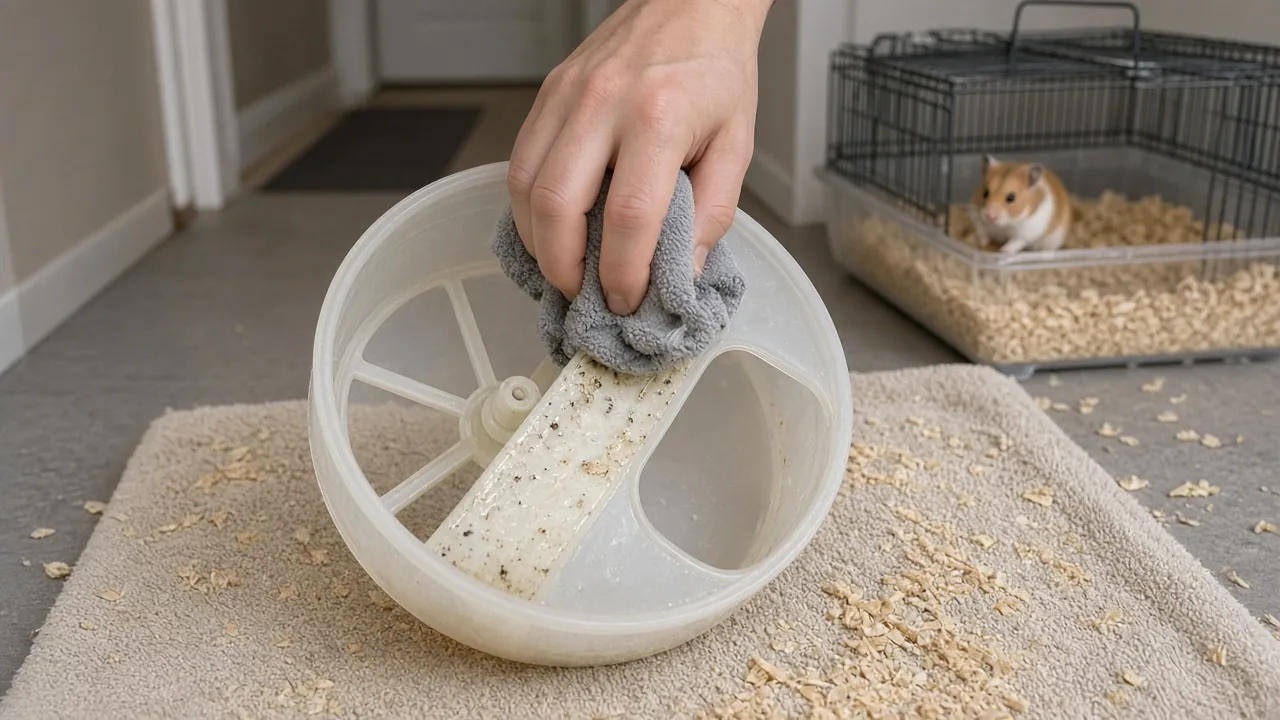
Hamsters often use the entry hole of their wheel as a convenient spot to relieve themselves, which means grime builds up right where the axle sits. That buildup isn’t just a smell problem; it can also increase friction at the exact point you’re trying to keep cool and smooth-running.
- Remove the wheel from the cage at least once a week, or more often if you notice odor or visible residue.
- Wipe down the running surface and the area around the entry hole with a pet-safe cleaner or warm water, then dry it fully before putting it back.
- Check the axle area specifically for trapped bedding or droppings, since this is the spot that collects the most debris and sits closest to the friction point.
- Let the wheel air dry completely before your hamster uses it again, since trapped moisture near the axle can encourage buildup to return faster.
A clean axle area runs more smoothly, which in turn means less friction and less heat buildup during those long overnight running sessions.
FAQ: Hamster Wheel Heat and Safety Questions
Does a warm-feeling axle automatically mean something is wrong?
No. A gentle, lingering warmth after a long run is a normal result of friction, especially with plastic axles. It only becomes a concern if the axle feels uncomfortably hot to hold, smells sharp or chemical, or is paired with grinding noise or visible wear.
How long is too long for a hamster to run on its wheel?
There’s no fixed time limit, since running in long stretches overnight is part of normal hamster behavior. What matters more is whether your hamster takes natural breaks to eat, drink, and rest at some point, rather than running nonstop with no pause for hours on end.
Is a squeaking wheel a warning sign?
A new squeak that wasn’t there before usually points to a dry or worn bearing rather than anything urgent, but it’s worth a quick look. If the squeak comes with wobble, grinding, or visible wear on the axle, treat it as a sign to inspect the wheel closely and consider replacing it.
Should I worry if my hamster poops near the entry hole?
This is common and not harmful on its own, but it does mean that spot needs regular cleaning so the buildup doesn’t add extra friction or odor around the axle over time.
Pay attention to how your own hamster actually uses its wheel and ball, since preferences for upright versus flat, or solid versus mesh, vary from one hamster to the next. Make the axle check and the cleaning routine part of your regular cage maintenance, and swap out any wheel that shows cracking, wobble, grinding, or a genuinely hot axle rather than waiting to see if it gets worse. If you’re setting up toys for other small pets at home, the same habit of checking for wear and rotating in a backup applies just as well there.
This article is for general information only and is not a substitute for advice from your veterinarian. Always supervise your pet with a new toy, and replace any toy that is damaged or small enough to swallow.

Contributor
admin
Continue reading
All stories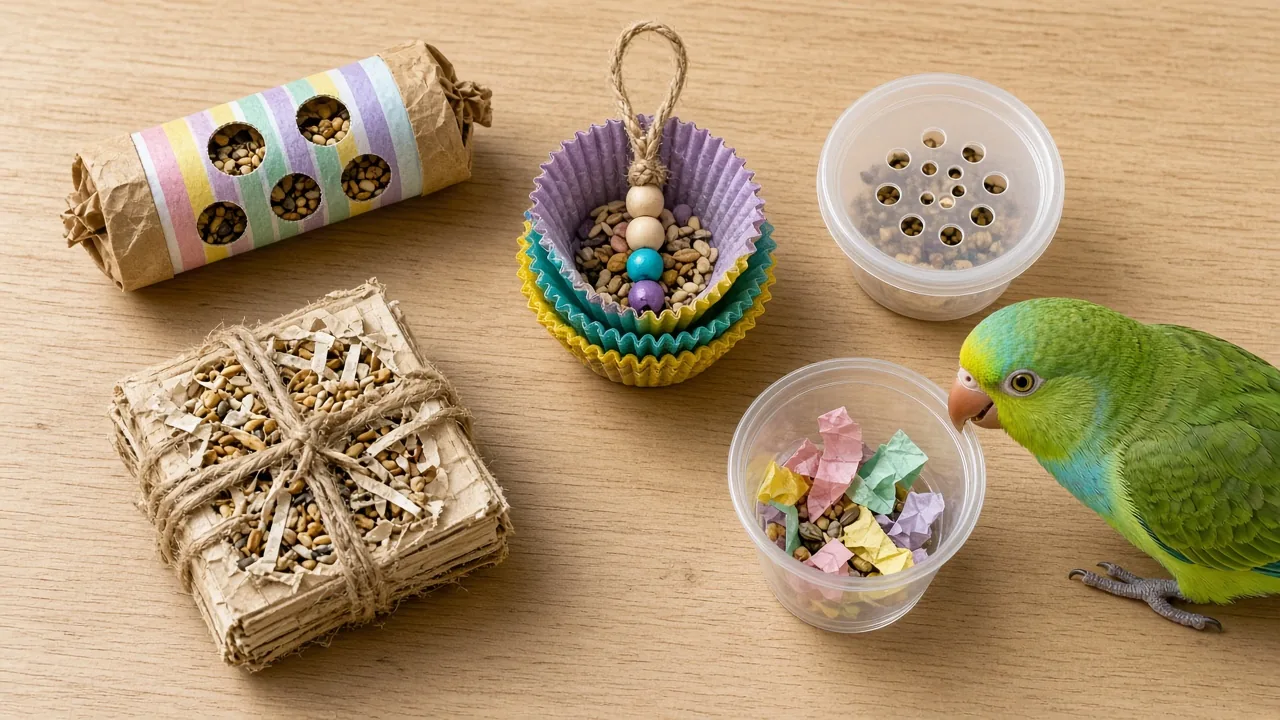
SMALL PETS & BIRDS · 11 October
DIY Foraging Toys for Budget Bird Owners: 5 Ideas Under $15

SMALL PETS & BIRDS · 11 October
How to Charge Little Live Pets Butterfly Toy Without Breaking the Wings
SMALL PETS & BIRDS · 11 October
Responses
Moderated discussion