SMALL PETS & BIRDS
How to Tame a New Hamster Without Getting Bitten: A Patient Guide
A patient, step-by-step guide to taming a new hamster without getting bitten, from settling-in time and scent-based trust building to safe first pickups.

If your hamster has already nipped you once or twice, you’re probably not dealing with an aggressive animal — you’re dealing with a scared one. Most biting in the first weeks after bringing a hamster home comes from startled defense, not temperament, and learning how to tame a new hamster without getting bitten is mostly a matter of slowing down and reading its body language. Give it two to four weeks of short, predictable sessions, and most hamsters start treating your hand as a familiar visitor instead of a threat.
How to Tame a New Hamster Without Getting Bitten: What to Set Up First
Before you reach into the cage at all, set up the environment so your hamster has less to be afraid of. A roomy cage placed in a quiet corner of the house, away from TVs, foot traffic, and other pets, cuts down on the background stress that makes a hamster more likely to snap at a hand.
Bedding matters just as much. Give your hamster enough depth to burrow and fully disappear from view — a few inches of loose bedding that only covers the cage floor doesn’t give it a real hideout, and a hamster that can’t hide tends to stay on edge.
One habit costs nothing and prevents a lot of confusion: wash your hands before every handling session. Food smells, lotion, or scent from another pet on your skin can make a hamster mistake your fingers for a snack or a threat, which is one of the more common reasons a hand ends up in its mouth by accident rather than out of aggression.
Why Hamster Breed and Personality Affect How Long Taming Takes
Not every hamster tames at the same speed, and the species you have sets a rough starting expectation. Syrian hamsters tend to be the most tolerant of handling once they settle in, which is part of why they’re often recommended for first-time owners. Dwarf hamsters are usually faster-moving and more easily startled, so sessions with them may need to stay shorter and calmer for longer. Robo hamsters are typically the most skittish of the three and often take the longest to warm up to a hand, with some owners reporting that a particularly shy Robo took considerably more patience than a Syrian or Dwarf housed under similar conditions.
Individual personality adds another layer on top of species tendencies. One owner who kept five hamsters — two Syrians and three Dwarfs — over the years noticed real differences in biting frequency and willingness to interact even among hamsters of the same species, which is a useful reminder that your hamster’s pace doesn’t reflect something you’re doing wrong. Health status plays a role too: a Dwarf hamster dealing with illness became noticeably more sensitive to changes in her environment and more prone to defensive nipping as her condition progressed, so a sudden increase in biting from a previously calm hamster is worth watching rather than dismissing as a phase.
Step 1: Let Your New Hamster Settle In Before Any Handling
Resist the urge to hold your hamster on the first day. A two- to three-day adjustment period in its new cage, with no handling at all, gives it time to learn that the space is safe before it has to cope with a hand reaching in too.
This settling-in window matters even more for hamsters bought from a pet store, since many have already been handled frequently — and not always gently — by staff and other customers before you bring them home. A hamster that arrives already on guard needs a slower introduction and a bit more patience than one that’s simply new to any handling at all.
During this period, limit your interaction to quiet observation and basic care: refilling food and water, and talking softly so it gets used to your voice. Avoid tapping the glass, picking the cage up, or hovering a hand over the enclosure, since all three can read as threatening to an animal that evolved to watch for predators from above.
Step 2: Pick the Right Time of Day to Approach Your Hamster
Hamsters are naturally active at night, but "most active" isn’t the same for every hamster, and forcing a session during the wrong window is a common reason owners get nipped. Spend a few evenings simply watching when your hamster wakes up, starts exploring, and begins eating on its own schedule before you plan any hands-on time.
Trying to interact with a hamster that’s still half-asleep or that hasn’t eaten yet tends to backfire, since a groggy or hungry hamster is more likely to react defensively to a hand it didn’t expect. If your hamster seems to be either sleeping or eating every time you check, that’s a sign to watch a bit longer rather than to push forward anyway — most hamsters do have an active window somewhere in the evening, it just might start later or earlier than you assumed.
Once you’ve found a reliable time, stick to it for your taming sessions. Consistency helps your hamster learn to expect your visits rather than being caught off guard.
Step 3: Get Your Hamster Used to Your Hand’s Scent First

Before you try to touch your hamster at all, let it get familiar with how your hand smells and looks near the cage. Rest a clean hand, with a small bit of a food your hamster likes on your palm, just inside the cage door or near its favorite corner, then stay still and let it approach on its own terms.
The goal here isn’t to grab the hamster the moment it comes close — it’s to let repetition do the work. Over several short sessions, a hamster that sniffs your hand, takes the food, and walks away without bolting is building a simple association: this hand shows up, food shows up, nothing bad happens.
Keep these sessions brief, a few minutes at a time, and end on a calm note rather than pushing until the hamster gets anxious. If it won’t approach at all after several tries, slow down further and keep the sessions shorter rather than skipping ahead to touching.
Step 4: Practice Approach and Touch Inside a Safe, Enclosed Space
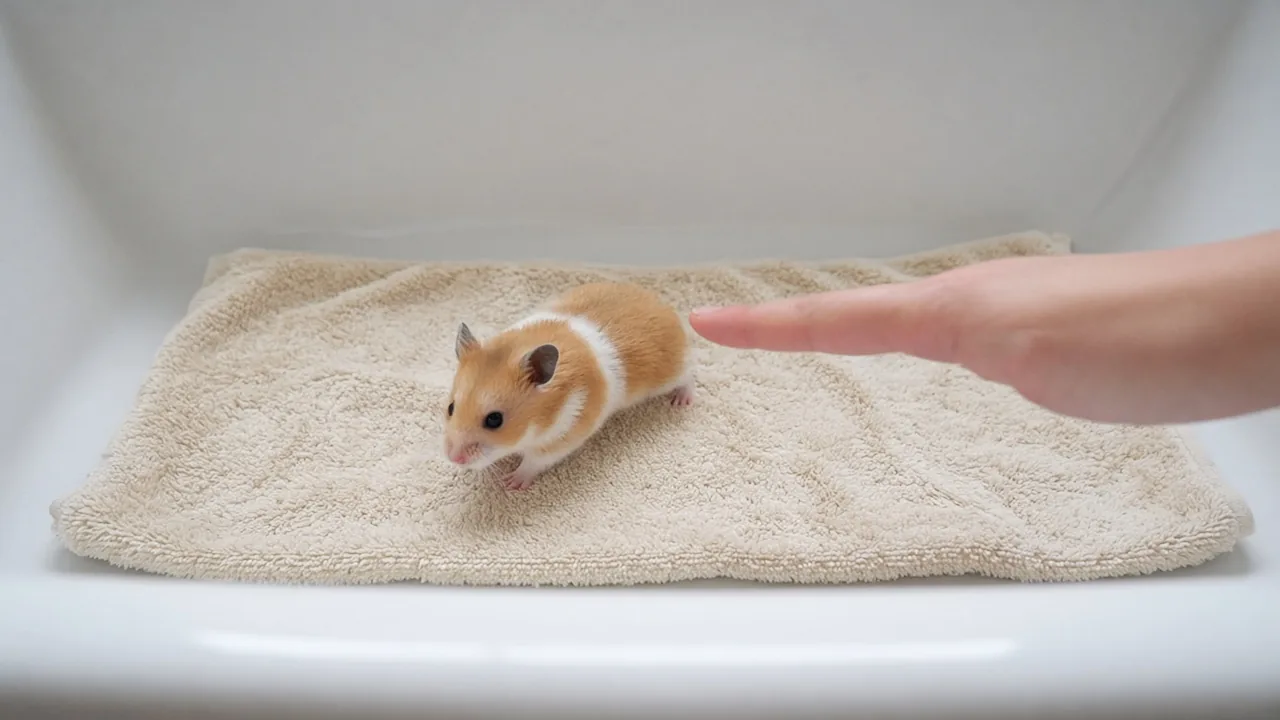
Once your hamster reliably takes food from your hand inside the cage, move early touching practice to a lower-risk space: an empty bathtub lined with a towel. The towel cushions any jumps, and the tub’s smooth, enclosed sides limit how far a startled hamster can run or where it can squeeze out of sight.
This setup takes pressure off both of you. You don’t have to worry about losing your hamster behind furniture if it bolts, and your hamster has a contained space to explore while you practice gently resting a hand nearby and, eventually, stroking its back with one or two fingers.
Keep early tub sessions short and end them before your hamster seems overstimulated — frantic running along the edges or repeated attempts to climb out are signs it’s had enough for the day. A calm hamster that pauses to groom or explore at a normal pace is telling you the session is going well.
Step 5: Move From Touching to Scooping Up Your Hamster

Once your hamster tolerates gentle touch without flinching or bolting, you’re ready to attempt your first full pickup. Do this inside the bathtub setup for the first several tries, since any accidental drop is far safer onto a towel-lined tub floor than from a height over hard flooring.
A simple sequence for the first pickup:
- Let your hamster approach your open hand resting flat on the towel, rather than reaching toward it.
- Wait for it to climb onto your palm on its own or stand calmly next to your hand without flinching.
- Cup your other hand loosely over the top, forming a tunnel rather than a tight grip.
- Lift slowly, only a few inches, and hold still for a few seconds before setting it back down.
- End the session there, even if it went well — short, successful sessions build trust faster than long ones.
Watch for signs your hamster is ready to continue: standing still in your hand, sniffing calmly, or beginning to groom are all good signs. Signs to pause and set it back down immediately include stiffening, trying to jump free, or showing teeth. Pushing through those warning signs is one of the more common ways new owners get bitten, so treat them as a stop signal rather than something to work through.
How Cage Size and Enrichment Affect Biting Behavior
Taming technique matters, but the cage itself can work against you if it’s too small. One experienced small-pet owner, returning to Syrian hamsters after a few years away, compared a 60-liter-class cage against a roomier 70-liter-plus option and found the smaller size only covers a hamster’s most basic needs — enough room to eat, sleep, and move, but not much else. A cramped, under-stimulating cage adds a layer of chronic stress that can make an already nervous hamster quicker to bite out of frustration or feeling cornered.
This doesn’t mean every 60-liter cage will cause problems, and cage size alone won’t fix a taming issue rooted in the hamster’s personality or history. Think of it as one variable among several: a bigger cage gives a stressed hamster more room to retreat, explore, and burn energy, which can make your taming sessions easier, but it won’t replace patient, consistent handling.
For Syrian hamsters especially, sizing up when you can is worth the extra footprint and cost. Dwarf and Robo hamsters are smaller but still benefit from more floor space than the minimum, since more room to explore tends to lower overall stress regardless of species.
Choosing Bedding, a Wheel, and a Hideout That Support Calmer Behavior
Bedding depth does more than look nice — it gives your hamster somewhere to disappear when something startles it. A combination of loose aspen shavings for burrowing, a layer of aspen-based sand for digging texture, and shredded paper bedding for both insulation and chew enrichment gives a hamster several ways to self-soothe. One owner piled aspen shavings roughly 4 inches deep across the cage floor, using about two-thirds of a standard bag, which was enough for a hamster to fully bury itself when it wanted privacy.
A solid hideout matters just as much as bedding depth. A hamster that’s mid-nap in an open area when you reach in is far more likely to bite out of surprise than one that has a den to retreat to and chooses to come out on its own. Ceramic hideouts double as a cooling spot in warm weather and can work as a second level if your cage has the height for it.
An exercise wheel won’t directly stop biting, but a magnetic, easy-to-remove wheel makes it simpler to keep the cage clean, and a hamster with an outlet for nighttime energy tends to be calmer overall than one that’s under-stimulated. If you’re setting up multiple platform levels, a common layout puts a litter area and burrowing space on the lower level and food, water, and the wheel up top, which keeps the cage organized without crowding your hamster’s hiding spots.
Are You Doing Something Wrong If Your Hamster Still Bites?
An occasional nip during the first few weeks of taming doesn’t mean you’ve done something wrong. Startled hamsters bite as a first response, and even hamsters that go on to be comfortable with handling may nip once or twice while they’re still learning your hand isn’t a threat.
What’s worth paying closer attention to is a pattern that doesn’t improve, or that gets worse after it seemed to be going well. Hard, repeated biting — especially from a hamster that was previously calm — can point to pain, illness, or a sudden increase in stress rather than a training issue. If your hamster’s biting escalates instead of easing off over several weeks, or if you notice other changes like reduced appetite, unusual lethargy, or a change in how it moves, it’s worth having a veterinarian experienced with small pets take a look rather than assuming more taming time will fix it.
It also helps to rule out simple triggers before assuming the worst. A hamster that bites specifically when you reach in right after it’s eaten, or right when it’s half-asleep, may just need you to adjust your timing rather than needing a health check.
How to Budget for Hamster Supplies Without Overspending on Day One
New hamster owners sometimes get caught off guard by how much a full supply list adds up to in one trip, especially when every accessory looks appealing at the store. One new owner who had just brought home a hamster found the first supply run cost noticeably more than expected once bedding, a cage, a wheel, and food were all added up together.
A more manageable approach is to prioritize in order. Put your budget toward cage size and safe bedding first, since those two things affect your hamster’s daily comfort and stress level the most. A larger cage and a generous layer of appropriate bedding do more for a nervous hamster than any single accessory will.
Once the basics are covered, add mid-range accessories gradually rather than all at once:
- A magnetic, easy-to-clean wheel once budget allows, rather than the cheapest option available
- A sealed storage container for food — a generic, non-brand container can work just as well as a premium one if it seals tightly and holds enough food
- A gravity water bottle with a reasonably large reservoir, useful if you’re sometimes away for a day or two
- A ceramic hideout for warm-weather cooling and extra hiding space
Mineral cat litter can also substitute for dedicated hamster sand in some setups, since the material is similar and it’s often sold at a lower cost with less dust — just confirm it’s unscented and free of clumping additives before using it for a small pet.
Common Questions About Taming a New Hamster
How long does taming a hamster realistically take?
Most hamsters start tolerating hand-feeding and gentle touch within one to two weeks of consistent, short sessions, with full comfort being picked up and held often taking two to four weeks total. Shy individuals, particularly some Robo hamsters, can take noticeably longer, and that’s normal rather than a sign the process has failed.
Do all hamster species bite about the same amount?
No — species sets a general tendency, with Syrians typically the easiest to tame, Dwarfs a step more reactive, and Robos often the most cautious around hands. Individual personality and past handling history can still push any hamster toward the more nervous or more confident end of that range.
What if my hamster seems unusually food-aggressive?
Some hamsters genuinely gulp down food as fast as possible and grab at anything near their mouth during feeding, which is closely tied to a hoarding instinct rather than general aggression. Avoid handling or reaching in right at feeding time, offer food from a slightly greater distance until your hamster calms around it, and give it more time before attempting pickups if grabbing persists outside of mealtimes.
Every hamster settles into handling at its own pace, so pay attention to how yours responds at each step and slow down whenever it seems unsure rather than sticking to a fixed schedule. As trust builds, keep an eye on cage setup too — a wheel that’s started squeaking or bedding that’s gone thin can undo some of that progress, so checking them regularly is worth adding to your routine alongside the taming itself.
This article is for general information only and is not a substitute for advice from your veterinarian. Always supervise your pet with a new toy, and replace any toy that is damaged or small enough to swallow.

Contributor
admin
Continue reading
All stories
SMALL PETS & BIRDS · 11 October
Best Chew Toys to Stop Parrot Plucking and Boredom
SMALL PETS & BIRDS · 10 October
Do Guinea Pigs Smell Bad Indoors? Causes and Odor Fixes

SMALL PETS & BIRDS · 10 October
Responses
Moderated discussion