DOG TOYS
How to Freeze Stuff a Kong for Dogs: A Step-by-Step Guide
A step-by-step guide to freeze-stuffing a Kong, from choosing the right toy size and recipe to keeping it safe, clean, and interesting for your dog.

If your dog finishes a plain-stuffed Kong in under ten minutes and goes right back to chewing the couch, freezing the filling is the fix. Learning how to freeze stuff a Kong for dogs turns a quick snack into a project that can occupy a bored or anxious dog for a much longer stretch, simply by making the food harder to reach. The method is simple, but a few details—recipe, texture, and timing—make the difference between a toy your dog works at happily and one that frustrates or barks at.
What Freeze-Stuffing a Kong Actually Does for Your Dog
A Kong toy has a large opening at one end and a small one at the other, both designed to hold food. Fill it with soft treats at room temperature and most dogs can lick or chew their way to empty in minutes. Freezing the same filling slows that process down because the dog now has to work through solid, cold material layer by layer instead of soft paste.
That extra time matters for two common situations: easing boredom when you’re not home, and giving an anxious dog something absorbing to do during a stressful moment like a thunderstorm or a crate-training session. A frozen Kong also naturally discourages gulping, since a dog physically cannot swallow large chunks of frozen filling the way they might with loose kibble poured into a bowl.
The tradeoff is texture. A fully frozen filling is harder than anything your dog normally chews, so matching the toy and the filling to your dog’s chewing style matters more once you add the freezer step. A dog who licks and nibbles patiently will handle a frozen Kong very differently than one who clamps down hard and tries to crack it open fast—and that difference should guide how firm you let the filling get before you hand it over.
How to Choose the Right Kong Before You Freeze It
Kong makes four main lines, each matched to a chewing strength: puppy (usually pink or light blue, for dogs still teething), senior (purple, for older dogs with softer gums or worn teeth), classic (red, for average adult chewers), and extreme (black, marketed for the most aggressive chewers). Picking the right line matters even more once you freeze the filling, because frozen food is denser and harder on both the toy and your dog’s teeth than a soft filling would be.
A toy that’s already a stretch for your dog’s jaw strength becomes more likely to crack, or more likely to frustrate a dog who can’t make headway on it, once it’s frozen solid. Starting with the line that matches your dog’s current chewing habits—not the toughest option available—is the safer first move. If you’re working with a puppy still losing baby teeth or a senior dog with worn-down molars, the softer puppy or senior lines also make more sense for frozen fillings than classic or extreme, since the rubber itself gives a little more under pressure.
Classic vs Extreme: Does Your Dog Really Need the Black Kong
Extreme is sold as the tougher option, built for dogs who chew through anything. One owner tested this directly by giving a strong chewer the classic red version and a second dog the extreme black version, expecting the red one to wear out fast. It didn’t. A side-by-side squeeze test of both toys found the firmness nearly identical, with extreme feeling only slightly stiffer.
That doesn’t mean extreme is pointless—it may still hold up longer under genuinely heavy daily chewing over time, and the marginally firmer rubber could matter for a dog that chews for hours every day. But for most dogs, including many large or strong-jawed breeds, classic can handle regular use, including frozen fillings, without the added cost. If you’re unsure which to buy, start with classic and only move to extreme if you see cracking, deep gouges, or pieces coming loose. Buying the pricier line as insurance against a problem you haven’t actually seen yet is a common but avoidable expense.
What Size Kong Fits Your Dog’s Breed and Jaw
Kong comes in six sizes, from extra small up to double extra large. Size by your dog’s current body size and mouth, not by breed stereotypes—a lean, narrow-jawed large breed may need a different size than a stocky dog of the same weight class.
| Size | Typical Dog Weight | Notes |
|---|---|---|
| Extra Small | Under 10 lbs | Toy breeds, puppies |
| Small | 10–20 lbs | Small adult dogs, older puppies |
| Medium | 20–30 lbs | Most small-to-mid breeds |
| Large | 30–50 lbs | Mid-size and some large breeds |
| Extra Large | 50–90 lbs | Large breeds |
| Double Extra Large | 90 lbs and up | Giant breeds |
A Kong that’s too small for your dog’s mouth is a choking risk once it’s slick with frozen filling—a dog can get more of it into their mouth than you’d expect, especially mid-chew when the toy is wet. If your dog is between two sizes, size up rather than down, and watch the first few sessions closely regardless of size. Growing puppies are worth rechecking every few months, since a toy sized correctly at twelve weeks can be noticeably too small by six months.
How to Freeze Stuff a Kong for Dogs: Step-by-Step
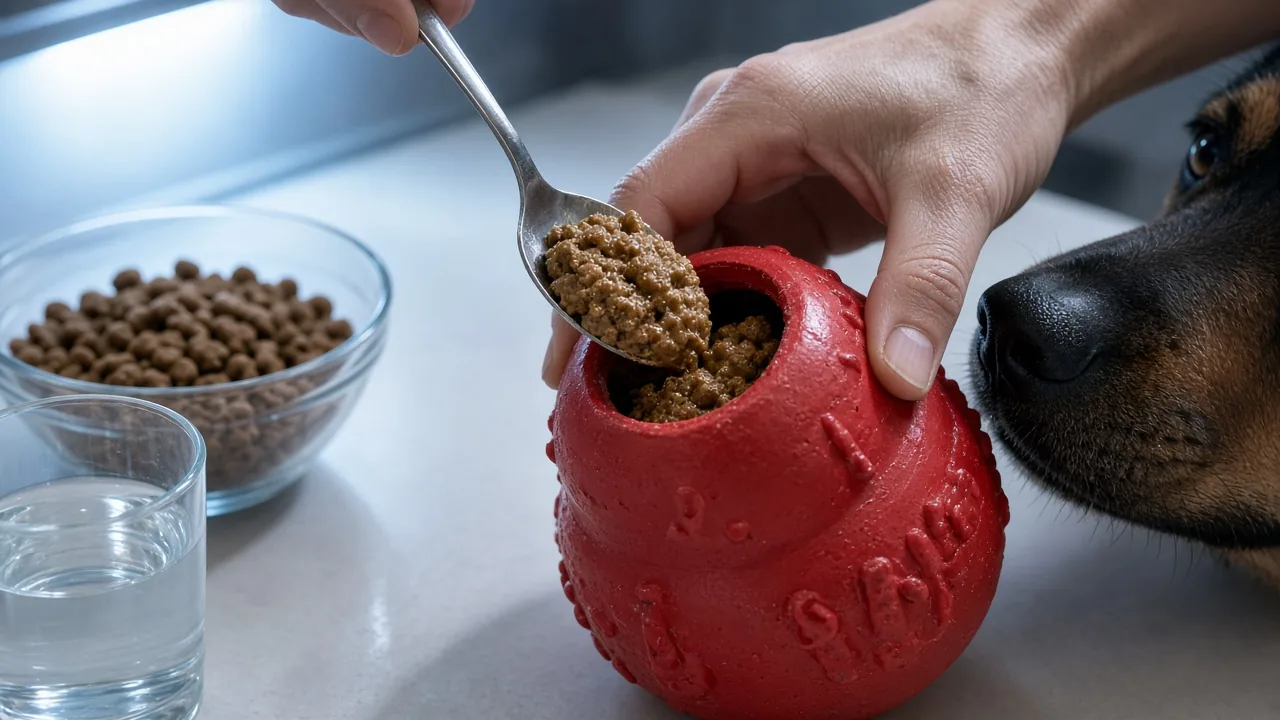
Once you’ve matched the toy to your dog, the actual process of how to freeze stuff a Kong for dogs is straightforward. The steps below work for most fillings, including the recipes further down.
- Mix your filling (kibble, wet food, pumpkin, yogurt, or a combination) with just enough water to make a thick, scoopable paste.
- Hold the Kong with the large opening facing up and pack the mixture in with a spoon or butter knife, pressing down to remove air pockets as you go.
- Fill to just below the rim, leaving a small gap at the top for the mixture to expand slightly as it freezes.
- Stand the Kong upright in a cup, mug, or egg carton so the filling doesn’t spill out before it sets.
- Freeze for at least 4 to 6 hours, or overnight if your freezer runs warmer or the filling is especially wet.
- Before handing it over, check that the filling is firm but not rock solid if your dog is new to frozen Kongs, and supervise the first session.
Keeping two or three Kongs in rotation makes this easier day to day—you can freeze a batch at once and always have one ready instead of scrambling before you leave the house. It also lets you offer a fresh one on busy mornings without waiting the full freezing time, which matters most if your dog gets a Kong on a regular schedule rather than occasionally.
Basic Kibble-and-Water Freeze Recipe
The simplest and most reliable filling is your dog’s regular kibble mixed with water. Soak the kibble until it softens slightly, pack it into the Kong, and freeze as described above.
Right before serving, smear a thin layer of sugar-free, seed-free peanut butter or plain cream cheese around the opening. This step adds flavor exactly where your dog starts chewing, which helps a hesitant dog get interested faster, and it’s the detail most owners who freeze Kongs regularly say makes the biggest difference.
Always check the label on the peanut butter. Some brands contain xylitol or added sugar, and seeded or chunky varieties can pose their own choking risk in a dog that gulps rather than licks. A quick label check before every jar you buy is a small habit that avoids a real hazard.
Pumpkin-Yogurt Freeze Recipe for Variety
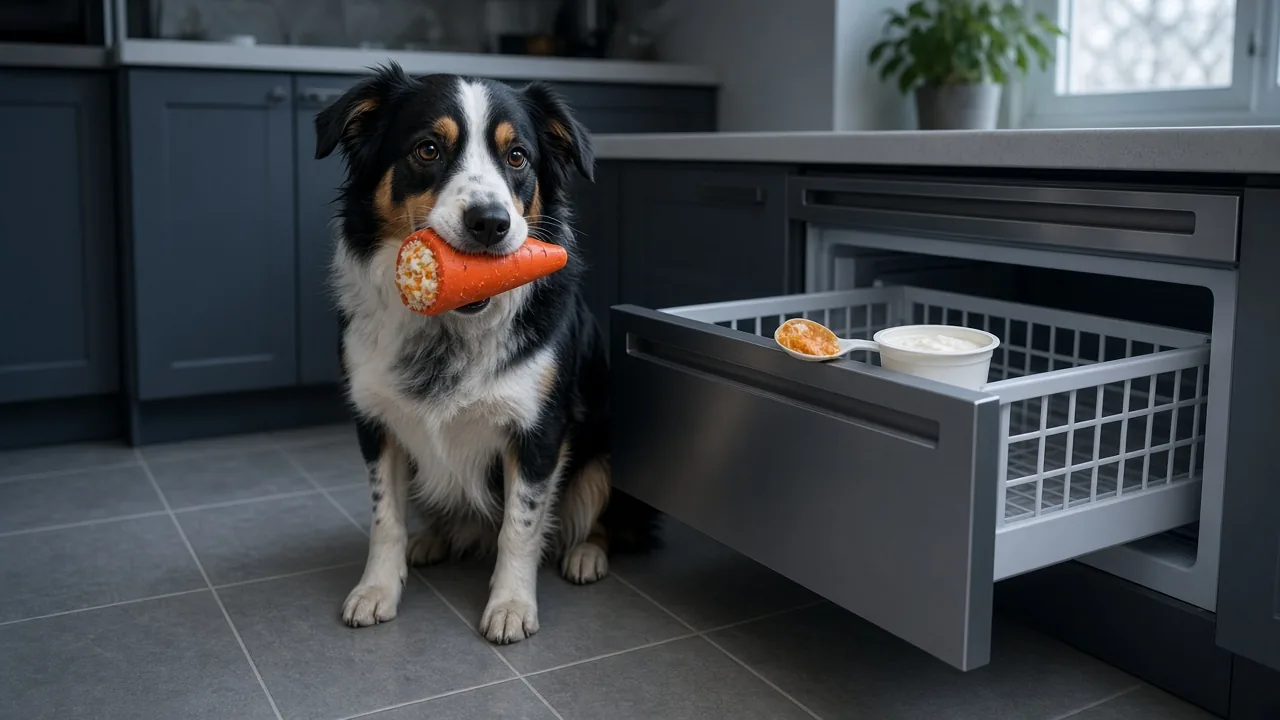
If your dog loses interest in the same kibble filling after a few rounds, plain canned pumpkin mixed with plain yogurt and a small amount of water makes a different texture and flavor. Stir in a scoop of kibble or a few small treats for substance, then pack and freeze the same way.
Keep both the pumpkin and the yogurt plain and unsweetened—flavored or sweetened versions often contain xylitol or added sugar that you don’t want in a filling your dog eats regularly. Rotating between the kibble-water base and the pumpkin-yogurt version gives your dog some variety without changing the overall routine, and it’s a simple way to notice early if a particular ingredient doesn’t agree with your dog, since you’ll see the effect of each recipe separately rather than always feeding a mixed combination.
Are Frozen Kong Fillings Safe for Your Dog’s Mouth and Teeth
A fully frozen filling is genuinely harder than most dogs are used to chewing, and some owners have raised the concern that it may feel uncomfortable against gums or teeth, especially for puppies, senior dogs, or dogs with sensitive mouths. This is a reasonable worry and one that doesn’t have a settled answer—it likely depends on the individual dog, how hard they bite down, and how long the filling has been in the freezer.
A simple middle ground is to let the Kong sit out for 10 to 15 minutes before handing it over, so the outer layer softens slightly while the inside stays cold and dense. You can also build in softer layers on purpose, alternating a thin band of plain yogurt or wet food between layers of the firmer kibble mixture, so your dog isn’t working through solid ice the entire time.
If your dog yelps, pulls away, or stops chewing abruptly when they hit the frozen filling, take the toy and let it thaw further before trying again. That reaction is worth taking seriously rather than assuming your dog will just push through it. Dogs with known dental issues or very young puppies still losing baby teeth may do better skipping the freezer step entirely until you’ve checked with your vet.
Common Mistakes When Freezing a Kong for Dogs
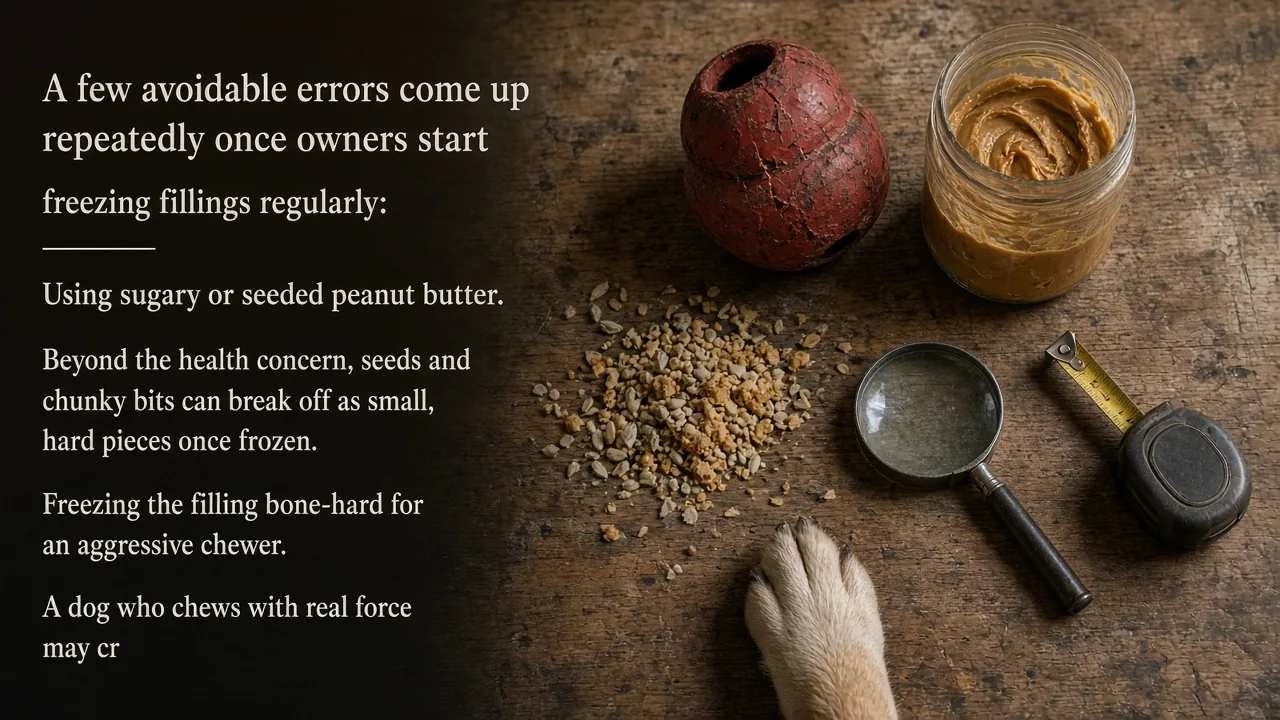
A few avoidable errors come up repeatedly once owners start freezing fillings regularly:
- Using sugary or seeded peanut butter. Beyond the health concern, seeds and chunky bits can break off as small, hard pieces once frozen.
- Freezing the filling bone-hard for an aggressive chewer. A dog who chews with real force may crack a tooth on a filling that’s frozen solid all the way through—softer centers or partial thawing reduce that risk.
- Ignoring general toy wear while focused on the filling. Freezing adds stress to the toy itself over time. Check the rubber regularly for cracks, especially around the openings, the same way you’d check any chew toy for damage.
- Overlooking small-part hazards elsewhere in your dog’s toy box. Toy recalls across pet products have repeatedly flagged loose small parts and packaging as choking risks—it’s worth applying that same scrutiny to anything you combine with a Kong, like treat pouches or wrappers.
- Leaving a dog unsupervised the first few times with a frozen filling, especially if you don’t yet know how hard they chew or how they react to the cold, dense texture.
- Reusing the same recipe so often that your dog stops caring. Rotating fillings and occasionally swapping which Kong is in play keeps the toy interesting instead of becoming background noise your dog ignores.
What If Your Dog Ignores or Barks at the Frozen Kong
Not every dog takes to a stuffed Kong right away. Some dogs, especially puppies just a few weeks past weaning, show no interest at all and would rather chase or play than work on a toy that just sits there. If that’s your dog, start with an easy, unfrozen filling—something soft and highly scented—so they learn the toy equals a reward before you add the challenge of frozen filling. Some dogs are simply more motivated by movement and chase games than by a stationary food puzzle, and that’s a personality difference, not a sign the toy or the method is failing.
Other dogs respond to a filled Kong with sustained barking instead of chewing, no matter what’s inside or how it’s prepared. This usually isn’t about the filling and more about frustration or an unclear expectation of what the toy is for. If this happens consistently, it’s worth talking to a certified trainer rather than cycling through different fillings, since the barking is likely a behavior pattern separate from the recipe itself.
How to Clean a Kong After Freeze-Stuffing It
Frozen fillings tend to get pushed deep into the toy as your dog chews, often farther than their tongue can reach to clean out on its own. Leftover paste sitting in the curves of the toy can dry out, grow bacteria, or simply start to smell if it’s left too long between washes.
Rinse the Kong under warm water after every use to loosen surface residue, then use a bottle brush to scrub inside both openings—the long, narrow shape of a bottle brush reaches the curved interior that a regular sponge can’t. For a deeper clean every week or two, run the Kong through the dishwasher on a top rack if the manufacturer label allows it, or soak it in warm water with a small amount of dish soap and scrub again.
Let it air dry fully before refilling and refreezing. A toy that goes into the freezer still damp inside can trap moisture that makes future buildup worse, and a Kong that smells sour even after washing is usually a sign it needs a longer soak rather than another quick rinse.
Frequently Asked Questions About Freezing a Kong for Dogs
How do I introduce a Kong to a puppy who isn’t interested?
Start with an unfrozen, soft filling and let your puppy explore it without pressure. Some puppies take a few sessions to understand what the toy is for, and pushing a frozen filling too soon can turn them off the toy altogether.
What else can I put inside besides kibble, pumpkin, or peanut butter?
Plain cooked meat, mashed banana, or small training treats mixed into the base recipe all work as long as they’re unsweetened and safe for dogs. Avoid anything with bones, seeds, or added sugar.
How long does a frozen filling stay good?
A filled, frozen Kong can generally be kept in the freezer for a few weeks before the quality starts to drop, similar to how you’d treat other frozen homemade food. Once thawed and given to your dog, treat any leftover filling the way you would fresh food and don’t refreeze it.
How often should I check the toy itself for wear?
Give it a quick look every time you clean it, and a closer check weekly if your dog uses it daily. Look for cracks, thinning rubber, or any piece that feels like it could tear free.
Can I give a frozen Kong every day?
Many owners do, but it’s worth varying the recipe and occasionally offering an unfrozen or lightly chilled version so your dog isn’t always working against the same level of resistance. Daily use also means daily wear, so the toy inspection matters more the more often it’s in rotation.
Every dog has their own way of playing—some chew steadily, some lick for long stretches, some would rather dig or carry a toy around than work it over with their teeth. Watch which one describes your dog before building a Kong routine around freezing, and keep checking the toy itself for cracks or soft spots so you know when it’s time to replace it rather than keep refilling it. If you’re also rotating other chew toys at home, the same wear checks and swap-out schedule apply there too.
This article is for general information only and is not a substitute for advice from your veterinarian. Always supervise your pet with a new toy, and replace any toy that is damaged or small enough to swallow.

Contributor
admin
Continue reading
All stories
DOG TOYS · 11 October
Why Do Dogs Lose Interest in Rubber Toys So Fast?
DOG TOYS · 11 October
How to Use Nina Ottosson Puzzle Toys: A Level-by-Level Guide
DOG TOYS · 11 October
Responses
Moderated discussion