CAT TOYS
Are Cardboard Boxes Better Than Cat Toys? What a 100-Year Toy Test Revealed
A decade-by-decade toy test with two cats reveals that cardboard boxes and cheap household items often outperform store-bought cat toys, and explains why hunting instincts matter more than price or design.
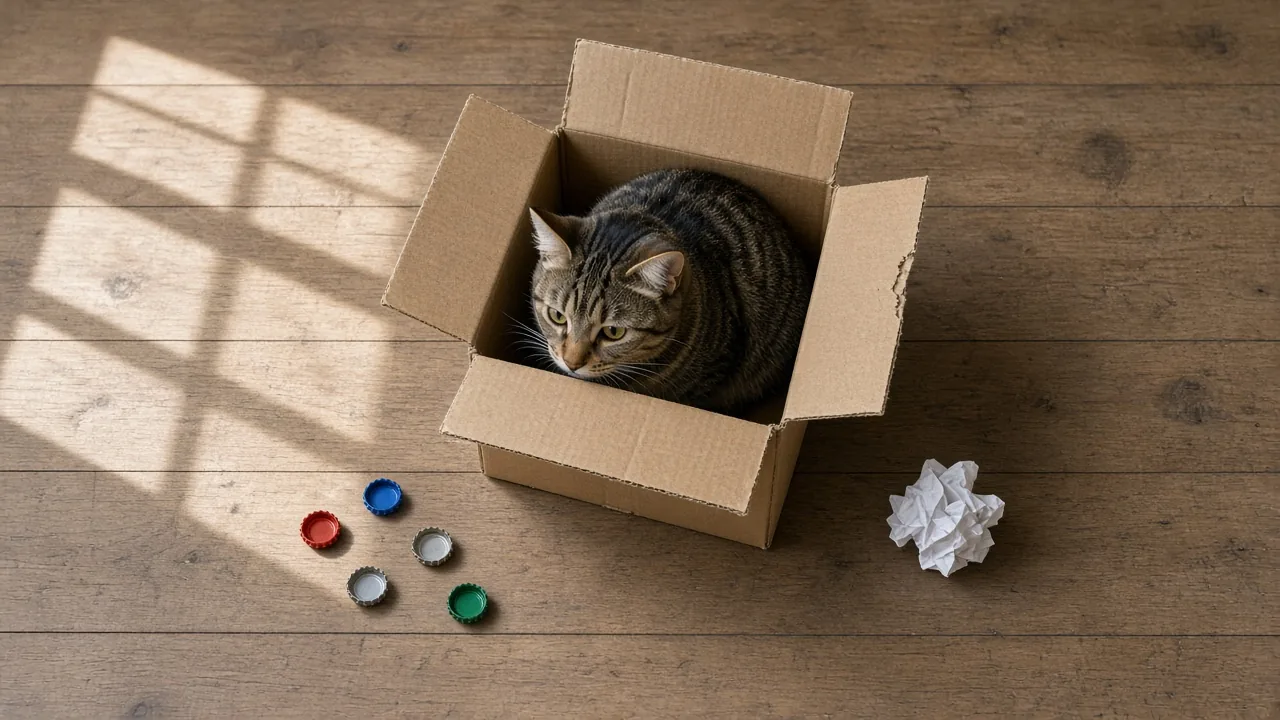
If your cat ignores a new toy but camps out in the box it came in, you are not imagining things, and testing toys across eras helps explain why. One pet owner ran two cats, an adult named Kurt and a kitten named Gary, through a toy from every decade since the 1920s, and the results raise a fair question: are cardboard boxes better than cat toys that cost real money? The pattern across eras suggests the answer depends less on polish and more on what a toy lets a cat actually do.
A decade-by-decade toy test with two cats showed that price and production value did not reliably predict which toys got real play. Some toys from the 1920s and 1950s barely got a sniff. Others from the 1970s and 1990s held up decades later. The common thread was not how advanced the toy looked, but whether it gave a cat something to track, grab, or settle into.
Which Decades of Cat Toys Actually Held Up
Not every "vintage" toy aged well, and not every modern one beat its older rivals. The 1920s paper ball interested the kitten, Gary, but the adult cat, Kurt, walked past it without a second look. A 1930s-style set of bottle caps fared about the same: Gary liked batting them around because they rolled in unpredictable directions, while Kurt stayed unmoved.
A few decades stood out as genuine favorites for both cats. The 1970s feather wand toy was a near-universal hit, the kind of toy that gets attention regardless of which cat is testing it. A 1990s wire dancer toy, built from a bent wire, a bit of paper, and some fur, also scored well with both cats because its jerky, irregular movement looked more like prey than a toy swinging on a predictable path.
By contrast, a 1940s mouse toy and a 1950s jingle ball mostly fell flat. The mouse toy, bought as a genuine antique, carried a musty smell that did nothing for either cat except give Gary something to chew on the tail end. The jingle ball’s constant noise made it one of the least appealing toys in the whole lineup, and its slick surface meant Gary could not even get a grip on it.
The overall takeaway from this stretch of toy history is that engineering alone does not win a cat over. A toy with moving parts and a modern look can lose out to something as basic as a loose feather on a string, simply because the simpler toy moves in a way that triggers a chase response.
Why Free Household Items Keep Winning in Comment Sections
Ask around among cat owners and you will hear the same story again and again: cardboard boxes, bottle caps, and the plastic rings from milk jugs often beat anything from a pet store shelf. These comments echo exactly what showed up in the decade-by-decade test, where some of the cheapest, oldest materials performed as well as or better than toys designed decades later with a cat’s play patterns in mind.
This pattern suggests that novelty and texture matter more to a cat than how "advanced" a toy is supposed to be. A cardboard box offers an enclosed space to hide in, cardboard to scratch and chew, and an unpredictable shape that does not move like a manufactured toy. A bottle cap or jug ring rolls erratically across a hard floor in a way that few engineered toys replicate.
None of this means every cat will treat a box as the best cat toy ever offered. Individual cats vary widely, and some show little interest in boxes at all. But the consistency of these reports across different households points to a real phenomenon: cheap, irregular, everyday objects can trigger the same hunting response that store-bought toys are designed to produce, sometimes more reliably.
Are Cardboard Boxes Better Than Cat Toys? What Drives the Preference
Cats are not evaluating a toy’s price tag or design pedigree. They are responding to cues that resemble prey: movement that is not perfectly smooth, textures that invite biting and clawing, and scents that suggest something worth investigating. Cheap materials can trigger these responses just as well as a toy that was engineered specifically for cats, sometimes because the cheap object’s imperfections make it behave less predictably.
A feather wand works for a similar reason as a crumpled piece of paper: both move erratically when disturbed, and that irregularity reads as "alive" to a cat’s prey drive. A bottle cap skittering across tile taps into the same instinct as a mouse darting across a floor. None of these objects were designed with a cat behaviorist’s input, yet they tap into the same hardwired responses that drive a cat toward a laser pointer’s red dot or a robotic mouse’s erratic path.
The Hunting Instinct Behind Stalk, Chase, Pounce, and Catch
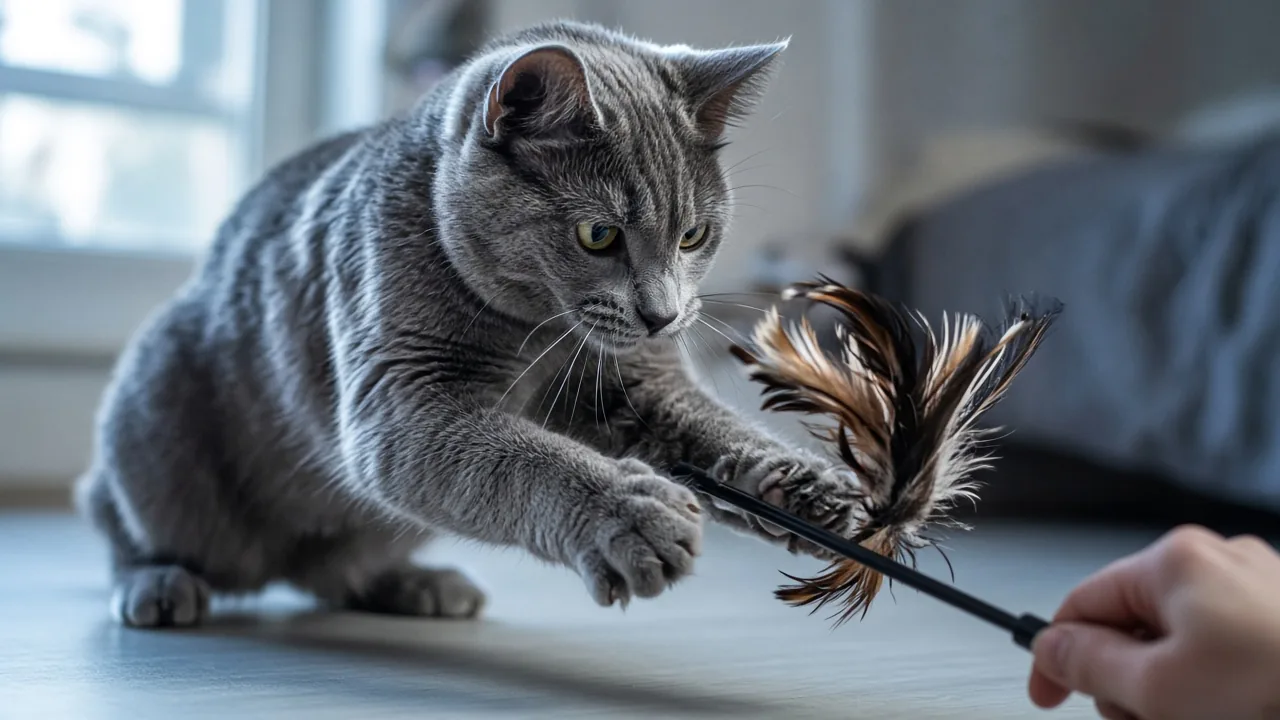
A cat’s play is built around four stages: stalking, chasing, pouncing, and catching. Toys that only cover one or two of these stages tend to satisfy a cat less than toys, or household objects, that let the full sequence play out.
This helps explain why a laser pointer, despite holding a cat’s attention almost universally, can leave a cat feeling unsatisfied over time. The light triggers stalking and chasing, but there is nothing physical to catch at the end. Without a real object to pounce on and hold, the hunting sequence never resolves, and that gap in the instinct cycle is worth taking seriously if a laser pointer is a regular part of your cat’s routine.
A cardboard box, on the other hand, often completes more of the sequence on its own. A cat can stalk toward it, pounce into it, and then physically hold and chew the edges, delivering the "catch" that a laser pointer cannot. The same goes for a wand toy with feathers attached: once the cat catches the feathers in its mouth or claws, the hunting sequence closes out in a way that feels complete.
Why Novelty Matters More for Kittens Than Adult Cats
Kittens tend to show interest in almost everything, from paper balls to bottle caps to things that are not toys at all, such as spoons or pens. That blanket enthusiasm says less about a specific toy’s quality than about where a kitten is developmentally: nearly everything in the environment is new and worth investigating.
Adult cats are a different story. An older cat’s preferences tend to be more settled, and what delighted that same cat as a kitten does not guarantee lasting interest later on. In the decade-by-decade toy test, the adult cat, Kurt, was consistently harder to impress than the kitten, Gary, skipping over several toys that Gary found endlessly interesting.
This gap matters for anyone shopping for toys. A kitten’s excitement over a new cardboard box or a bit of crumpled paper is not a reliable predictor of what that same cat will want to play with a few years down the line. Expect play preferences to shift as a kitten matures, and plan on reassessing which toys actually earn repeat interest once your cat settles into adulthood.
How to Choose Between Cardboard, DIY Toys, and Store-Bought Options
There is no single right answer to the cardboard-versus-store-bought debate, because the right choice depends on your specific cat, your budget, and how much supervision and cleanup you are willing to put in. A toy that works beautifully for one household’s cat may sit untouched in another.
Start by thinking about your cat’s play style. A cat that likes to stalk and pounce from a hiding spot may do better with a box or a tunnel than with a wand toy that demands constant interaction from you. A cat that gets most excited by fast, erratic movement may respond better to a feather wand or a wire-style toy than to a stationary cardboard box.
Budget is a real factor too. Cardboard boxes and homemade toys cost nothing beyond materials you likely already have. Mid-range toys like wands and wire dancers tend to be inexpensive and durable. Higher-end options like heated window hammocks or robotic mice cost more and may need batteries or occasional repair, so weigh that against how much daily use your cat is likely to give them.
| Option | Typical Cost | Supervision Needed | Best For |
|---|---|---|---|
| Cardboard box | Free | Low | Hiding, scratching, ambush play |
| Feather wand | Budget | High (interactive) | Stalk-chase-pounce-catch sequence |
| Wire dancer toy | Budget | Moderate | Cats drawn to erratic movement |
| Laser pointer | Budget | High (interactive) | Fast chase, needs a follow-up catch toy |
| Robotic mouse | Mid-range | Low to moderate | Solo play, curious or younger cats |
| Window hammock | Mid-range to premium | Low | Resting, watching, ambush positioning |
| DIY catnip kick toy | Free to low cost | Low | Kick-and-bite play, food-driven cats |
When a Laser Pointer or Robotic Mouse Makes Sense
A laser pointer earns its popularity honestly: it is cheap, it holds attention, and it works for almost any cat regardless of age. The catch, quite literally, is that the dot can never be caught. If you use one regularly, follow it up with a toy, treat, or other tangible object your cat can pounce on and hold immediately after you turn the laser off. That final catch matters more than it might seem, since it closes out the hunting sequence instead of leaving your cat keyed up with nowhere for that energy to go.
A robotic mouse solves part of this problem by giving a cat something physical to chase and eventually corner. It tends to appeal most to younger or more solo-play-oriented cats. Not every cat takes to it, especially an older cat that has already settled into favorite hiding or resting spots and shows little interest in chasing a moving object across the floor.
When a Window Perch, Tunnel, or Hiding Spot Works Better
Some cats are watchers and ambush players rather than constant chasers, and for these cats, a window perch or hammock can matter more than any wand toy. A suction-mounted window hammock, installed by pressing out trapped air so it sits securely against the glass, gives a cat an elevated resting spot with a view of the outdoors, and some versions include a heating element for cooler rooms.
A tunnel serves a different but related purpose. Cats that like to hide, peek out, and ambush toys or housemates often treat a tunnel as a favorite retreat. Worth noting: a tunnel does not always function as an interactive toy. Some cats will wander in and settle down for a nap rather than respond to a wand toy dangled at the entrance, so a tunnel may work better as a cozy hideout than as a tool for active play. Either use is fine, but set your expectations accordingly.
How to Build a Simple Enrichment Space at Home
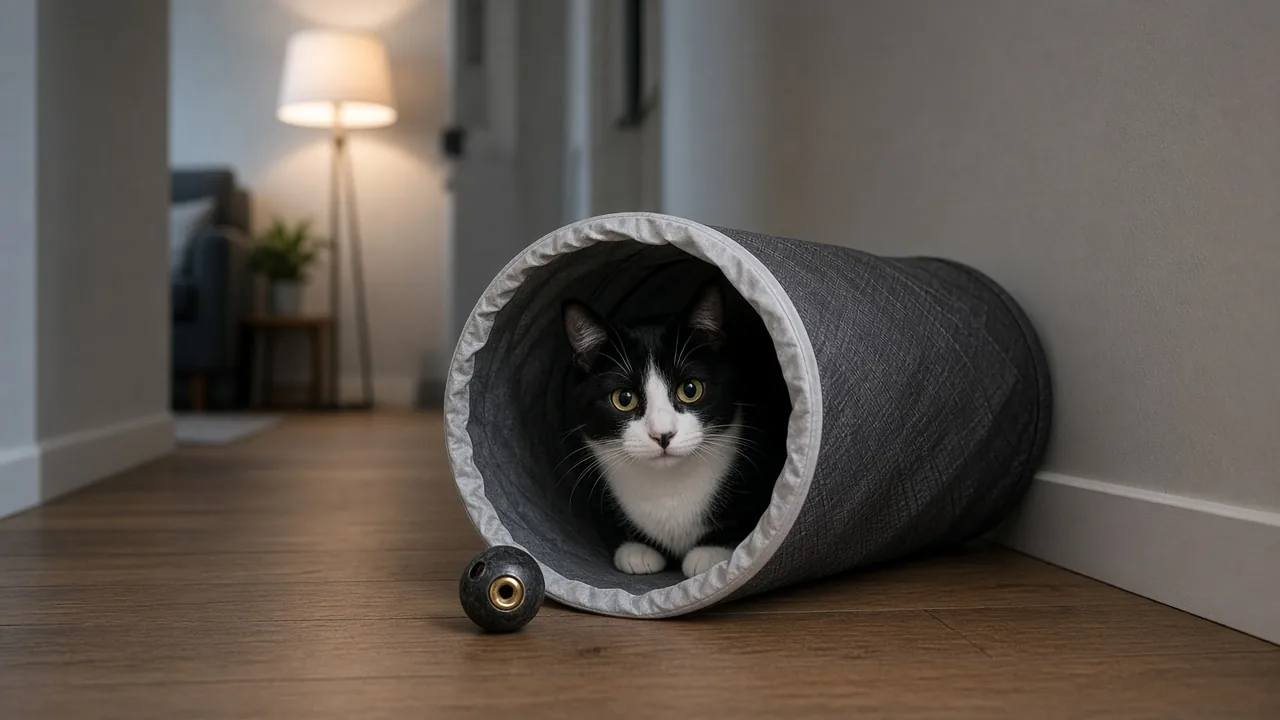
You do not need commercial equipment to build an engaging space for a cat to explore. Combining a tunnel, a few scent-filled hiding spots, and a toy that makes sound can recreate a lot of what a multi-sensory play area offers, at a fraction of the cost.
To put together a basic version at home:
- Set up a tunnel or enclosed space with at least one opening wide enough for your cat to enter and exit without squeezing.
- Tuck a scented item, such as a catnip-filled pouch or a cocoon-style hideaway, into one section to encourage sniffing and investigating.
- Add a toy that makes a sound, like a bell ball, in a separate spot to pull attention across the whole space rather than one corner.
- Rotate which hiding spot holds the scent every few days so the area stays interesting instead of becoming predictable.
One safety note worth repeating: check that every opening in a tunnel or enclosed structure is sized so your cat can move through it easily. A tunnel with an opening that is too tight can trap a cat partway through, which turns a fun hideout into a stressful situation.
How to Make a DIY Catnip Kick Toy Safely
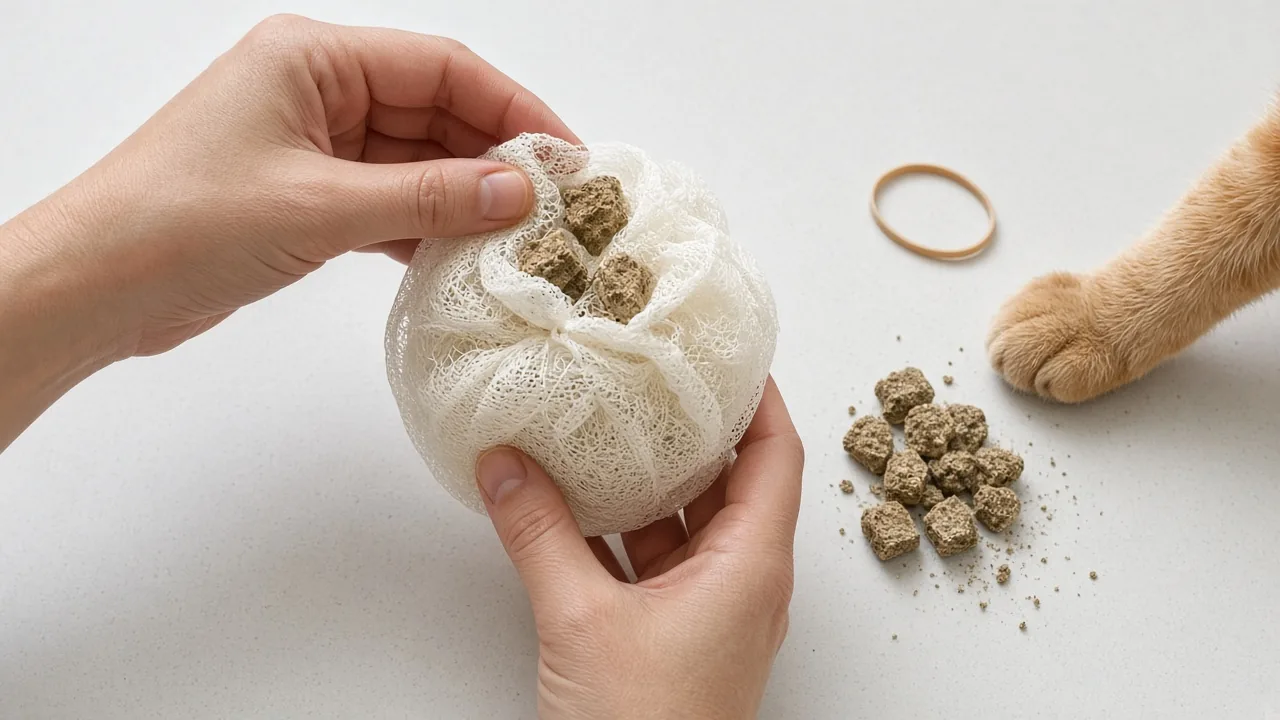
A homemade kick toy can rival anything on a store shelf, and it costs close to nothing if you already have the materials on hand. The basic version uses a loofah-style pouch, the kind made for scrubbing in the shower, filled with a few pieces of freeze-dried catnip and tied off so a cat can grip, kick, and bite it without the contents spilling everywhere.
This kind of toy appeals most to cats with a strong food or scent drive, since the catnip is doing most of the work. Not every cat responds the same way: some will investigate a kick toy thoroughly, while others will paw at it once, realize there is nothing edible inside, and lose interest. If your cat falls into the second group, a kick toy stuffed with catnip is not likely to become a favorite no matter how it is made.
Step-by-Step: Building and Reusing a Kick Toy
Building one of these toys takes only a few minutes:
- Take a loofah-style scrubbing pouch with an opening or pocket.
- Fill the pocket with three to four pieces of freeze-dried catnip.
- Roll or fold the pouch into a shape your cat can wrap its front paws around and kick with its back legs.
- Secure the roll with a rubber band so it holds its shape during play.
Once your cat has had a session with the toy, check whether the pouch is still intact. If it has not been chewed through, you can empty out the used catnip, store the pouch, and refill it with fresh catnip for the next play session. This keeps the toy reusable for a long stretch of time, rather than throwing it away after one use.
Catnip and Cat Grass Safety Basics
Cat grass offers a different kind of enrichment than catnip, but it comes with its own caution. Cat grass has a notably tough, fibrous texture, and it should never be swallowed whole or in large torn pieces, since the fiber does not break down easily. Letting your cat nibble small amounts under supervision is generally fine, but keep an eye on how much they are eating in one sitting.
Growing cat grass at home sounds simple, but plenty of owners find it harder than expected. Pots can develop mold before the grass is ready, or the seeds simply fail to sprout, which leaves you without a usable crop right when your cat wants to dig in. If growing real grass has not worked out for you, artificial grass mats, made from interlocking pieces that can be rearranged or swapped out, offer a lower-maintenance stand-in. They will not satisfy a cat that specifically wants to chew on live grass, but they hold up to clawing and lounging without the mold risk.
Safety Checks for Boxes, DIY Toys, and Store-Bought Cat Toys
Every toy in your cat’s rotation, whether it came free with a shipment or cost real money, needs a regular once-over. Cardboard boxes can develop sharp edges or loose staples. DIY kick toys can fray at the seams. Store-bought wands, bell balls, and wire dancers can shed small parts over time.
Check for these issues on a regular basis:
- Loose strings or ribbon that could be swallowed or wrapped around a paw
- Small parts, like bells or buttons, that have come loose from stitching
- Sharp edges on cardboard, wire, or plastic components
- Tunnel or enclosure openings that are too narrow for easy entry and exit
Any toy with these problems should be set aside, not left in rotation "just in case." A cat does not distinguish between a free cardboard box and a purchased toy when it comes to the risk of a loose string or a sharp edge; the hazard is the same either way.
How Often to Replace a Worn or Damaged Cat Toy
There is no fixed timeline for replacing a cat toy, since wear depends heavily on how roughly your cat plays. What matters more is the condition of the toy itself. Retire a toy right away if you notice fraying fabric or feathers coming loose, a bell or button working its way free of its stitching, wire components bending or exposing sharp ends, or a tunnel or enclosed toy with an opening that has become too tight for your cat to pass through comfortably.
Cardboard boxes wear out fast by nature, especially once a cat starts scratching and chewing the edges. Replace a box once the cardboard starts tearing into small, swallowable pieces rather than waiting for it to fall apart completely.
Common Mistakes When Comparing Cardboard Boxes to Cat Toys
The most common misstep is assuming one toy type works for every cat. Some owners buy the most elaborate toy available, expecting it to outperform a free cardboard box, only to watch their cat ignore it entirely. Others go the opposite direction, assuming a box will always satisfy their cat’s play needs and skipping the more interactive toys that provide real exercise.
A second common mistake is skipping supervision on a brand-new toy, whether it is a cardboard box, a DIY kick toy, or something purchased. New toys should get a supervised first session so you can see how your cat interacts with it and catch any safety issues, like a cat trying to chew through cardboard and swallow pieces, before they become a habit.
The third mistake is ignoring how much personality shapes a cat’s preferences. Comparing one cat’s reaction to a toy against another cat’s reaction, as if there is one universal answer, sets you up for disappointment.
Why the Same Toy Can Delight One Cat and Bore Another
An older, more selective cat and a curious kitten in the same household can react in completely opposite ways to the exact same toy. In side-by-side testing, an adult cat often skips past toys that a kitten finds endlessly entertaining, not because the toy is poorly made, but because the adult cat’s preferences have narrowed over time.
This pattern shows up with non-toy enrichment too. Some cats show strong interest in catnip-based toys, plant-based enrichment, or scented hideaways, while other cats in the same household show little to no interest in the same setup, responding instead only to food-driven toys like wands or kick toys with catnip inside. Personality and individual prey drive outweigh toy design in determining what actually gets played with.
Frequently Asked Questions About Cardboard Boxes and Cat Toys
Are objects that feel "forbidden" more appealing to cats?
Some owners suspect that a cat’s interest in paper, bottle caps, or other household items increases specifically because those objects are not official toys. This is a reasonable theory based on cat behavior, but it is not confirmed by hard data. It is just as likely that the texture, movement, and novelty of these items are what draw a cat in, regardless of whether the object was meant for play.
Why does my cat treat a tunnel as a bed instead of a toy?
Tunnels often end up serving as hideouts rather than interactive play spaces, and that is a normal outcome. Not every cat will respond to a wand toy at the tunnel entrance by coming out to play. If your cat prefers the tunnel as a resting spot, that is still a valid use, just a different one than you may have expected.
Do DIY toys like catnip kick toys work for every cat?
No. A DIY kick toy depends heavily on a cat’s individual response to catnip and its willingness to engage with an object that does not move on its own. Some cats bat a kick toy around enthusiastically, while others paw at it once and walk away once they realize there is nothing edible to find.
Should I replace cat grass with artificial turf?
If growing real cat grass has led to mold problems or failed sprouting, an artificial grass mat is a reasonable lower-maintenance substitute. It will not replace the chewing experience of real grass, but it holds up well to regular use and does not carry the same mold risk.
Watch how your own cat likes to play, whether that is stalking, pouncing, or carrying things around, and let that guide your choice between a box, a DIY toy, or a store-bought one. Check any toy regularly for wear, and keep a few different options in rotation so your cat stays genuinely interested instead of tuning out the same toy week after week.
This article is for general information only and is not a substitute for advice from your veterinarian. Always supervise your pet with a new toy, and replace any toy that is damaged or small enough to swallow.

Contributor
admin
Continue reading
All stories
CAT TOYS · 11 October
Are Hanging Spring Cat Toys Safe? What Injury Reports and Owners Say
CAT TOYS · 11 October
Are Pipe Cleaner Cat Toys Safe? Risks and Better DIY Swaps
CAT TOYS · 11 October
Responses
Moderated discussion