CAT TOYS
Are Pipe Cleaner Cat Toys Safe? Risks and Better DIY Swaps
Pipe cleaner cat toys carry real risks from exposed wire and swallowable fragments. This guide breaks down the dangers and offers safer DIY alternatives like crinkle balls, catnip socks, and felt mice.
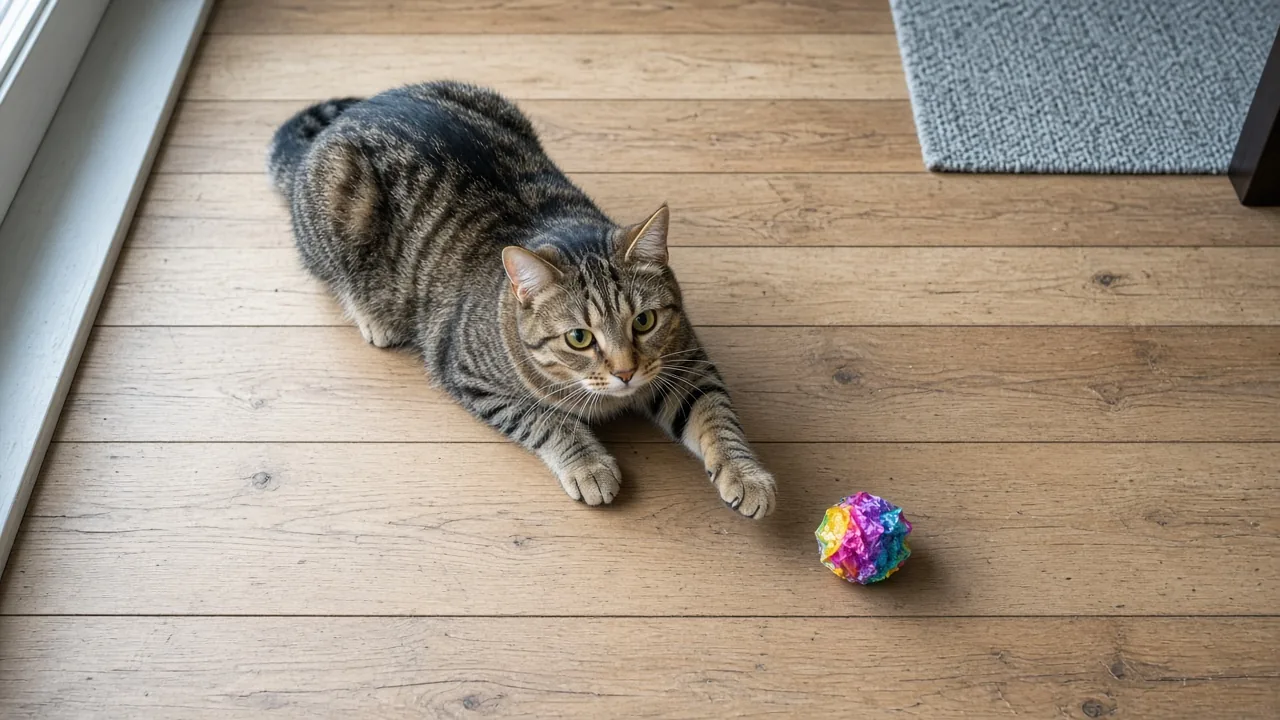
No, pipe cleaner cat toys are not a safe bet for unsupervised play. The fuzzy wire inside stays sharp even after you bend the ends over, and a cat that chews one apart can swallow wire fragments that only a vet can remove. If you want a quick, cheap homemade toy, crinkle balls, catnip socks, and felt mice give your cat the same stalk-and-pounce fun without the wire.
Are Pipe Cleaner Cat Toys Safe? What the Risks Actually Are
A pipe cleaner looks harmless: soft fuzz wrapped around a thin wire core, easy to twist into a spring or a little ball. The problem is what’s underneath that fuzz. Once a cat starts chewing, the wire inside can poke through, and the cut ends are sharp enough to nick gums or scratch an eye during normal play.
One cat owner learned this the hard way after her cat swallowed a piece of a pipe cleaner toy and needed a trip to the vet for removal, a bill she hadn’t budgeted for. Her vet told her plainly that bending the wire ends doesn’t make them safe, since the tip stays pointed even when folded back on itself.
That combination of sharp tip and swallowable size is exactly what makes pipe cleaner toys risky for solo cat play. They’re worth skipping if you want to answer the core question here honestly: are pipe cleaner cat toys safe enough to leave out unsupervised? Based on what owners and vets report, no.
Why Bent or Trimmed Ends Don’t Remove the Danger
Folding over a pipe cleaner’s tip feels like a reasonable safety fix, and it does blunt the point somewhat. But the wire inside is still rigid, and a few minutes of determined chewing can straighten that fold right back out or snap the wire into a shorter, equally sharp piece.
Cats chew with their back molars, not just nibble with their front teeth, so pressure on a bent tip is higher than it looks. A toy that seemed fine in your hand can end up with an exposed, pointed end after one solid play session. If you’ve already bought pipe cleaner toys, treat the bent-end version as a supervised-only item, not a toy you leave in the toy basket overnight.
What Can Happen If a Cat Swallows a Piece
Cats that chew a pipe cleaner into smaller pieces can swallow fragments of wire and fuzz together. Depending on where the piece lodges, that can mean an expensive vet visit and a procedure to retrieve it, rather than something that simply passes on its own.
Watch for drooling, repeated vomiting, or a cat that suddenly stops eating after you notice pieces missing from a pipe cleaner toy. None of those signs confirm swallowing by themselves, but together with a missing toy piece, they’re reason enough to call your vet rather than wait it out.
Other String-Like and Small-Part Toys That Carry Similar Risks
Pipe cleaners aren’t the only toy type that can turn into a foreign body problem. Felt strips, loose yarn, catnip wands, and small foil or pom-pom balls share the same basic risk: a cat chews off a piece small enough to swallow, and it’s either too long and thin (linear foreign body) or too small and round (choking hazard).
The common thread is size and shape, not the specific material. A felt mouse with a loose thread tail, a ball of yarn left on the floor, or a tiny foil ball that fits entirely in a cat’s mouth can all cause the same kind of trouble a pipe cleaner can.
Why Thin, String-Like Materials Need Extra Caution
String-like materials are risky because a cat can bite through them and leave frayed pieces short enough to swallow whole. Yarn, loose thread, felt strips, and ribbon all behave this way, and a swallowed length of string can bunch up the intestine in a way that’s harder to resolve than a single swallowed chunk.
The simplest rule: if a toy has thread, yarn, or a thin strip hanging off it, that’s a supervised toy only. Put it away in a drawer or closed bin once playtime ends, the same way you’d store a toy with a bell or squeaker that could come loose.
How Big Is Big Enough for Ball and Crinkle Toys
Small ball toys, like foil balls or pom-poms, need a basic size check before you let a cat bat them around alone. If the ball fits entirely inside your cat’s mouth, it’s small enough to choke on, especially for cats that like to carry toys around and occasionally try to chew them.
A good working rule is to make or choose balls at least an inch and a half across, bigger for larger cats. If you’re rolling your own foil ball, crumple several layers together rather than one thin sheet, both for size and so it doesn’t flatten into sharp-edged shards after a few chewing sessions.
Safer DIY Alternatives: Comparing Materials, Durability, and Play Style
Once pipe cleaners and loose string are off the table, you’ve still got plenty of homemade options. The main trade-offs come down to material: paper and cardboard toys are free and quick to make but wear out fast, while fabric toys like catnip socks and felt mice take a little more effort and last longer.
Your choice should match how your cat actually plays. A cat that likes to carry toys around and "kill" them with a few hard bites does better with a sturdier fabric toy than a cardboard one that falls apart after a single session.
DIY Toy Comparison Table: Material, Risk Level, and Best Use
| Toy | Material | Risk Level | Durability | Cleaning | Best Play Style |
|---|---|---|---|---|---|
| Crinkle ball | Paper (tissue bag) | Low – no small parts | Low, needs remaking | Not washable, replace when torn | Solo batting, chasing |
| Pipe cleaner spring | Wire + fuzz | Higher – sharp tip, swallow risk | Low | Not washable | Supervised only |
| Cardboard shaker | Cardboard tube + ball | Low–moderate if sealed well | Low–moderate | Not washable | Solo batting |
| Catnip sock | Old sock + catnip | Low | Moderate | Hand-washable | Solo carrying, kicking |
| Felt mouse | Felt + stuffing + catnip | Low if stitched well | Moderate | Spot clean | Solo carrying, batting |
Crinkle and fabric options generally beat wire-based toys on safety, since neither one leaves a sharp, rigid piece behind when chewed. The trade-off is that paper toys need more frequent remaking, while fabric toys take a bit more time upfront but hold up over more play sessions.
How to Make a Safe Crinkle Ball from a Tissue Bag
An empty tissue bag, the kind that held a pack of facial tissues, makes a genuinely free crinkle toy with no wire, no loose string, and no parts small enough to swallow whole. Pick one with a bright color or pattern if you have a choice, since the visual movement seems to catch a cat’s attention during batting.
This is one of the simplest swaps for a pipe cleaner toy, since it costs nothing and uses something you’d otherwise throw out. It won’t survive aggressive chewing forever, but that’s a fair trade for a toy that doesn’t carry a swallowing risk.
Step-by-Step: Folding and Tying the Crinkle Ball
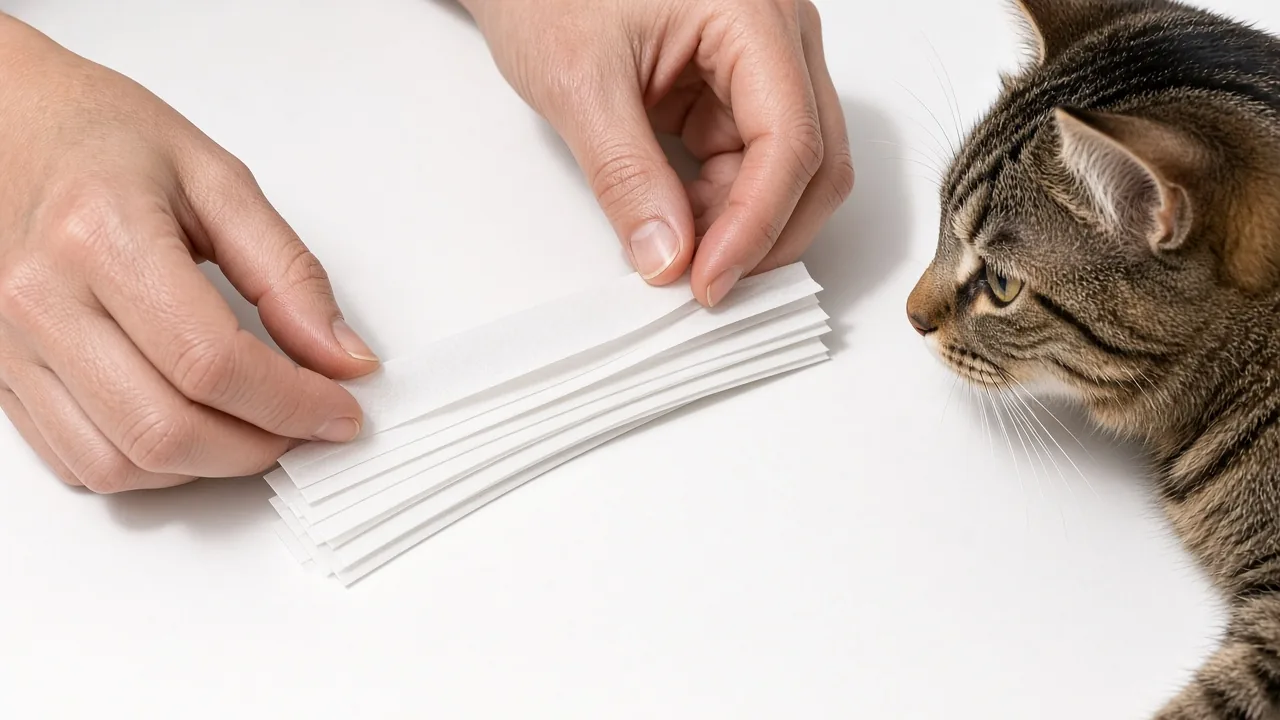
- Trim off both ends of the empty tissue bag, keeping the flat middle section intact.
- Fold the bag in half along the wide edge and cut along the fold.
- Fold each resulting piece in half along the narrow edge and cut again, so you end up with four even strips.
- Stack all four strips on top of each other.
- Starting from the narrow edge, fan-fold the stack back and forth, the way you’d fold a paper fan, until you have a short, compact strip.
- Tie a piece of string or thread tightly around the center of the folded strip.
- Gently pull apart and fluff each layer of the folded bag to open it into a rounded, crinkly shape.
The whole process takes a few minutes, and you can make several at once from a single tissue bag if you have more than one on hand.
How to Make Catnip Toys That Rival Store-Bought Options
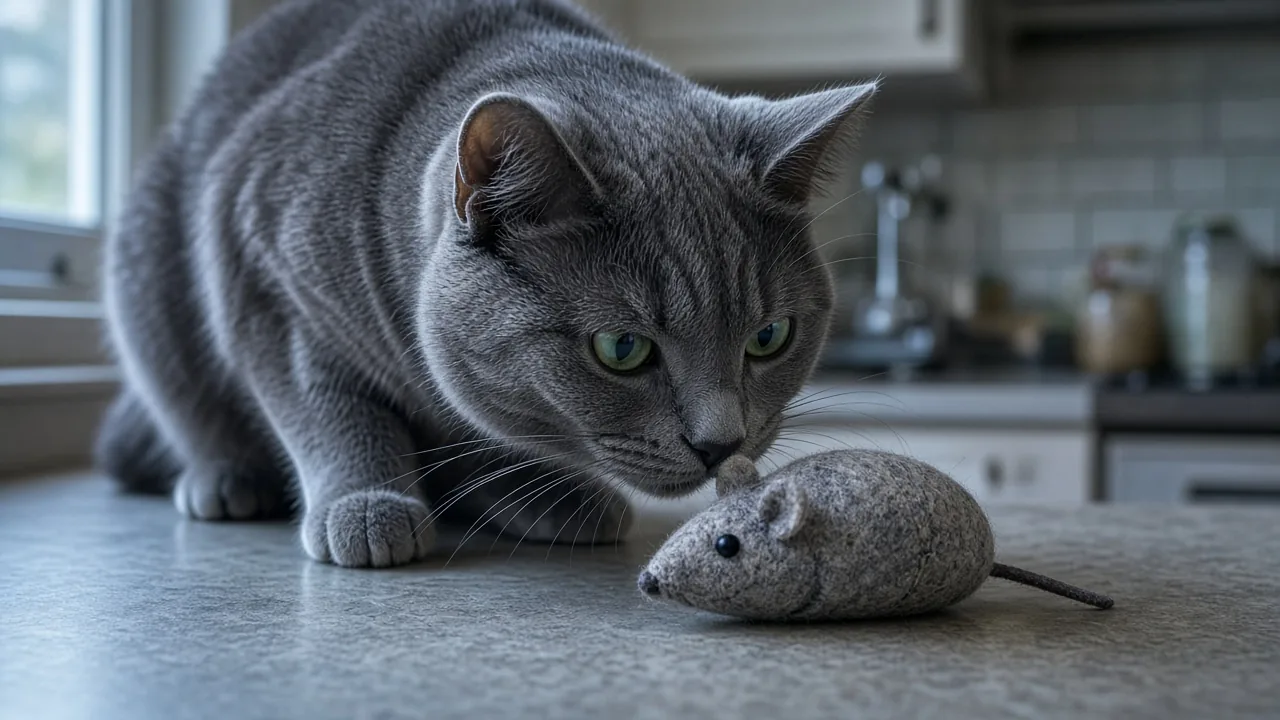
Catnip toys are where DIY can genuinely compete with anything you’d find at a pet store, because the strength of the toy comes down to how much catnip you pack in. Store-bought toys with high catnip content exist, but a homemade version lets you control exactly how much goes in, and more than one owner has found their homemade version works just as well, sometimes better.
Felt mice and catnip socks are the two easiest starting points, and both avoid the wire and loose-thread problems that come with pipe cleaner toys.
Catnip Sock and Baby Sock Mouse: Which to Choose
A basic catnip sock takes the least time: stretch an old sock over a glass, pack in a generous amount of catnip, slide it off, and tie off the open end tightly. It’s a fast project and a reasonable answer for owners who just want something ready in five minutes.
A baby sock mouse takes a bit more handling but holds its shape better over time. Use one baby sock filled with catnip and a second sock pulled over it, then tie the open end firmly with sturdy yarn, leaving a length of yarn hanging free as a tail. Cats that like to carry toys around in their mouths tend to do better with this sturdier shape than with a simple sock pouch.
Felt Wand and Felt Mouse: Best for Interactive vs Solo Play
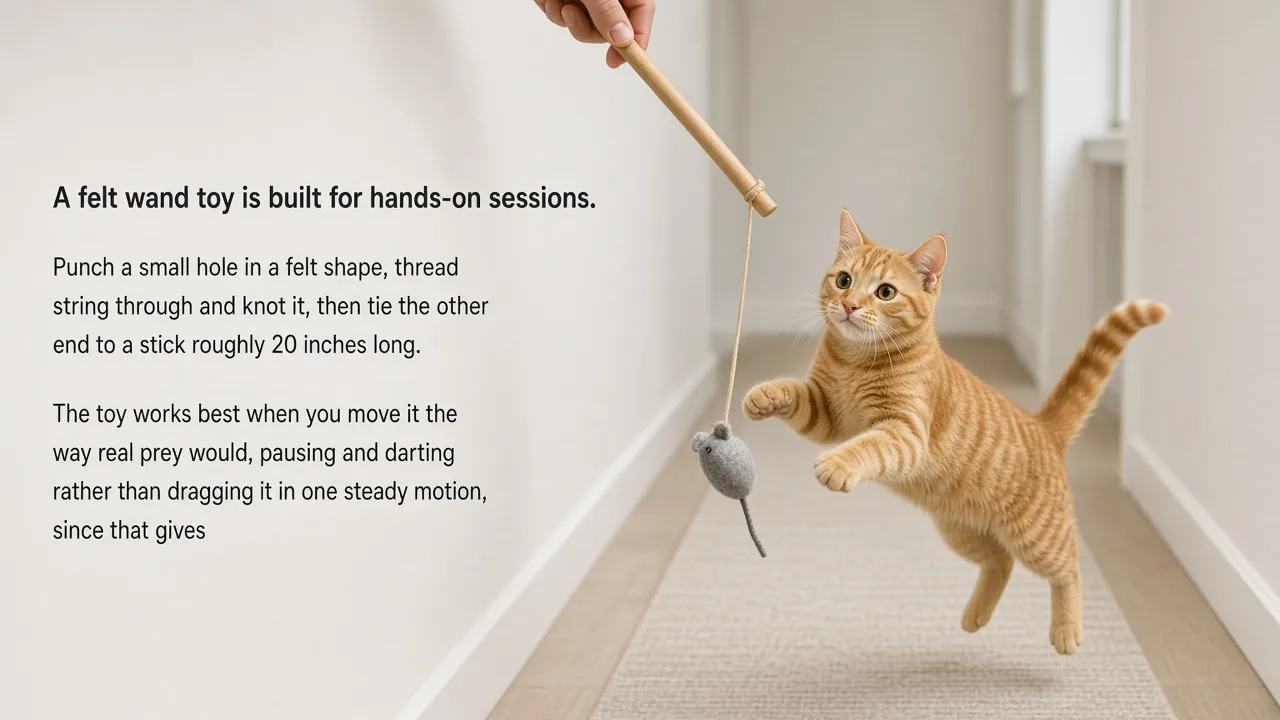
A felt wand toy is built for hands-on sessions. Punch a small hole in a felt shape, thread string through and knot it, then tie the other end to a stick roughly 20 inches long. The toy works best when you move it the way real prey would, pausing and darting rather than dragging it in one steady motion, since that gives your cat an actual opening to pounce.
A felt mouse, by contrast, is a solo-play toy. Trace a mouse shape onto paper, cut it out, use it as a pattern on felt, then sew the pieces together, stuff lightly, and tuck in catnip before closing it up. It’s better suited to the cat that wants something to bat around and carry off when you’re busy doing something else.
How Often Should You Replace or Rotate Cat Toys
Cardboard and paper toys, like crinkle balls and shaker toys, wear out faster than felt or fabric ones and should get a weekly once-over. Check for crumbling edges, a shaker ball working its way loose, or cardboard strips starting to separate, and toss anything that’s lost its shape rather than trying to reinforce it.
Felt and fabric toys last longer but aren’t maintenance-free either. Loose stitching, a frayed tail, or stuffing poking through a seam are all signs it’s time to retire the toy rather than keep offering it as-is.
Toy Rotation: Why Cats Lose and Regain Interest
Cats can lose interest in a toy they’ve had out for weeks, not because it’s worn out, but simply because it’s no longer novel. Putting a toy away for a couple of weeks and then bringing it back out can renew that interest, and some owners find this more effective than buying something new every time play slows down.
A simple system: keep two or three toys out at a time, rotate in a "retired" one every few weeks, and watch which ones actually get picked up again versus ignored. That tells you more about your cat’s real preferences than guessing based on what looks appealing to you.
Why Some Cats Prefer Boxes and Packaging Over Any Toy
It’s a familiar scene for a lot of first-time cat owners: you buy a toy, and the cat is far more interested in the box it came in, or the crumpled paper it was wrapped in. One owner summed it up well, noting that in a cat’s eyes, the box is the real toy and the packaging material is the prize.
This pattern suggests that novelty, texture, and the ability to climb into or bat around an object may matter more to cats than how much a toy cost or how it was designed. It’s worth keeping in mind before you spend much on an elaborate toy setup: a cardboard box with a few holes cut in it might get more use than anything you buy.
DIY vs Store-Bought: Which Makes Sense for Your Cat
Store-bought cat toys generally hold up longer under repeated chewing and batting, especially ones with reinforced seams or tougher fabric. That durability comes at a cost, and it doesn’t guarantee your cat will actually prefer them over something homemade.
DIY toys give you two real advantages: full control over catnip strength, and the ability to avoid wire, loose string, or other small parts that come standard in some manufactured toys. The honest answer to which one makes sense depends on your cat’s chew habits. A gentle batter who never really destroys a toy can get a lot of mileage out of homemade crinkle balls and catnip socks, while a determined chewer may need the sturdier construction of a well-made store-bought toy, chosen with the same size and material checks you’d apply to anything DIY.
Frequently Asked Questions About Cat Toy Safety
Will an older cat even want to play with toys?
Many senior cats still enjoy short play sessions, though their energy and interest may come in shorter bursts than a kitten’s. Some owners find a quick play session right before a meal helps engage an older cat that otherwise seems uninterested in toys.
How closely do I need to supervise a new toy?
Stay in the room for a new toy’s first few sessions, especially anything with small parts, loose string, or catnip stuffing a cat might try to tear open. Once you’ve seen how your cat handles it, you can judge whether it’s safe to leave out unsupervised or needs to stay a supervised-only toy.
Are cardboard toys worth making if they don’t last?
If you don’t mind remaking them every so often, yes. The trade-off is low durability for low cost and quick assembly, so plan to treat cardboard and paper toys as short-term and keep an eye on them rather than expecting them to last like a fabric toy.
Watch how your cat actually plays, whether that’s stalking and pouncing, batting things across the floor, or carrying toys around to "kill" them, and pick DIY options that match that style without relying on wire or loose string. Check every toy for wear before your cat gets ahold of it again, the same way you’d check any toy you keep in rotation.
This article is for general information only and is not a substitute for advice from your veterinarian. Always supervise your pet with a new toy, and replace any toy that is damaged or small enough to swallow.

Contributor
admin
Continue reading
All stories
CAT TOYS · 11 October
Why Do Cats Scratch Holes in Water Mats? Causes and Fixes
CAT TOYS · 11 October
Do Cats Get Bored of Automatic Toys? What Owners Keep Noticing
CAT TOYS · 11 October
Responses
Moderated discussion