CAT TOYS
Are Hanging Spring Cat Toys Safe? What Injury Reports and Owners Say
Hanging spring cat toys can entertain cats for years without incident, but reviewers also report injuries from tangled cords and weak hardware. Here's how to judge the risk, inspect toys safely, and choose better alternatives.
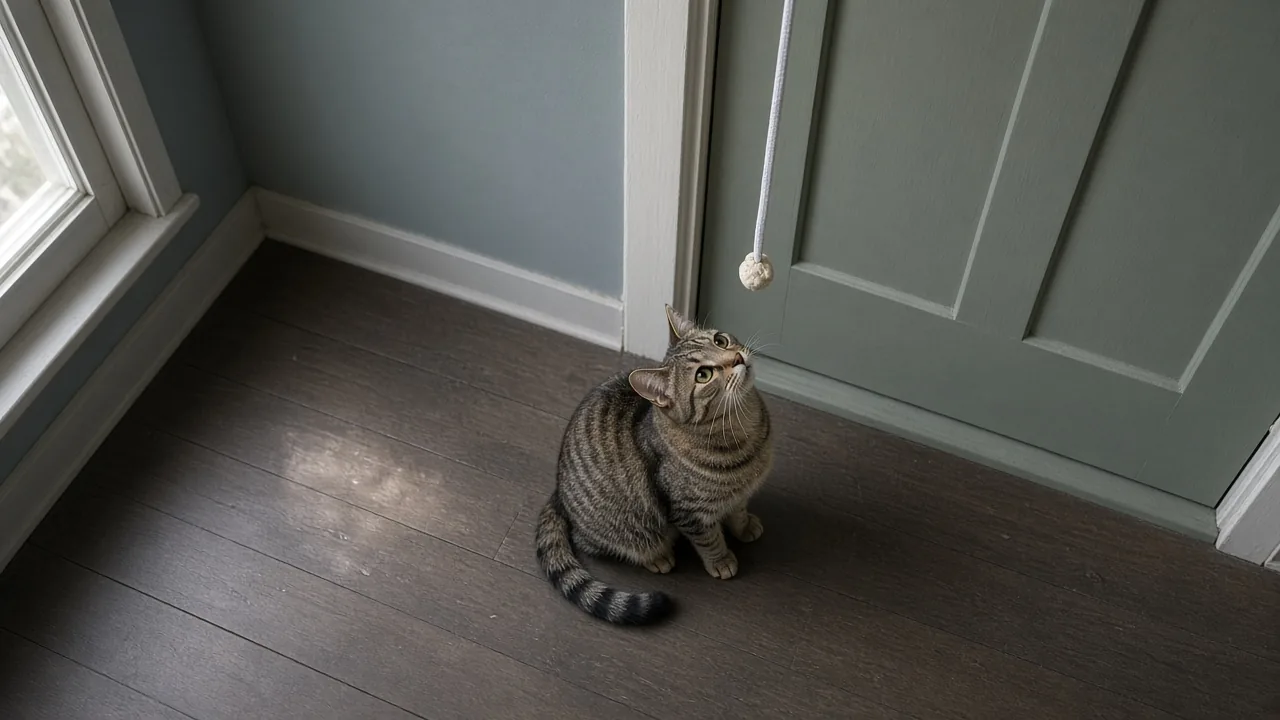
If you’re wondering whether hanging elastic spring cat toys are safe to buy, the honest answer is: it depends. One longtime toy reviewer ranks this toy category at the very bottom of her safety list, citing cases where kittens were hurt by the elastic cord and the attachment hardware. At the same time, plenty of cat owners report years of trouble-free play with the exact same style of toy. The right call for your household comes down to how closely you supervise play and how your own cat tends to interact with cord-based toys.
What Makes Hanging Spring Cat Toys Risky in the First Place
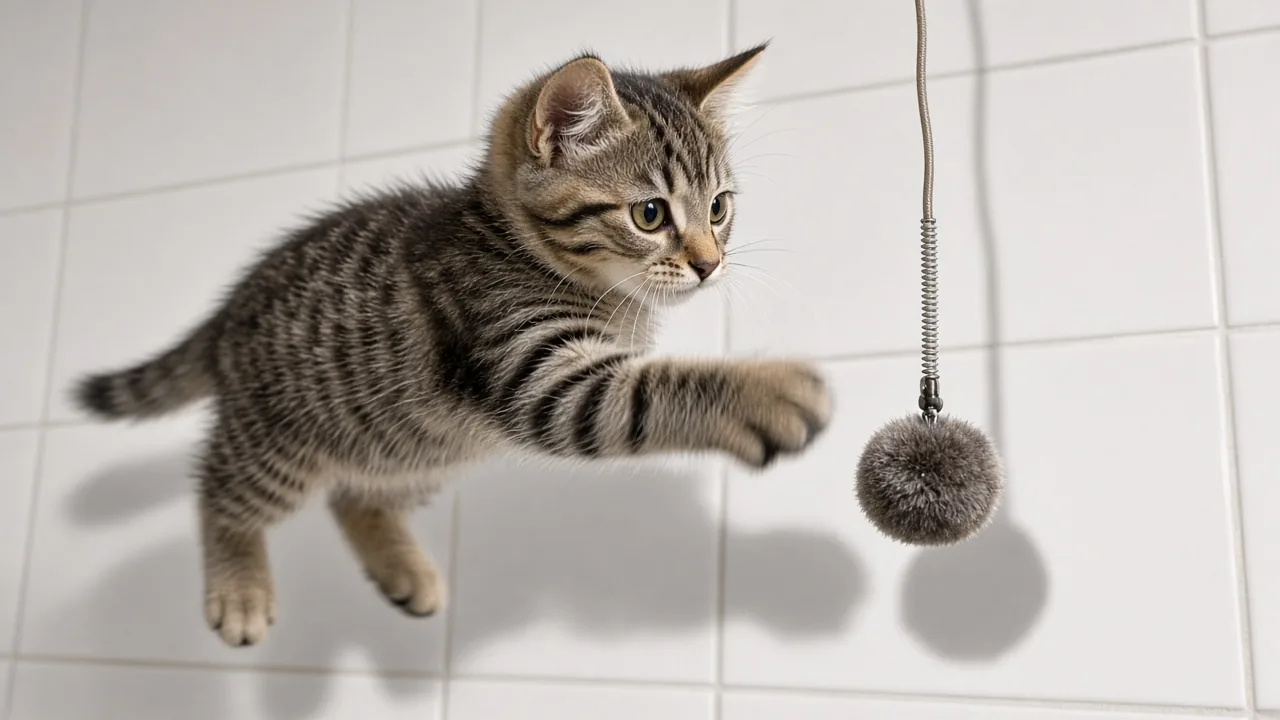
Hanging spring cat toys typically combine a stretchy elastic cord with a small attachment, often mounted to a door frame, cabinet, or stand so a cat can bat and bounce it from below. The bounce-back action is part of the appeal—it mimics the resistance of a struggling prey animal, which can be genuinely satisfying for a cat that likes to pounce.
The same features that make the toy fun are also what create risk. One reviewer who has tested a wide range of cat toys places this category at the bottom of her rankings specifically because of reported injuries to kittens. In her assessment, young cats that bite and tug aggressively on the elastic cord are more likely to get tangled around the neck or a limb, and loose or weak attachment hardware can give way under repeated pulling, turning a toy into a hazard rather than entertainment.
This isn’t a claim that every hanging spring toy is dangerous in every home. It’s a pattern she has observed often enough to flag the category as a whole, which is worth taking seriously even if it doesn’t match every cat’s experience.
Are Hanging Spring Cat Toys Safe? Weighing the Warnings Against Owner Experiences
Here’s where the picture gets more complicated. Alongside that bottom-of-the-list ranking, some cat owners describe using the same type of toy for extended periods without a single incident. One owner, for example, reported that her cat played with a hanging spring toy for a long stretch of time and only stopped when the toy itself finally wore out—no tangling, no injury, just normal wear and tear.
That contrast doesn’t mean one side is wrong and the other is right. It means individual outcomes can diverge quite a bit from a general risk warning. A reviewer’s ranking is based on patterns seen across many cats and toys, while a single owner’s good experience reflects one cat’s temperament, one home’s setup, and one particular toy’s build quality. Both pieces of information are useful, but they’re answering slightly different questions.
If your cat is a gentle batter who taps the toy and moves on, the risk profile looks very different than if your cat is a determined chewer who clamps down on the cord and won’t let go. The warning is real, but so is the variation in how cats actually use these toys.
Who Should Avoid This Toy and Who Might Use It Safely
Rather than treating hanging spring toys as universally off-limits or universally fine, it helps to look at your specific cat against a few criteria.
Cats who are poorer candidates for this toy:
- Kittens. Young cats tend to bite and tug with more force and less restraint than adults, and they’re also more likely to be left playing unsupervised while an owner assumes the toy is "just a toy."
- Heavy chewers of any age. A cat that regularly gnaws on cords, wires, or cables elsewhere in the house is likely to treat the elastic cord the same way, increasing the chance of fraying or breakage.
- Cats that play rough and solo. If your cat likes to launch at a toy and wrestle with it on the floor rather than bat it from a distance, a hanging toy on a stretchy cord gives it more opportunity to get a paw or the head caught in the loop.
Cats who may be reasonable candidates, under the right conditions:
- Calm adult cats who bat and release rather than bite and hold.
- Cats that are only given access to the toy during supervised play sessions, not left alone with it hanging within reach.
- Households willing to inspect the toy before every session and retire it the moment it shows wear (more on that below).
If you’re a first-time cat owner trying to decide, the safest starting assumption is to treat this toy as "supervised only" rather than "safe to leave out," at least until you’ve watched how your own cat interacts with it.
How to Choose a Safer Hanging or Spring-Based Cat Toy
If you decide the toy’s benefits are worth the tradeoff, a few selection details can lower the risk meaningfully.
| Feature | Lower-risk choice | Higher-risk choice |
|---|---|---|
| Cord thickness | Thick, braided cord that resists stretching thin | Thin, single-strand elastic that can snap or fray quickly |
| Attachment hardware | Metal clips or screws rated for repeated pulling | Lightweight plastic clips that can crack under tension |
| Mounting location | Away from furniture edges, shelves, or anything a cat could jump onto and get tangled against | Near cabinets, stair railings, or open shelving within jumping range |
| Mounting surface | Door frame or dedicated stand rated for the toy’s pull | Suction-based or adhesive mounts not designed for repeated tugging |
A few practical notes to go with the table:
- Check whether the elastic cord has any visible stretch marks or thinning right out of the box—manufacturing quality varies.
- Mount the toy at a height and distance where your cat’s full-body pounce won’t bring it into contact with a shelf edge, chair leg, or anything else it could get a paw or collar caught on.
- Avoid toys with weak plastic clasps if your cat weighs more than a typical adult cat or tends to play with real force.
How to Inspect a Spring Toy for Damage Before Every Play Session
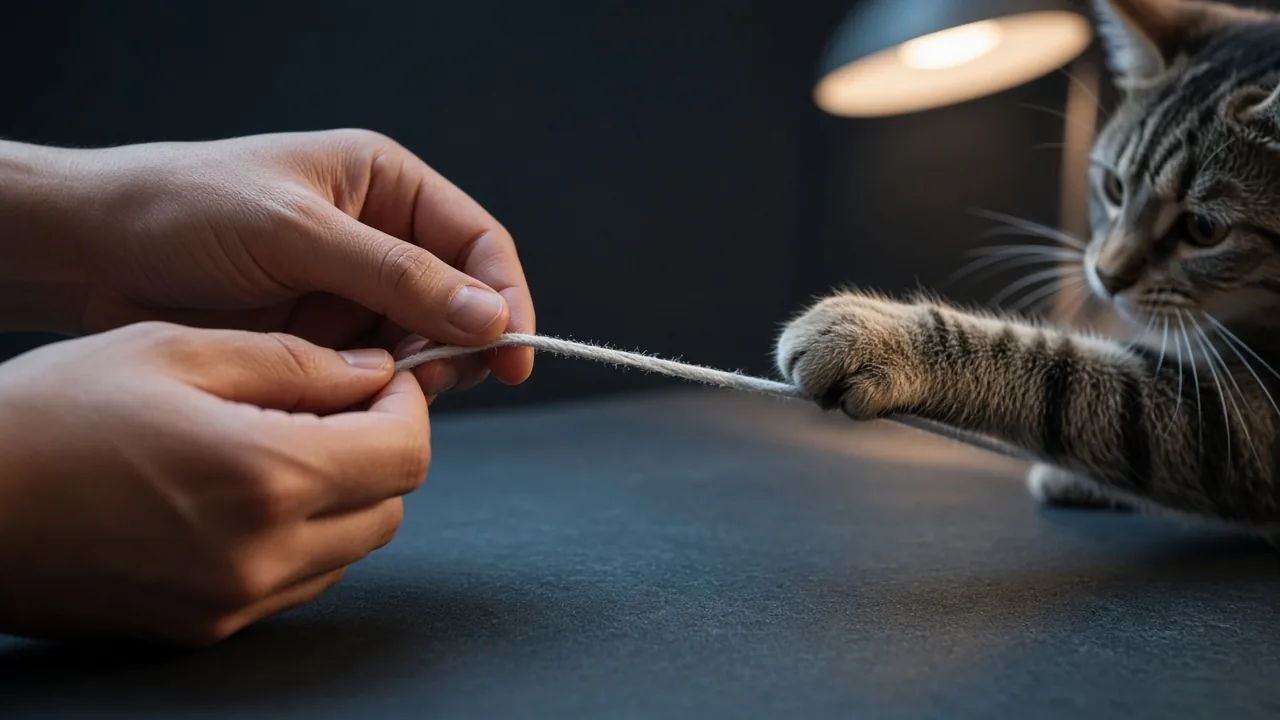
Because this toy category carries more risk than most, a quick check before each use is worth the thirty seconds it takes.
- Look at the cord along its full length for fraying, thinning, or any spot where the elastic looks stretched thin compared to the rest.
- Check the attachment point where the cord meets the wall or door mount—wiggle it gently to see if it has loosened since the last session.
- Inspect any metal fasteners or wire for exposed edges, rust, or bending that wasn’t there before.
- Press on the toy attachment itself (the feather, mouse, or ball at the end) to make sure it’s still securely fastened to the cord.
- If anything looks different from the last check, skip the session and either repair the mount or set the toy aside until you can replace it.
This kind of routine matters more for this toy than for, say, a stuffed mouse, because the cord and hardware are under constant tension and the failure point is often invisible until it gives way mid-play.
How Often to Replace a Hanging Spring Cat Toy
The general guidance is to replace the toy at the first sign of stretching, fraying, or hardware looseness—not to wait until it visibly snaps or a clip breaks off. Elastic cord degrades gradually, and by the time damage is obvious to the eye, it may have already been weak enough to fail during a rough play session.
A simple rule of thumb: if you find yourself thinking "I should probably replace this soon," that’s the signal to do it now rather than get one more week of use out of it. Given the injury reports associated with this category, erring early costs you the price of a new toy; erring late risks an actual vet visit.
Safer Alternatives If You Decide to Skip the Spring Toy
If you weigh the warnings and decide the risk isn’t worth it for your household, you have good lower-risk options that still satisfy a cat’s hunting instincts.
Wand Teaser Toys for Supervised Hunting-Style Play
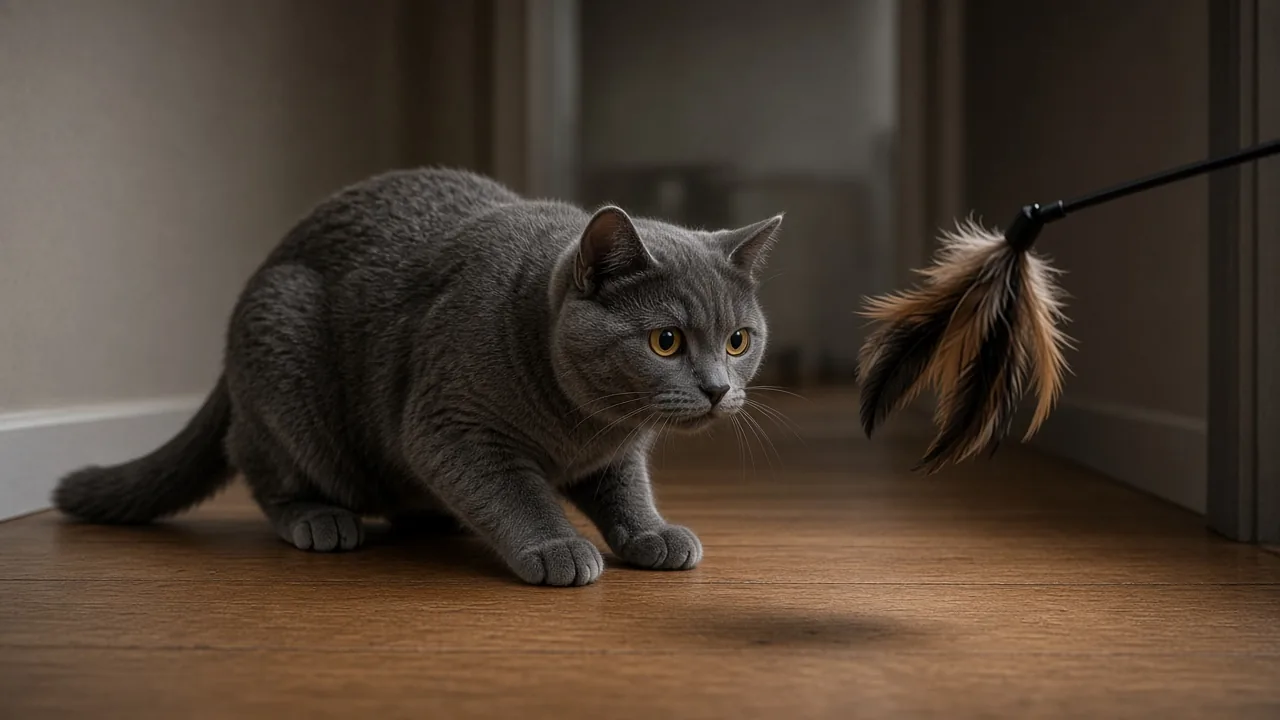
Handheld wand teasers—typically a feather or fabric lure on a stick, controlled directly by you—score among the highest-rated toys in one reviewer’s rankings, and for good reason. Because you’re holding the other end, you control speed, direction, and distance, letting your cat go through the full stalk-chase-pounce sequence that hanging toys only partially offer. There’s also no cord left unattended for a cat to get tangled in between sessions, since the toy only comes out when you’re actively playing.
Energetic cats in particular benefit from this style of play, since a human-controlled wand lets you tire out a high-energy cat without the toy ever being left within reach when no one’s watching. It’s also worth building the habit of playing with your hand kept off to the side rather than wiggling your fingers as the "prey"—that keeps a cat from learning to treat human hands as a target during rough play.
If you want a lower-cost version, some owners build their own wand toy using a few feathers, a sturdy shoelace, and two small metal clips, which can hold up better over time than some inexpensive store-bought versions.
Automatic Wand Toys Like CATPICK for Unsupervised Play
For times when you can’t play directly with your cat, automatic wand toys fill a different niche. One example on the market, CATPICK, uses a pole roughly 31 to 32 inches long attached to a base, and it creates semi-random movement to mimic the unpredictability of live prey rather than a simple back-and-forth motion.
The base includes a suction attachment so you can anchor the toy to a smooth tabletop or counter, or you can skip the suction and let the whole unit slide and shift randomly across the surface on its own, which gives a different play pattern. The pole and feather attachment can be disassembled for cleaning, and the feather piece can double as a handheld toy when you want to play directly instead.
One caution worth noting: mounting this kind of toy on a door isn’t recommended, since the suction strength may not hold reliably on a vertical surface over repeated use. Stick to a flat, stable surface like a table or low shelf instead.
Scratcher and Chew-Based Toys for Lower-Risk Dental Play
Scratch-and-chew toys—think sturdy scratchers, cardboard, or sisal-based pieces designed for gnawing—serve double duty as dental maintenance while carrying far fewer entanglement risks than cord-based hanging toys. Many cats naturally treat these as a chewing outlet, and the mechanical action of gnawing helps with some tartar control along the way.
Because there’s no elastic cord, no small attachment pieces, and nothing dangling within jumping range, this category is a reasonable default for households with kittens, heavy chewers, or multiple cats where supervision of every toy isn’t always realistic.
How to Clean and Maintain Interactive Cat Toys
Keeping toys clean matters for your cat’s health and for the lifespan of the toy itself, and the steps differ a bit by toy type.
For automatic toys like CATPICK:
- Disassemble the pole and feather attachment using the built-in rotation (clockwise to install, counterclockwise to remove).
- Wipe down the base and pole with a damp cloth; avoid submerging the motorized base in water.
- Let all parts air dry fully before reassembling to avoid trapping moisture near any electronic components.
For handheld wand toys:
- Remove any feather or fabric lure and hand-wash it separately if it’s washable.
- Check the string or cord for fraying each time you clean it, since repeated handling adds wear.
For cord-based hanging toys:
- Wipe the cord and attachment down rather than soaking them, since repeated saturation can accelerate elastic breakdown.
- Air-dry fully before the next use—damp elastic can degrade faster and lose its stretch-back properties over time.
As a general habit, cleaning time is also a good moment to run the inspection checklist from earlier in this article, since you’re already handling every part of the toy closely.
Common Questions About Hanging Spring Cat Toys
My cat shows no interest in laser pointers—is that normal?
Yes. Cat reactions to laser pointers vary a lot; some cats chase enthusiastically, while others barely glance at the dot or seem to look at their owner as if confused by the pointless exercise. If your cat isn’t interested, there’s no need to force it—move on to a wand toy or a toy your cat can actually catch and hold, which also solves the common frustration cats can feel from never physically "capturing" the laser dot.
How do I prevent my cat from becoming afraid of a wand toy after a startling incident?
If a cat has been accidentally hit or startled by a wand toy once, it may associate the toy itself with that moment and avoid it going forward. Rebuilding trust usually means reintroducing the toy slowly, keeping movements gentle and predictable, and letting your cat initiate contact rather than waving the toy at them directly. Patience matters more than speed here, and if the avoidance persists, a certified trainer or your veterinarian can offer more tailored behavior guidance.
Is it ever safe to leave a hanging spring toy up when I’m not home?
Given the injury reports tied to this category, the more cautious approach is to take the toy down—or at least unhook the cord—when you’re not actively supervising, even if your cat has used it without incident so far.
What about toys with small ball attachments, like some silvervine toys?
Check the product details before buying, since some versions include a small ball that a cat could attempt to swallow whole. If your cat tends to mouth or chew toy attachments aggressively, a version without a loose ball piece is the safer pick.
Watching how your own cat actually plays—whether it chews, chases, carries things around, or digs—tells you more than any general ranking can about which toys are worth bringing home. Check whatever toy you choose regularly for fraying, loose parts, or stretched-out material, and rotate a few different types in and out to keep playtime interesting without leaning too hard on any single toy, hanging spring toys included.
This article is for general information only and is not a substitute for advice from your veterinarian. Always supervise your pet with a new toy, and replace any toy that is damaged or small enough to swallow.

Contributor
admin
Continue reading
All stories
CAT TOYS · 11 October
Why Do Cats Scratch Holes in Water Mats? Causes and Fixes
CAT TOYS · 11 October
Do Cats Get Bored of Automatic Toys? What Owners Keep Noticing
CAT TOYS · 11 October
Responses
Moderated discussion